

Ready & Packaged Foods
All →Vegetables & Legumes
All →Desserts & Confectionery
All →Meat & Protein
All →Grains & Bakery
All →Beverages
All →Milk & Dairy
All →

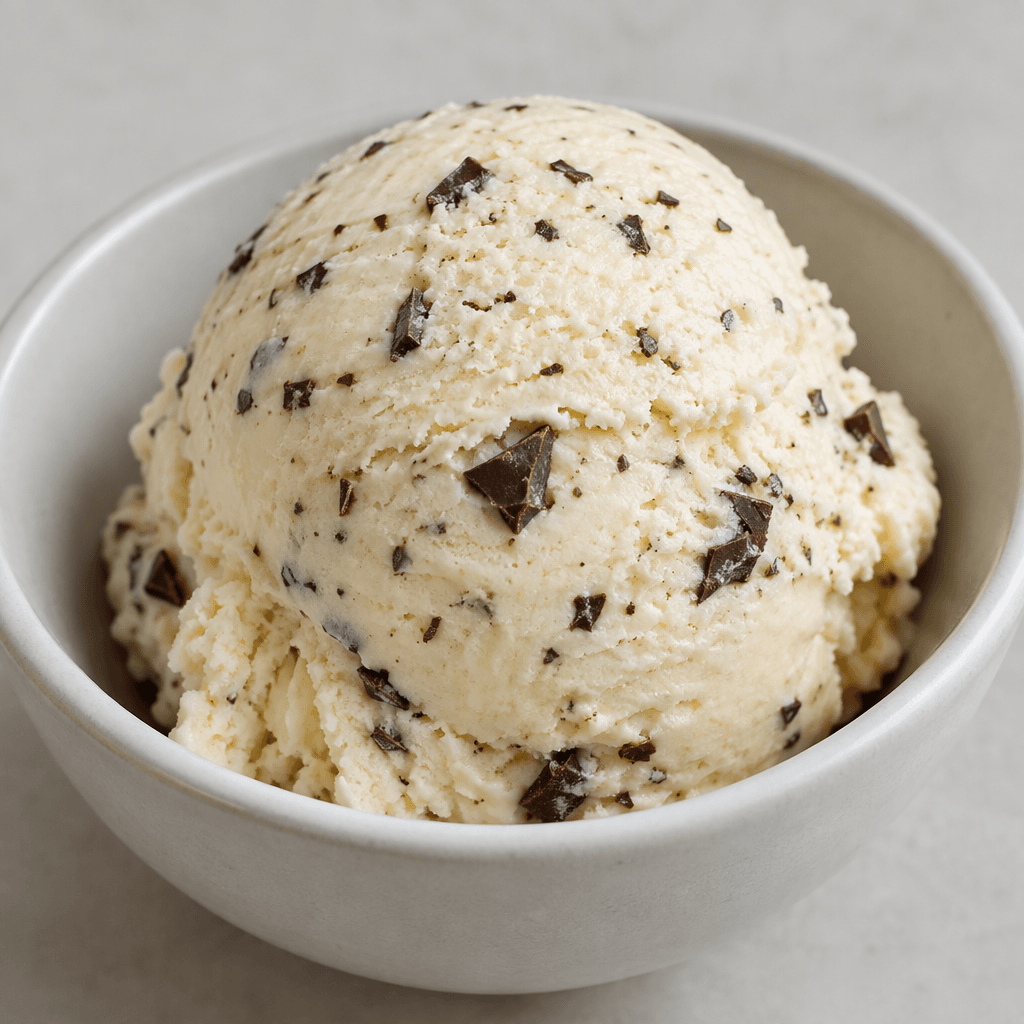
Chocolate Chip Ice Cream Calories
Creamy ice cream with chocolate chips
In season: Summer
CALORIES
GI
POTASSIUM
FIBER
Quick answer
1 cup (medium) of Chocolate Chip Ice Cream (130 g) has 286 calories. That works out to 220 calories per 100 g. It contains 35.1 g of carbs, 4.6 g of protein, 14.3 g of fat and 1.6 g of fiber. Its 0.5 µg of B12 covers 19% of the Daily Value. Its glycemic index is 60 (medium), so it raises blood sugar at a moderate pace.
What is Chocolate Chip Ice Cream?
Chocolate Chip Ice Cream combines a sweet, creamy milk or vanilla ice-cream base with small pieces of chocolate. It is a familiar flavour in the United States and elsewhere, rather than a regional style of Turkish dondurma. The smooth base contrasts with the firmer, bittersweet chocolate, so each spoonful has a little crunch as well as creaminess.
It is commonly served in a bowl or cone as a dessert or a cool treat, and works well alongside a slice of cake or fresh berries. For a lighter-feeling serving, keep the scoop modest and add fruit. It is relatively energy-dense for its volume, with 220 calories per 100 grams, and is mostly a source of carbohydrates and fat rather than protein.
Chocolate Chip Ice Cream Nutrition Facts
Selected: 100 g
220
KCAL / 100G
Carbs
27g
· 10% DV
Protein
3.5g
· 7% DV
Fat
11g
· 14% DV
Fiber
1.2g
· 4% DV
DV is the share of the daily value covered, on a 2,000 kcal reference diet.
Calories come from: Carbs 49% · Protein 6% · Fat 45%
Chocolate Chip Ice Cream Vitamins & Minerals
Vitamins
B12
0.35µg · 15% DV
B2
0.18mg · 14% DV
B5
0.5mg · 10% DV
Vitamin A
75µg · 8% DV
Minerals
Phosphorus
85mg · 12% DV
Calcium
110mg · 11% DV
Zinc
1mg · 9% DV
Iron
1mg · 6% DV
How Nutritious Is Chocolate Chip Ice Cream?
Nutrient density
Low
How many vitamins, minerals and how much fiber this food carries per calorie. A high score means a lot of nutrition for few calories.
Satiety score
Low
An EatBetter score computed from fiber, protein and calorie density. A high score means staying full longer on the same calories.
Both scores are calculated per 100 g and do not change with the selected portion. The satiety score is EatBetter's own calculation, not a clinical measure.
Chocolate Chip Ice Cream Glycemic Index
GLYCEMIC INDEX
GLYCEMIC LOAD
Accounts for portion size — a more realistic measure than GI alone.
How to Burn Off Chocolate Chip Ice Cream
To burn the 220 calories in 100 g:
🚶
Walking (5 km/h)
🏃
Running (8 km/h)
🚴
Cycling
🏊
Swimming
Times are calculated with the MET equation for a 70 kg adult. Actual burn varies with your weight, age and pace.
Is Chocolate Chip Ice Cream Processed?
NOVA 3
Processed
1. Unprocessed
2. Minimally Processed
3. Processed
4. Ultra-Processed
NOVA classifies foods into 4 groups by industrial processing. NOVA 1 (unprocessed) is the healthiest.
Does Chocolate Chip Ice Cream Contain Allergens?
Contains these allergens:
Which Diets Is Chocolate Chip Ice Cream Good For?
Vegan
— Not suitable
Vegetarian
✓ Suitable
Gluten-Free
— Not suitable
Dairy-Free
— Not suitable
Mediterranean
— Not suitable
Paleo
— Not suitable
Whole30
— Not suitable
DASH
— Not suitable
Keto
— Not suitable
Low FODMAP
— Not suitable
Chocolate Chip Ice Cream Fat Profile
SATURATED
6.5g
MONOUNSATURATED
2.8g
POLYUNSATURATED
0.2g
Omega 6:3 ratio 9:1
Above the ideal 4:1 (9:1).
Compare Chocolate Chip Ice Cream
Foods Similar to Chocolate Chip Ice Cream
Frequently Asked Questions About Chocolate Chip Ice Cream
What is Chocolate Chip Ice Cream made of?
Chocolate Chip Ice Cream is usually a vanilla or sweet-cream ice cream base mixed with small pieces of chocolate. The contrast between the smooth base and crisp chocolate bits is what distinguishes it from chocolate-flavored ice cream.
How do you make Chocolate Chip Ice Cream at home?
To make Chocolate Chip Ice Cream, chill an ice-cream base made with cream, milk, sugar, and vanilla, then churn it until thick. Add finely chopped chocolate near the end so the pieces remain distinct and spread evenly.
Is Chocolate Chip Ice Cream the same as chocolate ice cream?
No. Chocolate Chip Ice Cream usually has a vanilla or sweet-cream base with pieces of chocolate mixed in, while chocolate ice cream gets its chocolate flavor from cocoa or melted chocolate in the base. Some recipes combine both.
Can you make Chocolate Chip Ice Cream without an ice cream maker?
Yes. Fold whipped cream into sweetened condensed milk, freeze the mixture in a covered container, and stir it a few times as it firms up. Add the chocolate pieces once the base has thickened so they do not all sink.
What kind of chocolate is best for Chocolate Chip Ice Cream?
Dark or semisweet chocolate gives Chocolate Chip Ice Cream a sharper contrast against its sweet, creamy base; milk chocolate makes it milder. Chop a chocolate bar finely for small, crisp pieces, or use mini chocolate chips for even distribution.
Why does the chocolate in Chocolate Chip Ice Cream get so hard?
Chocolate becomes firm at freezer temperatures, so the pieces in Chocolate Chip Ice Cream can feel harder than the surrounding ice cream. Finely chopped chocolate is easier to bite than large chunks, and letting the scoop soften briefly helps.
How should you store Chocolate Chip Ice Cream in the freezer?
Store Chocolate Chip Ice Cream in a tightly sealed, freezer-safe container, with parchment or wax paper pressed against the surface to limit air exposure. Keep it at a steady freezer temperature and use a clean scoop to prevent contamination.
Why does Chocolate Chip Ice Cream get icy?
Chocolate Chip Ice Cream can turn icy when it partially melts and refreezes or when air reaches its surface. Repeated temperature changes encourage large ice crystals, so return the container to the freezer promptly and keep it tightly covered.
Can you refreeze melted Chocolate Chip Ice Cream?
Refreeze Chocolate Chip Ice Cream only if it is still very cold and partly frozen; its texture may become less creamy. If it has been at room temperature for more than two hours, discard it rather than refreezing it.
What can you serve with Chocolate Chip Ice Cream?
Chocolate Chip Ice Cream pairs well with warm brownies, fruit pies, or fresh berries; the contrast with a warm dessert is especially popular. For a simple topping, try toasted nuts or a little chocolate sauce without covering up the chocolate pieces.
Have another question about Chocolate Chip Ice Cream?
Ask the AI nutrition coach — calories, portions, alternatives and more, answered in seconds in the app.

Scan calories with your camera
Instant AI nutrition analysis

Nutrition data compiled from USDA FoodData Central and scientific sources.