

Ready & Packaged Foods
All →Vegetables & Legumes
All →Desserts & Confectionery
All →Meat & Protein
All →Grains & Bakery
All →Beverages
All →Milk & Dairy
All →

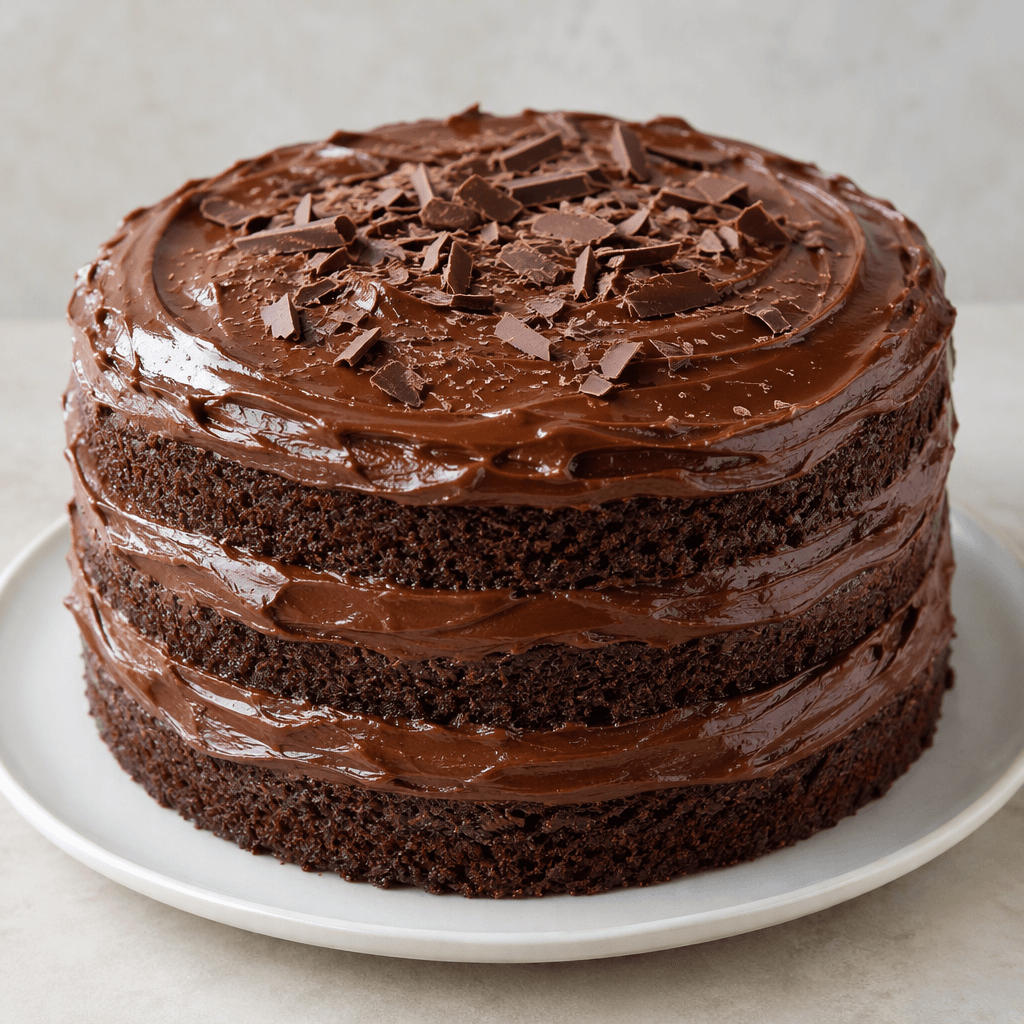
Chocolate Cake Calories
Rich chocolate flavor, sweet and moist cake
In season: Spring · Summer · Autumn · Winter
CALORIES
GI
POTASSIUM
FIBER
Quick answer
1 slice (medium) of Chocolate Cake (80 g) has 296 calories. That works out to 370 calories per 100 g. It contains 41.6 g of carbs, 4.2 g of protein, 12.8 g of fat and 2 g of fiber. Its 0.1 mg of Copper covers 16% of the Daily Value. Its glycemic index is 65 (high), so it raises blood sugar quickly.
What is Chocolate Cake?
Chocolate cake brings cocoa- or chocolate-flavoured sponge together with a sweet frosting or ganache. It is baked in many countries, with no single place of origin, and ranges from simple home-baked cakes to elaborate celebration layers. A layered version, like the one pictured, has frosting between the dark sponge layers and over the outside, often finished with chocolate shavings.
Its moist crumb and rich sweetness make it a familiar choice for birthdays, afternoon tea and dessert, often served with coffee or a glass of milk. It is energy-dense: 100 g provides 370 kcal. For a lighter portion, cut a smaller slice and pair it with fresh berries or unsweetened coffee rather than adding another sweet topping.
Chocolate Cake Nutrition Facts
Selected: 100 g
370
KCAL / 100G
Carbs
52g
· 19% DV
Protein
5.2g
· 10% DV
Fat
16g
· 21% DV
Fiber
2.5g
· 9% DV
DV is the share of the daily value covered, on a 2,000 kcal reference diet.
Calories come from: Carbs 56% · Protein 6% · Fat 38%

Log this food in EatBetter
100,000+ people use it
- Get your daily calorie target
- Snap your meal, log it in seconds
- See every vitamin and mineral

📸 Scan the code to get the app free.

Chocolate Cake Vitamins & Minerals
Vitamins
B2
0.13mg · 10% DV
Biotin
2.5µg · 8% DV
Vitamin E
0.9mg · 6% DV
B1
0.07mg · 6% DV
Minerals
Selenium
7µg · 13% DV
Phosphorus
85mg · 12% DV
Iron
2mg · 11% DV
Potassium ⭐
180mg · 5% DV
Copper
0mg · 0% DV
How Nutritious Is Chocolate Cake?
Nutrient density
Low
How many vitamins, minerals and how much fiber this food carries per calorie. A high score means a lot of nutrition for few calories.
Satiety score
Low
An EatBetter score computed from fiber, protein and calorie density. A high score means staying full longer on the same calories.
Both scores are calculated per 100 g and do not change with the selected portion. The satiety score is EatBetter's own calculation, not a clinical measure.
Chocolate Cake Glycemic Index
GLYCEMIC INDEX
GLYCEMIC LOAD
Accounts for portion size — a more realistic measure than GI alone.
How to Burn Off Chocolate Cake
To burn the 370 calories in 100 g:
🚶
Walking (5 km/h)
🏃
Running (8 km/h)
🚴
Cycling
🏊
Swimming
Times are calculated with the MET equation for a 70 kg adult. Actual burn varies with your weight, age and pace.
Is Chocolate Cake Processed?
NOVA 3
Processed
1. Unprocessed
2. Minimally Processed
3. Processed
4. Ultra-Processed
NOVA classifies foods into 4 groups by industrial processing. NOVA 1 (unprocessed) is the healthiest.
Does Chocolate Cake Contain Allergens?
Contains these allergens:
Which Diets Is Chocolate Cake Good For?
Vegan
— Not suitable
Vegetarian
— Not suitable
Gluten-Free
— Not suitable
Dairy-Free
— Not suitable
Mediterranean
— Not suitable
Paleo
— Not suitable
Whole30
— Not suitable
DASH
— Not suitable
Keto
— Not suitable
Low FODMAP
— Not suitable
Chocolate Cake Fat Profile
SATURATED
7.2g
MONOUNSATURATED
4.8g
POLYUNSATURATED
1.4g
Omega 6:3 ratio 30:1
Above the ideal 4:1 (30:1).
Compare Chocolate Cake
Foods Similar to Chocolate Cake
Frequently Asked Questions About Chocolate Cake
How do you make chocolate cake from scratch?
To make chocolate cake from scratch, whisk the dry ingredients separately, combine the wet ingredients, then mix them together just until smooth. Bake the batter in prepared pans and let the layers cool completely before filling or frosting so they do not crumble.
Why is my chocolate cake bitter?
Chocolate cake can taste bitter if the cocoa is very dark, the chocolate has a high cocoa content, or too much cocoa was added. Measure cocoa carefully and use the type specified in the recipe; Dutch-process and natural cocoa are not always interchangeable.
Should you use oil or butter in chocolate cake?
Oil usually keeps chocolate cake softer and moister after chilling, while butter gives it a richer flavor and a firmer crumb. Use the fat called for in the recipe rather than swapping them cup for cup, since their water content and behavior differ.
How do you stop chocolate cake layers from breaking when you stack them?
Cool chocolate cake layers completely before stacking them, then level any domed tops with a serrated knife. A thin layer of frosting between the layers helps them hold together; chilling the filled cake briefly makes it easier to frost without shifting.
Can you add coffee to chocolate cake?
Yes, coffee can deepen chocolate cake’s flavor without making the finished cake taste strongly of coffee. Use brewed coffee in place of an equal amount of liquid in the recipe, or add a small amount of instant espresso to the dry ingredients.
Why does chocolate cake crack on top?
Chocolate cake often cracks because the oven is too hot or the pan is too small, causing the outside to set before the center finishes rising. Check your oven temperature and use the pan size specified in the recipe; a small crack is usually harmless.
Can you make chocolate cake layers ahead of time?
Yes, you can bake chocolate cake layers ahead of time. Once they are fully cool, wrap each layer tightly and keep them at room temperature for a short period or freeze them for longer storage; thaw frozen layers while still wrapped.
How long does frosted chocolate cake last in the refrigerator?
Frosted chocolate cake generally keeps for several days in the refrigerator when covered well. The exact shelf life depends on the frosting: cakes made with perishable dairy fillings need refrigeration, while a firm buttercream-covered cake can also dry out if left uncovered.
Can you freeze chocolate cake with frosting on it?
Yes, you can freeze frosted chocolate cake, although soft whipped-cream frosting may not thaw as well as buttercream or ganache. Chill the cake until the frosting firms, wrap it carefully, and thaw it slowly in the refrigerator to protect the finish.
What can you serve with chocolate cake besides ice cream?
Fresh berries, sliced pears, or lightly sweetened whipped cream pair well with chocolate cake and balance its richness. For a less sweet contrast, serve a slice with plain yogurt or coffee; avoid heavily sweetened accompaniments if the frosting is already very rich.
Have another question about Chocolate Cake?
Ask the AI nutrition coach — calories, portions, alternatives and more, answered in seconds in the app.

Scan calories with your camera
Instant AI nutrition analysis

Nutrition data compiled from USDA FoodData Central and scientific sources.