

Ready & Packaged Foods
All →Vegetables & Legumes
All →Desserts & Confectionery
All →Meat & Protein
All →Grains & Bakery
All →Beverages
All →Milk & Dairy
All →

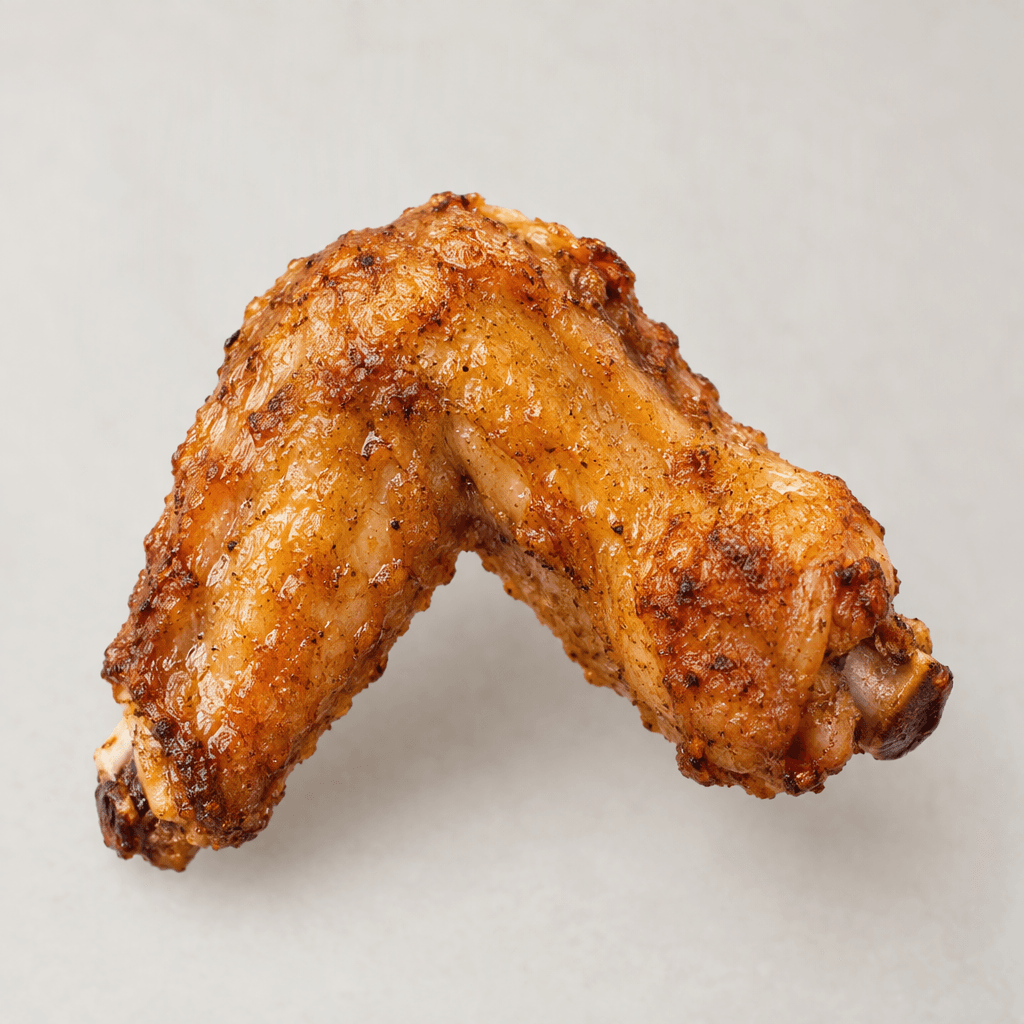
Chicken wing Calories
Protein source, bone-in, fatty, popular snack
In season: Spring · Summer · Autumn · Winter
CALORIES
GI
POTASSIUM
FIBER
Quick answer
1 piece (medium) of Chicken wing (30 g) has 61 calories. That works out to 203 calories per 100 g. It contains 0 g of carbs, 5.4 g of protein, 4.2 g of fat and 0 g of fiber. Its 48 mg of Phosphorus covers 7% of the Daily Value. Its glycemic index is 0 (low), so it raises blood sugar slowly.
What is Chicken wing?
Chicken wings are the jointed wing portions of a chicken, usually cooked with the skin on and served bone-in. They became especially well known as a sauced bar snack in the United States, but are now enjoyed around the world, from grilled and spiced versions to oven-roasted wings. They work as a shareable starter or as part of a meal with vegetables, potatoes or a fresh salad.
The meat is savoury and tender, with crisp skin when roasted or fried. It provides protein, though the skin and cooking method can make it relatively rich in fat; a 100 g portion has 18 g of protein. For a lighter plate, bake rather than deep-fry the wings and serve them with a simple dip and plenty of vegetables.
Chicken wing Nutrition Facts
Selected: 100 g
203
KCAL / 100G
Carbs
0g
· 0% DV
Protein
18g
· 36% DV
Fat
14g
· 18% DV
Fiber
0g
· 0% DV
DV is the share of the daily value covered, on a 2,000 kcal reference diet.
Calories come from: Carbs 0% · Protein 36% · Fat 64%

Log this food in EatBetter
100,000+ people use it
- Get your daily calorie target
- Snap your meal, log it in seconds
- See every vitamin and mineral

📸 Scan the code to get the app free.

Chicken wing Vitamins & Minerals
Vitamins
B5
1mg · 20% DV
B3
2.7mg · 17% DV
Biotin
5µg · 17% DV
B6
0.25mg · 15% DV
Minerals
Phosphorus
160mg · 23% DV
Selenium
12µg · 22% DV
Zinc
2mg · 18% DV
Potassium ⭐
210mg · 6% DV
How Nutritious Is Chicken wing?
Nutrient density
High
How many vitamins, minerals and how much fiber this food carries per calorie. A high score means a lot of nutrition for few calories.
Satiety score
Medium
An EatBetter score computed from fiber, protein and calorie density. A high score means staying full longer on the same calories.
Both scores are calculated per 100 g and do not change with the selected portion. The satiety score is EatBetter's own calculation, not a clinical measure.
Chicken wing Glycemic Index
GLYCEMIC INDEX
GLYCEMIC LOAD
Accounts for portion size — a more realistic measure than GI alone.
How to Burn Off Chicken wing
To burn the 203 calories in 100 g:
🚶
Walking (5 km/h)
🏃
Running (8 km/h)
🚴
Cycling
🏊
Swimming
Times are calculated with the MET equation for a 70 kg adult. Actual burn varies with your weight, age and pace.
Is Chicken wing Processed?
NOVA 1
Unprocessed
1. Unprocessed
2. Minimally Processed
3. Processed
4. Ultra-Processed
NOVA classifies foods into 4 groups by industrial processing. NOVA 1 (unprocessed) is the healthiest.
Does Chicken wing Contain Allergens?
No known major allergens
Which Diets Is Chicken wing Good For?
Vegan
— Not suitable
Vegetarian
— Not suitable
Gluten-Free
✓ Suitable
Dairy-Free
— Not suitable
Mediterranean
✓ Suitable
Paleo
✓ Suitable
Whole30
— Not suitable
DASH
— Not suitable
Keto
✓ Suitable
Low FODMAP
— Not suitable
Chicken wing Fat Profile
SATURATED
4g
MONOUNSATURATED
5g
POLYUNSATURATED
3g
Omega 6:3 ratio 40:1
Above the ideal 4:1 (40:1).
Compare Chicken wing
Foods Similar to Chicken wing
Frequently Asked Questions About Chicken wing
What is the difference between chicken wing flats and drumettes?
Chicken wing flats are the two-boned middle section, while drumettes are the meatier, single-bone section that looks like a small drumstick. A whole wing also includes the pointed tip, which is often saved for stock.
Where did Buffalo chicken wings come from?
Buffalo chicken wings are widely credited to the Anchor Bar in Buffalo, New York, where they were served in the 1960s. The classic version is fried and tossed in a cayenne-pepper hot sauce and butter mixture.
How do you make chicken wings crispy in the oven?
Dry the chicken wings thoroughly, arrange them with space between each piece, and bake them on a rack if available. Crowding traps steam and softens the skin; toss with sauce after baking to keep the exterior crisp.
How do you make chicken wings in an air fryer?
Cook chicken wings in a single layer in the air fryer, turning them partway through so they brown evenly. If the basket is crowded, cook in batches; sauce them after cooking for a crisper skin.
How do you grill chicken wings without burning them?
Grill chicken wings over moderate indirect heat until cooked through, then briefly move them over direct heat to brown the skin. Brush on sweet sauces near the end, since their sugar can burn quickly over a hot flame.
How can you tell when chicken wings are safely cooked?
Chicken wings are safely cooked when the thickest part reaches 165°F (74°C), measured with a food thermometer without touching the bone. Color alone is not a dependable safety test, especially near the bone.
Can you freeze raw or cooked chicken wings?
Yes, both raw and cooked chicken wings can be frozen in an airtight, freezer-safe package. Freeze them promptly, and thaw them in the refrigerator rather than on the counter to limit bacterial growth.
How do you reheat chicken wings and keep them crispy?
Reheat chicken wings in an oven or air fryer rather than a microwave to help restore crisp skin. Spread them out in one layer and heat until steaming hot throughout; add extra sauce afterward if needed.
What are traditional sauces for chicken wings besides Buffalo sauce?
Chicken wings are also commonly served with barbecue, honey-garlic, lemon-pepper, or dry spice coatings. For a classic American-style platter, serve Buffalo wings with celery and carrot sticks plus a blue-cheese dip.
Should you remove the skin from chicken wings before cooking?
No, you do not need to remove chicken wing skin before cooking; it browns and helps keep the meat moist. Leaving it on gives a crispier result, while removing it after cooking reduces the amount of fat eaten.
Have another question about Chicken wing?
Ask the AI nutrition coach — calories, portions, alternatives and more, answered in seconds in the app.

Scan calories with your camera
Instant AI nutrition analysis

Nutrition data compiled from USDA FoodData Central and scientific sources.