

Ready & Packaged Foods
All →Vegetables & Legumes
All →Desserts & Confectionery
All →Meat & Protein
All →Grains & Bakery
All →Beverages
All →Milk & Dairy
All →

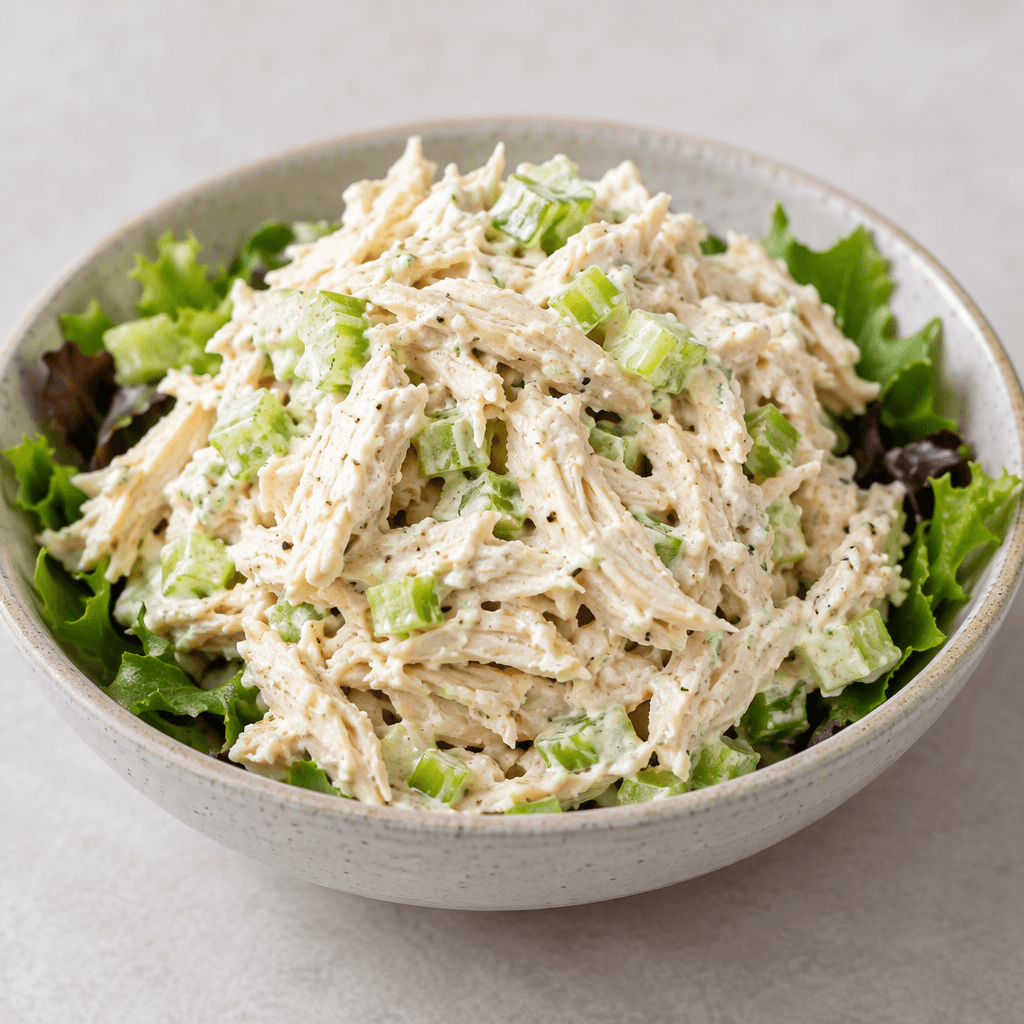
Chicken Salad Calories
High in protein and vegetables, light and filling
In season: Spring · Summer · Autumn · Winter
CALORIES
GI
POTASSIUM
FIBER
Quick answer
1 serving (medium) of Chicken Salad (180 g) has 216 calories. That works out to 120 calories per 100 g. It contains 8.1 g of carbs, 23.4 g of protein, 9.9 g of fat and 3.2 g of fiber. Its 5.6 mg of B3 covers 35% of the Daily Value. Its glycemic index is 35 (low), so it raises blood sugar slowly.
What is Chicken Salad?
Chicken Salad combines cooked chicken, often shredded or diced, with vegetables and a creamy dressing; celery and leafy greens are common additions. Creamy versions are especially familiar in North American cooking, where the mixture is served chilled as a sandwich filling or over a bed of greens. Recipes vary, and lighter versions use yogurt or a simple vinaigrette instead.
It has a tender, mild base with a cool crunch from the vegetables. Serve it for lunch in a sandwich, with crackers, or alongside salad greens. With 13 g of protein per 100 g, it makes a filling option; for a lighter bowl, go easy on the dressing and add extra fresh vegetables.
Chicken Salad Nutrition Facts
Selected: 100 g
120
KCAL / 100G
Carbs
4.5g
· 2% DV
Protein
13g
· 26% DV
Fat
5.5g
· 7% DV
Fiber
1.8g
· 6% DV
DV is the share of the daily value covered, on a 2,000 kcal reference diet.
Calories come from: Carbs 15% · Protein 44% · Fat 41%
Chicken Salad Vitamins & Minerals
Vitamins
B3
3.1mg · 19% DV
Vitamin K
22µg · 18% DV
B6
0.22mg · 13% DV
B5
0.6mg · 12% DV
Minerals
Phosphorus
110mg · 16% DV
Selenium
7µg · 13% DV
Sodium
260mg · 11% DV
Zinc
1mg · 9% DV
How Nutritious Is Chicken Salad?
Nutrient density
High
How many vitamins, minerals and how much fiber this food carries per calorie. A high score means a lot of nutrition for few calories.
Satiety score
Medium
An EatBetter score computed from fiber, protein and calorie density. A high score means staying full longer on the same calories.
Both scores are calculated per 100 g and do not change with the selected portion. The satiety score is EatBetter's own calculation, not a clinical measure.
Chicken Salad Glycemic Index
GLYCEMIC INDEX
GLYCEMIC LOAD
Accounts for portion size — a more realistic measure than GI alone.
How to Burn Off Chicken Salad
To burn the 120 calories in 100 g:
🚶
Walking (5 km/h)
🏃
Running (8 km/h)
🚴
Cycling
🏊
Swimming
Times are calculated with the MET equation for a 70 kg adult. Actual burn varies with your weight, age and pace.
Is Chicken Salad Processed?
NOVA 2
Minimally Processed
1. Unprocessed
2. Minimally Processed
3. Processed
4. Ultra-Processed
NOVA classifies foods into 4 groups by industrial processing. NOVA 1 (unprocessed) is the healthiest.
Does Chicken Salad Contain Allergens?
No known major allergens
Which Diets Is Chicken Salad Good For?
Vegan
— Not suitable
Vegetarian
— Not suitable
Gluten-Free
✓ Suitable
Dairy-Free
— Not suitable
Mediterranean
✓ Suitable
Paleo
✓ Suitable
Whole30
— Not suitable
DASH
— Not suitable
Keto
— Not suitable
Low FODMAP
— Not suitable
Chicken Salad Fat Profile
SATURATED
1.3g
MONOUNSATURATED
2.1g
POLYUNSATURATED
1.1g
Omega 6:3 ratio 5.6:1
Above the ideal 4:1 (5.6:1).
Compare Chicken Salad
Foods Similar to Chicken Salad
Frequently Asked Questions About Chicken Salad
What is Chicken Salad made of?
Chicken Salad usually combines cooked chicken with a creamy dressing and add-ins such as celery, onion, herbs, or pickles. Recipes vary: some use mayonnaise, others use yogurt or a mix, and it may be served on greens, in a sandwich, or with crackers.
How do you make Chicken Salad?
To make Chicken Salad, shred or chop cooked, cooled chicken and mix it with celery and a dressing until evenly coated. Season to taste, then chill it briefly so the flavors meld. Add leafy greens just before serving if you want them to stay crisp.
How long does Chicken Salad last in the fridge?
Chicken Salad generally keeps for 3–4 days in a covered container in the refrigerator. Refrigerate it promptly rather than leaving it at room temperature, and discard it if its smell, appearance, or texture suggests it has spoiled.
Can you freeze Chicken Salad?
Chicken Salad with mayonnaise or yogurt usually does not freeze well because the dressing can separate and become watery after thawing. For better results, freeze cooked chicken on its own, thaw it in the refrigerator, and mix the salad fresh.
Is Chicken Salad healthy?
Chicken Salad can be a nourishing meal because it pairs protein-rich chicken with vegetables. The dressing and portion of vegetables shape the overall balance, so adding plenty of greens and choosing a lighter dressing can make it a more vegetable-forward option.
What chicken is best for Chicken Salad?
Cooked chicken breast is a popular choice for Chicken Salad because it shreds easily and takes on the dressing’s flavor. Thigh meat works too and tends to be juicier. Use cooled chicken so the dressing stays creamy rather than thinning from heat.
Why is Chicken Salad watery?
Chicken Salad can turn watery when celery or other vegetables release liquid, the chicken is still warm, or the dressing is too thin. Drain ingredients well, cool the chicken completely, and add the dressing shortly before serving if you are making it ahead.
What should you serve with Chicken Salad?
Chicken Salad pairs well with leafy greens, crusty bread, crackers, or a bowl of soup. For a fuller plate, add roasted vegetables or fruit; if you are serving it in a sandwich, crisp lettuce gives it a fresh contrast.
Can you make Chicken Salad ahead of time?
Yes, you can make Chicken Salad ahead of time and keep it covered in the refrigerator. For the best texture, store delicate greens separately and stir them in just before serving; the flavors in the chicken mixture can meld while it chills.
Can you make Chicken Salad without mayonnaise?
Yes, Chicken Salad can be made without mayonnaise. Plain yogurt, mashed avocado, or a mustard-and-olive-oil dressing can bind the chicken and vegetables instead; add the substitute gradually so the mixture stays creamy rather than loose.
Have another question about Chicken Salad?
Ask the AI nutrition coach — calories, portions, alternatives and more, answered in seconds in the app.

Scan calories with your camera
Instant AI nutrition analysis

Nutrition data compiled from USDA FoodData Central and scientific sources.