

Ready & Packaged Foods
All →Vegetables & Legumes
All →Desserts & Confectionery
All →Meat & Protein
All →Grains & Bakery
All →Beverages
All →Milk & Dairy
All →

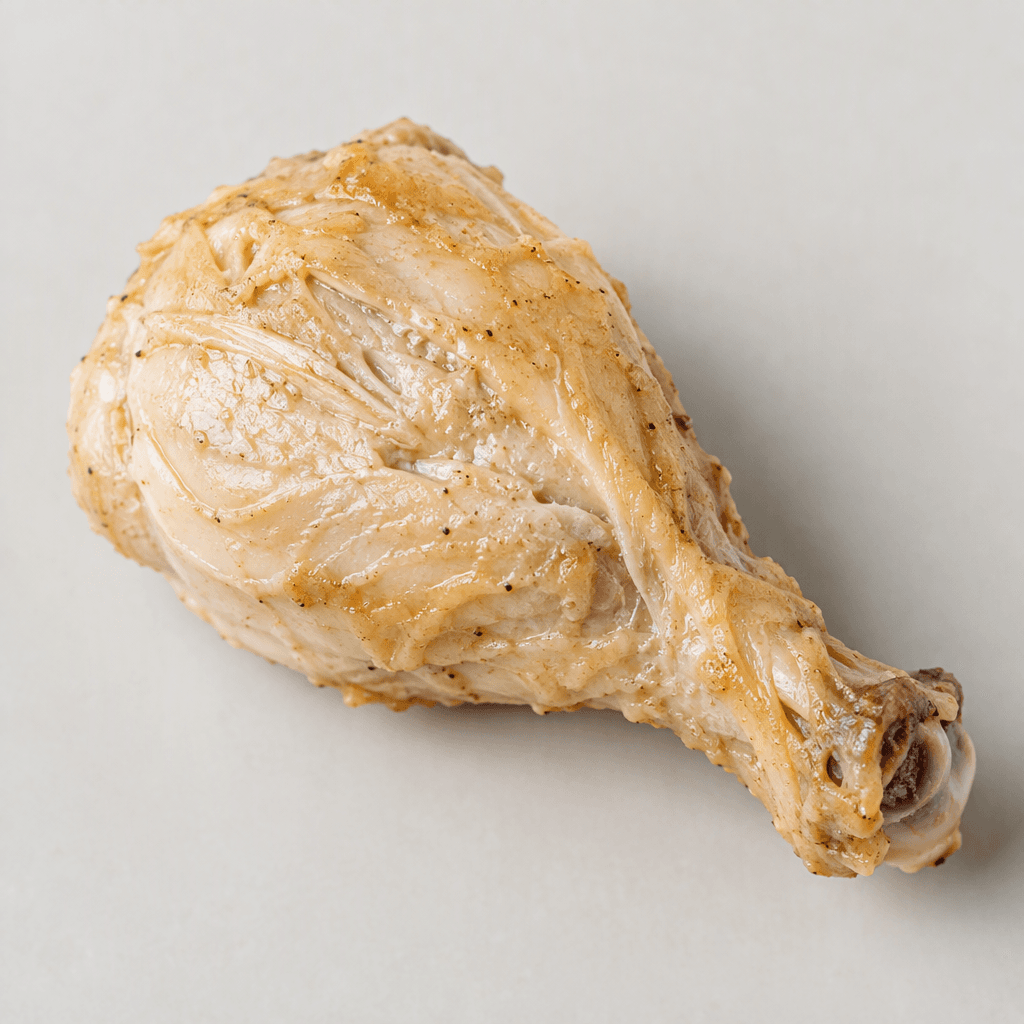
Chicken leg (skinless, cooked) Calories
High protein, low fat, good source of B vitamins
CALORIES
GI
POTASSIUM
FIBER
Quick answer
1 piece (medium) of Chicken leg (skinless, cooked) (120 g) has 198 calories. That works out to 165 calories per 100 g. It contains 0 g of carbs, 31.4 g of protein, 5 g of fat and 0 g of fiber. Its 25.2 µg of Selenium covers 46% of the Daily Value. Its glycemic index is 0 (low), so it raises blood sugar slowly.
What is Chicken leg (skinless, cooked)?
Chicken leg (skinless, cooked) is the leg portion of a chicken with the skin removed, cooked by roasting, simmering or grilling. It may be served on the bone or picked off for use in soups, salads, sandwiches and grain bowls.
The meat is darker and more tender than breast, with a savoury flavour that works well with herbs, spices and cooking juices. It makes an easy centrepiece for a meal with vegetables or rice, and leftovers are convenient for lunches. It is protein-rich, providing 26.2 g of protein per 100 g, with relatively little fat once the skin is removed. For a lighter plate, roast it without extra oil and pair it with vegetables or a fresh salad.
Chicken leg (skinless, cooked) Nutrition Facts
Selected: 100 g
165
KCAL / 100G
Carbs
0g
· 0% DV
Protein
26.2g
· 52% DV
Fat
4.2g
· 5% DV
Fiber
0g
· 0% DV
DV is the share of the daily value covered, on a 2,000 kcal reference diet.
Calories come from: Carbs 0% · Protein 73% · Fat 27%
Chicken leg (skinless, cooked) Vitamins & Minerals
Vitamins
B3
5.7mg · 36% DV
B6
0.45mg · 26% DV
B5
1mg · 20% DV
B12
0.33µg · 14% DV
Minerals
Selenium
21µg · 38% DV
Phosphorus
210mg · 30% DV
Zinc
2mg · 18% DV
Potassium ⭐
260mg · 8% DV
How Nutritious Is Chicken leg (skinless, cooked)?
Nutrient density
High
How many vitamins, minerals and how much fiber this food carries per calorie. A high score means a lot of nutrition for few calories.
Satiety score
Medium
An EatBetter score computed from fiber, protein and calorie density. A high score means staying full longer on the same calories.
Both scores are calculated per 100 g and do not change with the selected portion. The satiety score is EatBetter's own calculation, not a clinical measure.
Chicken leg (skinless, cooked) Glycemic Index
GLYCEMIC INDEX
GLYCEMIC LOAD
Accounts for portion size — a more realistic measure than GI alone.
How to Burn Off Chicken leg (skinless, cooked)
To burn the 165 calories in 100 g:
🚶
Walking (5 km/h)
🏃
Running (8 km/h)
🚴
Cycling
🏊
Swimming
Times are calculated with the MET equation for a 70 kg adult. Actual burn varies with your weight, age and pace.
Is Chicken leg (skinless, cooked) Processed?
NOVA 2
Minimally Processed
1. Unprocessed
2. Minimally Processed
3. Processed
4. Ultra-Processed
NOVA classifies foods into 4 groups by industrial processing. NOVA 1 (unprocessed) is the healthiest.
Does Chicken leg (skinless, cooked) Contain Allergens?
No known major allergens
Which Diets Is Chicken leg (skinless, cooked) Good For?
Vegan
— Not suitable
Vegetarian
— Not suitable
Gluten-Free
✓ Suitable
Dairy-Free
— Not suitable
Mediterranean
✓ Suitable
Paleo
✓ Suitable
Whole30
— Not suitable
DASH
— Not suitable
Keto
✓ Suitable
Low FODMAP
— Not suitable
Chicken leg (skinless, cooked) Fat Profile
SATURATED
1.2g
MONOUNSATURATED
1.6g
POLYUNSATURATED
1g
Omega 6:3 ratio 6.4:1
Above the ideal 4:1 (6.4:1).
Compare Chicken leg (skinless, cooked)
Foods Similar to Chicken leg (skinless, cooked)
Frequently Asked Questions About Chicken leg (skinless, cooked)
How long does a skinless cooked chicken leg last in the fridge?
A skinless cooked chicken leg keeps for 3–4 days in the refrigerator when chilled within two hours of cooking. Store it in a covered, airtight container and freeze it if you will not eat it in time.
What is the best way to reheat a skinless cooked chicken leg?
Reheat a skinless cooked chicken leg covered, with a splash of water or broth to help keep the meat moist. Heat it until steaming hot throughout, turning it once if using a microwave.
Can you freeze a skinless cooked chicken leg?
Yes, a skinless cooked chicken leg freezes well. Cool it promptly, seal it in a freezer-safe container, and thaw it in the refrigerator before reheating; avoid repeatedly thawing and refreezing it.
Can you eat a skinless cooked chicken leg cold?
Yes, you can eat a skinless cooked chicken leg cold in a salad or sandwich if it has been stored safely. Refrigerate leftovers within two hours of cooking and do not leave them at room temperature for long.
Why is the meat near the bone in a skinless cooked chicken leg sometimes pink?
A pink tint near the bone does not always mean a skinless cooked chicken leg is undercooked; pigments from the bone can affect the meat’s color. Use a food thermometer and check that the thickest part reached 74°C.
Is a skinless cooked chicken leg the same as a chicken thigh?
Not necessarily: a chicken leg can mean the whole leg, including the thigh and drumstick, while a thigh is only the upper part. A packaged or served skinless cooked chicken leg may refer to either a whole leg or a single portion.
Why is skinless cooked chicken leg meat darker than chicken breast?
Skinless cooked chicken leg is dark meat because the leg muscles contain more myoglobin, a pigment that stores oxygen. Those muscles work more than breast muscles, which is also why leg meat is often more tender and flavorful.
How do you shred a skinless cooked chicken leg?
Remove the skin and pull the meat from the bone while the skinless cooked chicken leg is still warm. Use two forks to separate it into strands, checking carefully for small bones before adding it to tacos, soup, or sandwiches.
Is skinless cooked chicken leg good for weight loss?
It can fit a weight-loss meal because its protein can help make a meal satisfying. Pair a skinless cooked chicken leg with vegetables and choose baking or poaching over adding a rich sauce or frying.
Is skinless cooked chicken leg useful for building muscle?
Yes, skinless cooked chicken leg provides complete protein, which supplies the amino acids your body uses to build and repair muscle. Include it as part of a meal after training, alongside carbohydrates and fluids.
Have another question about Chicken leg (skinless, cooked)?
Ask the AI nutrition coach — calories, portions, alternatives and more, answered in seconds in the app.

Scan calories with your camera
Instant AI nutrition analysis

Nutrition data compiled from USDA FoodData Central and scientific sources.