

Ready & Packaged Foods
All →Vegetables & Legumes
All →Desserts & Confectionery
All →Meat & Protein
All →Grains & Bakery
All →Beverages
All →Milk & Dairy
All →

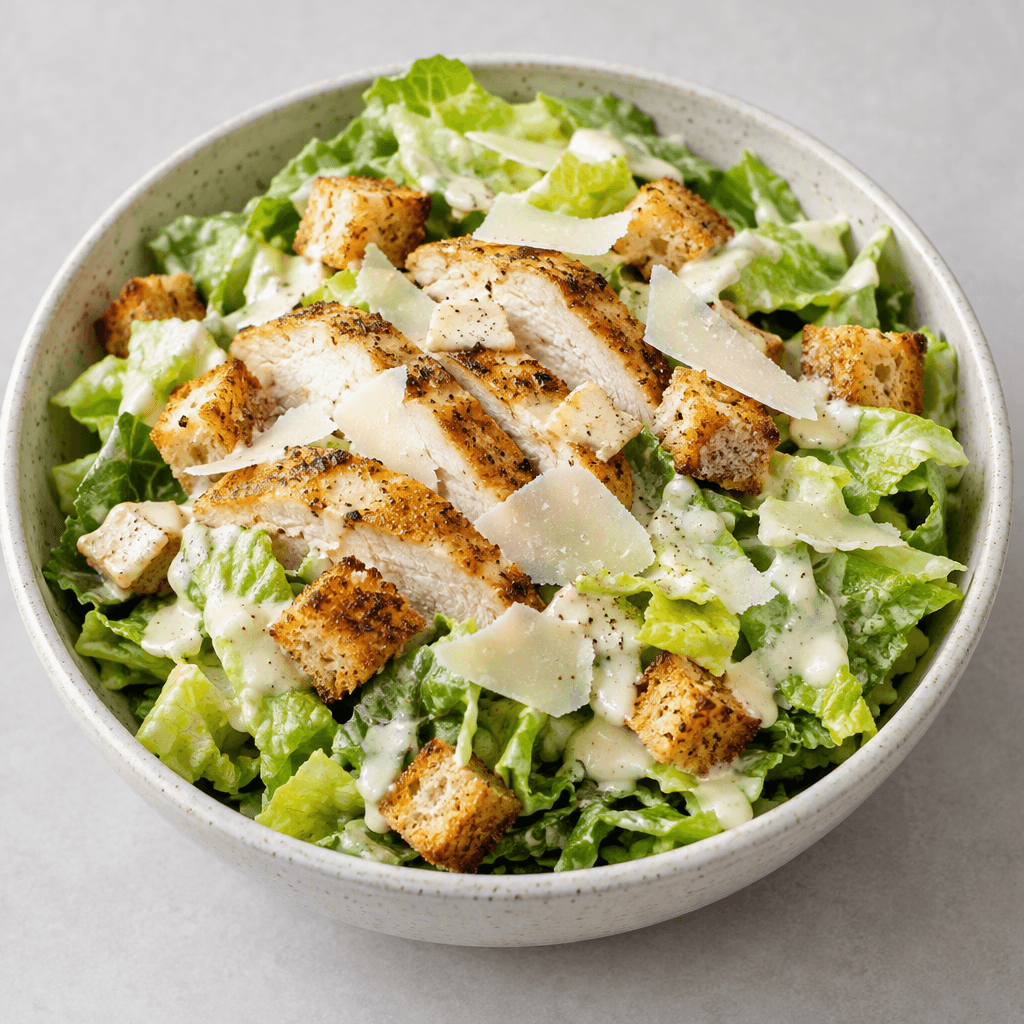
Chicken Caesar Salad Calories
Classic Caesar salad with grilled chicken, protein-rich
In season: Spring · Summer · Autumn · Winter
CALORIES
GI
POTASSIUM
FIBER
Quick answer
1 serving (medium) of Chicken Caesar Salad (220 g) has 264 calories. That works out to 120 calories per 100 g. It contains 15.4 g of carbs, 18.7 g of protein, 14.3 g of fat and 4 g of fiber. Its 83.6 µg of Vitamin K covers 70% of the Daily Value. Its glycemic index is 45 (low), so it raises blood sugar slowly.
What is Chicken Caesar Salad?
Chicken Caesar Salad combines crisp romaine with grilled chicken, crunchy croutons, shavings of hard cheese and a creamy, savoury dressing. Caesar salad is associated with Tijuana, Mexico, where Italian-American restaurateur Caesar Cardini is said to have created the original; chicken became a popular addition later.
The cool, leafy crunch balances the tender chicken, salty cheese and rich dressing, while croutons add extra bite. It is commonly served as a lunch or light main meal in cafés and restaurants around the world, including in English-speaking countries. The chicken makes it a satisfying, protein-rich choice. For a lighter version, ask for the dressing on the side or use less, and add extra romaine if you want more freshness.
Chicken Caesar Salad Nutrition Facts
Selected: 100 g
120
KCAL / 100G
Carbs
7g
· 3% DV
Protein
8.5g
· 17% DV
Fat
6.5g
· 8% DV
Fiber
1.8g
· 6% DV
DV is the share of the daily value covered, on a 2,000 kcal reference diet.
Calories come from: Carbs 23% · Protein 28% · Fat 49%
Chicken Caesar Salad Vitamins & Minerals
Vitamins
Vitamin K
38µg · 32% DV
Vitamin A
120µg · 13% DV
B3
2.1mg · 13% DV
B5
0.6mg · 12% DV
Minerals
Sodium
340mg · 15% DV
Selenium
6.5µg · 12% DV
Phosphorus
75mg · 11% DV
Zinc
1mg · 9% DV
How Nutritious Is Chicken Caesar Salad?
Nutrient density
Medium
How many vitamins, minerals and how much fiber this food carries per calorie. A high score means a lot of nutrition for few calories.
Satiety score
Medium
An EatBetter score computed from fiber, protein and calorie density. A high score means staying full longer on the same calories.
Both scores are calculated per 100 g and do not change with the selected portion. The satiety score is EatBetter's own calculation, not a clinical measure.
Chicken Caesar Salad Glycemic Index
GLYCEMIC INDEX
GLYCEMIC LOAD
Accounts for portion size — a more realistic measure than GI alone.
How to Burn Off Chicken Caesar Salad
To burn the 120 calories in 100 g:
🚶
Walking (5 km/h)
🏃
Running (8 km/h)
🚴
Cycling
🏊
Swimming
Times are calculated with the MET equation for a 70 kg adult. Actual burn varies with your weight, age and pace.
Is Chicken Caesar Salad Processed?
NOVA 3
Processed
1. Unprocessed
2. Minimally Processed
3. Processed
4. Ultra-Processed
NOVA classifies foods into 4 groups by industrial processing. NOVA 1 (unprocessed) is the healthiest.
Does Chicken Caesar Salad Contain Allergens?
Contains these allergens:
Which Diets Is Chicken Caesar Salad Good For?
Vegan
— Not suitable
Vegetarian
— Not suitable
Gluten-Free
— Not suitable
Dairy-Free
— Not suitable
Mediterranean
✓ Suitable
Paleo
— Not suitable
Whole30
— Not suitable
DASH
— Not suitable
Keto
— Not suitable
Low FODMAP
— Not suitable
Chicken Caesar Salad Fat Profile
SATURATED
1.6g
MONOUNSATURATED
2.3g
POLYUNSATURATED
1g
Omega 6:3 ratio 4.4:1
Above the ideal 4:1 (4.4:1).
Compare Chicken Caesar Salad
Foods Similar to Chicken Caesar Salad
Frequently Asked Questions About Chicken Caesar Salad
What is in a Chicken Caesar Salad?
A Chicken Caesar Salad typically contains romaine lettuce, cooked chicken, croutons, Parmesan, and Caesar dressing. The dressing is creamy, tangy, and often made with egg, lemon, garlic, and anchovies; recipes vary by restaurant and home cook.
Is Chicken Caesar Salad healthy?
Chicken Caesar Salad can be a balanced meal, with chicken and lettuce alongside a creamy dressing, cheese, and croutons. For a lighter version, use less dressing and cheese, choose grilled chicken, and add extra romaine.
Where did Chicken Caesar Salad come from?
Chicken Caesar Salad is a later variation of Caesar salad, which is generally credited to restaurateur Caesar Cardini in Tijuana, Mexico. Cardini’s original salad did not include chicken; adding it turned the salad into a more substantial meal.
What lettuce is best for Chicken Caesar Salad?
Romaine is the classic lettuce for Chicken Caesar Salad because its crisp leaves hold up well to thick dressing. Wash and dry the leaves thoroughly, then tear or chop them so the dressing coats them evenly.
How do you keep Chicken Caesar Salad from getting soggy?
Keep Chicken Caesar Salad crisp by drying the romaine well and adding the dressing and croutons just before serving. If preparing it ahead, store the chicken, lettuce, dressing, and croutons separately, then toss them together at mealtime.
Can you make Chicken Caesar Salad ahead of time?
Yes, you can prepare Chicken Caesar Salad components ahead, but assemble the salad just before eating. Refrigerate the cooked chicken and washed, dried romaine in separate covered containers; keep the croutons dry and the dressing apart.
Is the chicken in Chicken Caesar Salad served hot or cold?
Chicken in Chicken Caesar Salad can be served warm or cold. Warm, freshly grilled chicken is common, while chilled cooked chicken works well for a make-ahead lunch; let hot chicken cool slightly before adding it to the romaine.
Does Chicken Caesar Salad dressing contain anchovies?
Often, yes: traditional Caesar dressing for Chicken Caesar Salad includes anchovies for a savory, salty flavor. Some versions leave them out or use Worcestershire sauce instead, so the taste and ingredients can differ between recipes.
Can you make Chicken Caesar Salad without croutons?
Yes, Chicken Caesar Salad works without croutons. Leave them out for a softer texture, or add toasted nuts or seeds for crunch; if you want to keep the familiar flavor, retain the Parmesan and Caesar dressing.
Can you eat Chicken Caesar Salad while pregnant?
Yes, Chicken Caesar Salad can be eaten during pregnancy if the chicken is fully cooked and the romaine is washed well. Choose dressing made with pasteurized egg or without raw egg, and avoid salad that has been left unrefrigerated.
Have another question about Chicken Caesar Salad?
Ask the AI nutrition coach — calories, portions, alternatives and more, answered in seconds in the app.

Scan calories with your camera
Instant AI nutrition analysis

Nutrition data compiled from USDA FoodData Central and scientific sources.