

Ready & Packaged Foods
All →Vegetables & Legumes
All →Desserts & Confectionery
All →Meat & Protein
All →Grains & Bakery
All →Beverages
All →Milk & Dairy
All →

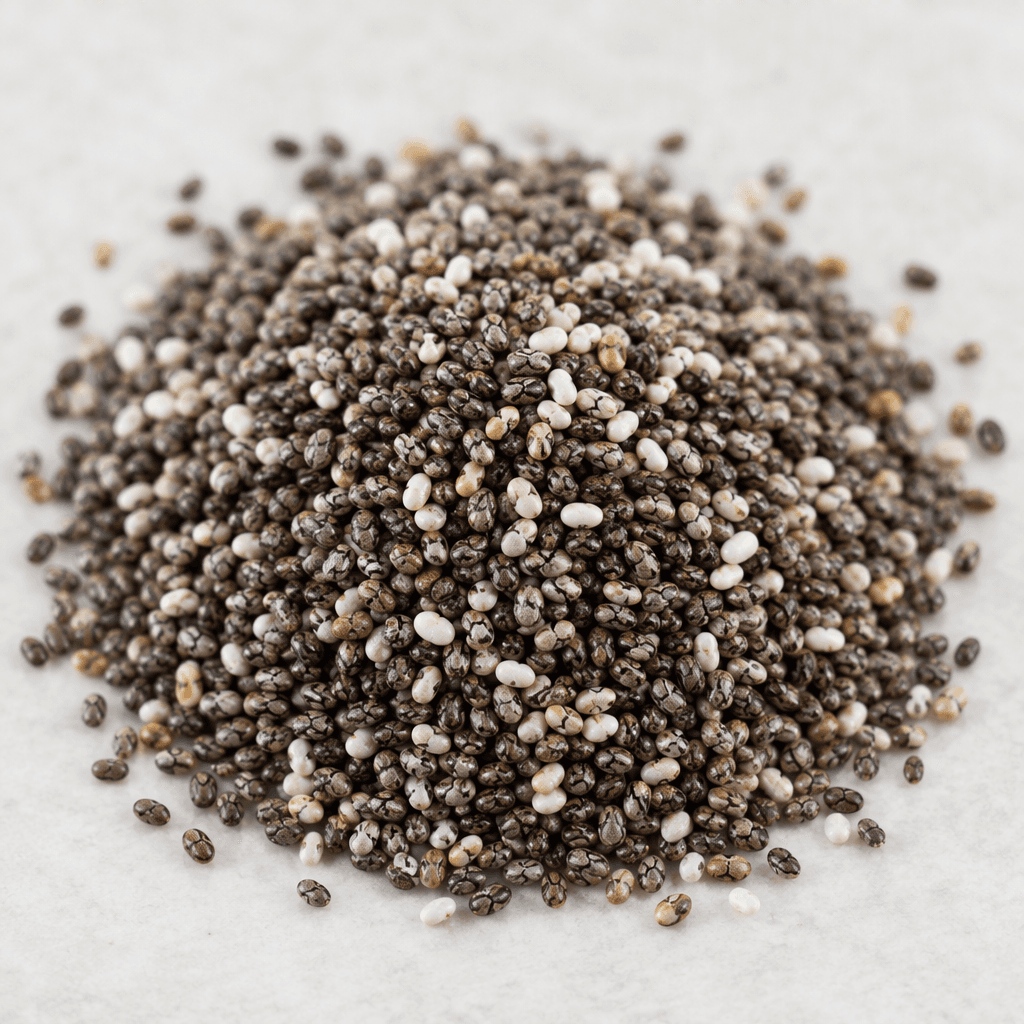
Chia seeds (raw) Calories
Omega-3 source, high fiber, plant protein
In season: Spring · Summer · Autumn · Winter
CALORIES
GI
POTASSIUM
FIBER
Quick answer
1 tablespoon (medium) of Chia seeds (raw) (12 g) has 58 calories. That works out to 486 calories per 100 g. It contains 5.1 g of carbs, 2 g of protein, 3.7 g of fat and 4.1 g of fiber. Its 103.2 mg of Phosphorus covers 15% of the Daily Value. Its glycemic index is 1 (low), so it raises blood sugar slowly.
What is Chia seeds (raw)?
Raw chia seeds are the small edible seeds of a plant native to Central America and Mexico. Their mild flavour makes them easy to add to porridge, yoghurt, smoothies and baked goods; soaked seeds are also used to make chia pudding. They are popular in breakfasts and snacks in many parts of the world.
Dry, they have a slight crunch; after soaking, they swell and form a soft gel. They provide plenty of fibre, along with plant protein and omega-3 fats. A medium tablespoon is about 12 g. For a smoother pudding or drink, stir them into enough liquid and let them stand until thickened.
Chia seeds (raw) Nutrition Facts
Selected: 100 g
486
KCAL / 100G
Carbs
42.1g
· 15% DV
Protein
16.5g
· 33% DV
Fat
30.7g
· 39% DV
Fiber
34.4g
· 123% DV
DV is the share of the daily value covered, on a 2,000 kcal reference diet.
Calories come from: Carbs 33% · Protein 13% · Fat 54%
Chia seeds (raw) Vitamins & Minerals
Vitamins
B3
8.83mg · 55% DV
B1
0.62mg · 52% DV
Vitamin K
16.4µg · 14% DV
B2
0.17mg · 13% DV
Minerals
Manganese
3mg · 130% DV
Phosphorus
860mg · 123% DV
Copper
1mg · 111% DV
Selenium
55µg · 100% DV
How Nutritious Is Chia seeds (raw)?
Nutrient density
Very high
How many vitamins, minerals and how much fiber this food carries per calorie. A high score means a lot of nutrition for few calories.
Satiety score
Medium
An EatBetter score computed from fiber, protein and calorie density. A high score means staying full longer on the same calories.
Both scores are calculated per 100 g and do not change with the selected portion. The satiety score is EatBetter's own calculation, not a clinical measure.
Chia seeds (raw) Glycemic Index
GLYCEMIC INDEX
GLYCEMIC LOAD
Accounts for portion size — a more realistic measure than GI alone.
How to Burn Off Chia seeds (raw)
To burn the 486 calories in 100 g:
🚶
Walking (5 km/h)
🏃
Running (8 km/h)
🚴
Cycling
🏊
Swimming
Times are calculated with the MET equation for a 70 kg adult. Actual burn varies with your weight, age and pace.
Is Chia seeds (raw) Processed?
NOVA 1
Unprocessed
1. Unprocessed
2. Minimally Processed
3. Processed
4. Ultra-Processed
NOVA classifies foods into 4 groups by industrial processing. NOVA 1 (unprocessed) is the healthiest.
Does Chia seeds (raw) Contain Allergens?
No known major allergens
Which Diets Is Chia seeds (raw) Good For?
Vegan
✓ Suitable
Vegetarian
✓ Suitable
Gluten-Free
✓ Suitable
Dairy-Free
— Not suitable
Mediterranean
✓ Suitable
Paleo
✓ Suitable
Whole30
— Not suitable
DASH
— Not suitable
Keto
✓ Suitable
Low FODMAP
— Not suitable
Chia seeds (raw) Fat Profile
SATURATED
3.3g
MONOUNSATURATED
2.3g
POLYUNSATURATED
23.7g
Omega 6:3 ratio 0.3:1
Below the ideal 4:1 — a good omega balance.
Compare Chia seeds (raw)
Foods Similar to Chia seeds (raw)
Frequently Asked Questions About Chia seeds (raw)
Do chia seeds need to be soaked before eating?
No, chia seeds do not have to be soaked, but soaking makes them swell and form a gel. For a softer texture, stir them into liquid and let them thicken before eating.
Can you eat chia seeds raw?
Yes, you can eat raw chia seeds without cooking them. They absorb liquid and swell, so mix them into moist food or a drink rather than swallowing a spoonful of dry seeds on its own.
How do you make chia seed pudding?
Chia seed pudding is made by stirring chia seeds into milk or a plant-based drink and letting the mixture thicken. Stir again after it rests to break up clumps, then add fruit or other toppings.
Do chia seeds help with weight loss?
Chia seeds do not cause weight loss on their own. Their fiber absorbs liquid and may make a meal feel more filling, but adding them to your diet is not a substitute for an overall calorie deficit.
Can you put chia seeds in a smoothie?
Yes, chia seeds work well in smoothies. Blend them in for a smoother, thicker drink, or stir them in afterward if you want their gel-like texture; allow the smoothie to stand briefly if it becomes too thick.
Why do chia seeds turn into a gel?
Chia seeds form a gel because soluble fiber on their outer layer absorbs water. This is a normal feature of chia seeds and is what gives chia pudding its thick, spoonable texture.
Should chia seeds be ground to get their nutrients?
No, chia seeds do not need to be ground to be eaten. Whole seeds are commonly used in meals and absorb liquid; grinding is optional and mainly changes their texture and how they blend into a recipe.
How much chia seeds should you eat a day?
Start with a small serving of chia seeds and increase it gradually if it suits you. Their high fiber content can cause gas or bloating when you suddenly eat a lot, so have them with enough fluid.
Can chia seeds cause bloating or constipation?
Yes, chia seeds can cause bloating, and eating a large amount without enough fluid may worsen constipation. Their fiber intake is easier to tolerate when you begin with a small amount and increase it gradually.
How should you store chia seeds?
Store chia seeds in a tightly sealed container in a cool, dry place away from direct light. Keeping moisture and heat out helps preserve their freshness and the quality of their natural oils.
Have another question about Chia seeds (raw)?
Ask the AI nutrition coach — calories, portions, alternatives and more, answered in seconds in the app.

Scan calories with your camera
Instant AI nutrition analysis

Nutrition data compiled from USDA FoodData Central and scientific sources.