

Ready & Packaged Foods
All →Vegetables & Legumes
All →Desserts & Confectionery
All →Meat & Protein
All →Grains & Bakery
All →Beverages
All →Milk & Dairy
All →

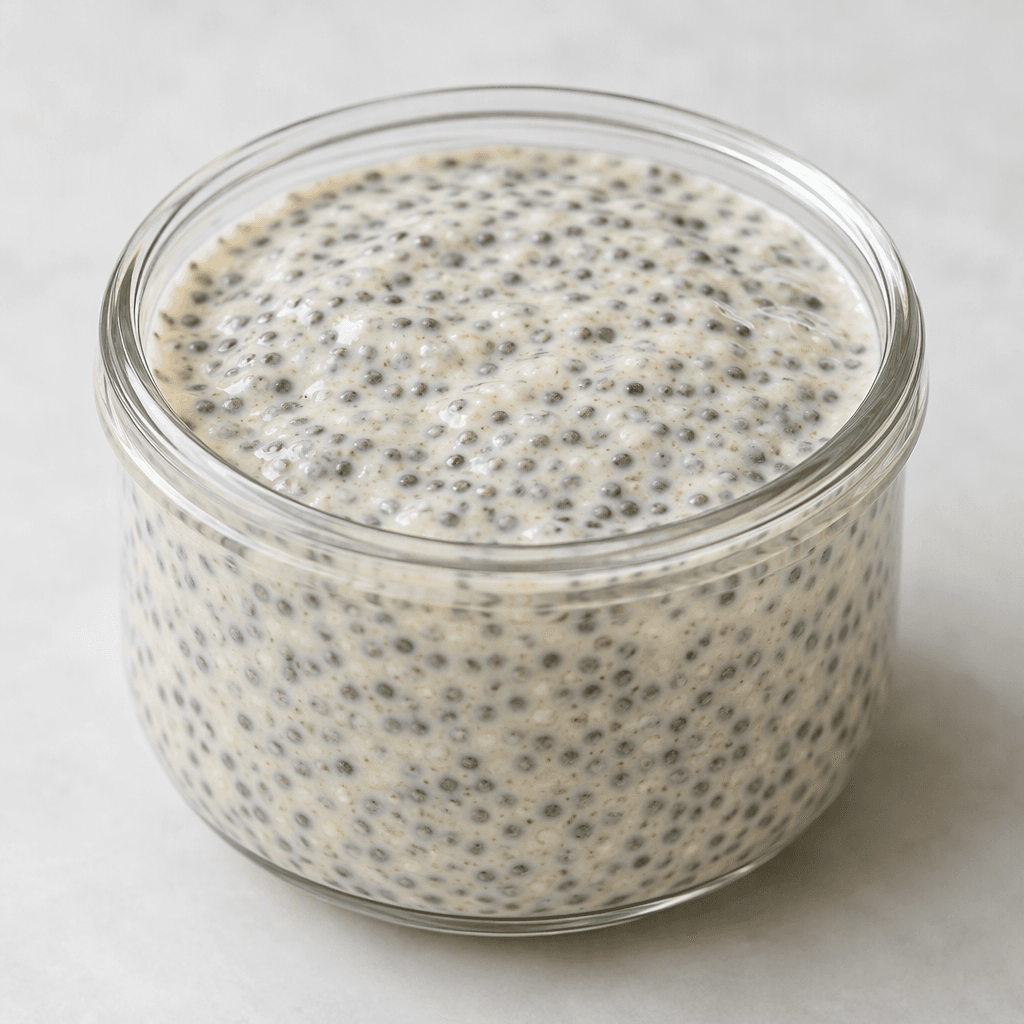
Chia Pudding Calories
Omega-3 source, high fiber, plant protein, low sugar
In season: Spring · Summer · Autumn · Winter
CALORIES
GI
POTASSIUM
FIBER
Quick answer
1 cup (medium) of Chia Pudding (150 g) has 180 calories. That works out to 120 calories per 100 g. It contains 15.8 g of carbs, 6.3 g of protein, 9.3 g of fat and 10.2 g of fiber. Its 0.2 mg of Copper covers 25% of the Daily Value. Its glycemic index is 2 (low), so it raises blood sugar slowly.
What is Chia Pudding?
Chia pudding is made by soaking chia seeds in milk or a plant-based drink until the mixture thickens into a spoonable breakfast or snack. Chia is native to Central America and Mexico; the pudding is a newer, widely adopted way of serving the seeds. Recipes may use dairy milk, yoghurt or plant milk, with fruit or another sweetener added to taste.
Served chilled, it has a soft, slightly gel-like texture, with the seeds providing a gentle crunch. It is commonly eaten for breakfast or as a snack, topped with berries, banana, nuts or granola. Chia pudding provides fibre and plant protein, and the seeds are a source of omega-3 fats. For a less-sweet option, use an unsweetened milk and let ripe fruit provide the sweetness.
Chia Pudding Nutrition Facts
Selected: 100 g
120
KCAL / 100G
Carbs
10.5g
· 4% DV
Protein
4.2g
· 8% DV
Fat
6.2g
· 8% DV
Fiber
6.8g
· 24% DV
DV is the share of the daily value covered, on a 2,000 kcal reference diet.
Calories come from: Carbs 37% · Protein 15% · Fat 48%
Chia Pudding Vitamins & Minerals
Vitamins
Vitamin K
16µg · 13% DV
Folate
32µg · 8% DV
B1
0.08mg · 7% DV
B3
0.9mg · 6% DV
Minerals
Magnesium
60mg · 14% DV
Selenium
7µg · 13% DV
Phosphorus
85mg · 12% DV
Calcium
110mg · 11% DV
How Nutritious Is Chia Pudding?
Nutrient density
High
How many vitamins, minerals and how much fiber this food carries per calorie. A high score means a lot of nutrition for few calories.
Satiety score
High
An EatBetter score computed from fiber, protein and calorie density. A high score means staying full longer on the same calories.
Both scores are calculated per 100 g and do not change with the selected portion. The satiety score is EatBetter's own calculation, not a clinical measure.
Chia Pudding Glycemic Index
GLYCEMIC INDEX
GLYCEMIC LOAD
Accounts for portion size — a more realistic measure than GI alone.
How to Burn Off Chia Pudding
To burn the 120 calories in 100 g:
🚶
Walking (5 km/h)
🏃
Running (8 km/h)
🚴
Cycling
🏊
Swimming
Times are calculated with the MET equation for a 70 kg adult. Actual burn varies with your weight, age and pace.
Is Chia Pudding Processed?
NOVA 2
Minimally Processed
1. Unprocessed
2. Minimally Processed
3. Processed
4. Ultra-Processed
NOVA classifies foods into 4 groups by industrial processing. NOVA 1 (unprocessed) is the healthiest.
Does Chia Pudding Contain Allergens?
No known major allergens
Which Diets Is Chia Pudding Good For?
Vegan
✓ Suitable
Vegetarian
✓ Suitable
Gluten-Free
✓ Suitable
Dairy-Free
— Not suitable
Mediterranean
✓ Suitable
Paleo
— Not suitable
Whole30
— Not suitable
DASH
— Not suitable
Keto
✓ Suitable
Low FODMAP
— Not suitable
Chia Pudding Fat Profile
SATURATED
0.7g
MONOUNSATURATED
0.6g
POLYUNSATURATED
2.9g
Omega 6:3 ratio 0.3:1
Below the ideal 4:1 — a good omega balance.
Compare Chia Pudding
Foods Similar to Chia Pudding
Frequently Asked Questions About Chia Pudding
How do you make chia pudding?
To make chia pudding, stir chia seeds into milk or a plant-based drink until evenly mixed, then refrigerate until thick. Add vanilla, fruit, or another flavoring if you like, and stir again after a few minutes to prevent clumps.
Why is my chia pudding still runny?
Chia pudding usually stays runny when it has too much liquid or the seeds have not been mixed evenly. Stir it again, let it chill longer, and add a little more chia if it still has not thickened.
How long does chia pudding last in the fridge?
Chia pudding keeps for a few days in a covered container in the refrigerator. For the freshest texture, store it plain and add cut fruit or crunchy toppings just before serving.
Can you freeze chia pudding?
Yes, chia pudding can be frozen, although thawing may make its texture less smooth. Freeze it in a sealed, portion-sized container, then thaw it in the refrigerator and stir well before eating.
Can you make chia pudding with water instead of milk?
Yes, chia pudding can be made with water, but it will taste less creamy and rich than a version made with milk. Add fruit, spices, or a spoonful of yogurt when serving if you want a fuller flavor.
Can chia pudding be eaten warm?
Yes, chia pudding can be eaten warm, though heating may change its texture. Warm a serving gently and stir it; add a splash of milk if it becomes too thick, rather than boiling it for a long time.
What is the difference between chia pudding and overnight oats?
Chia pudding thickens as chia seeds absorb liquid, while overnight oats soften as rolled oats soak. Chia pudding has a gel-like texture with visible seeds; overnight oats are softer and more like a cold porridge.
Is chia pudding good for weight loss?
Chia pudding can be filling because it contains fiber, but it does not cause weight loss on its own. Sweeteners, large portions, and calorie-dense toppings can make a serving substantially more energy-dense.
Can you make chia pudding without sweetener?
Yes, chia pudding does not need added sweetener to set. Use naturally sweet fruit, such as ripe banana or berries, for flavor, or leave it unsweetened and add toppings when you serve it.
Can chia pudding cause bloating or constipation?
Chia pudding may cause bloating for some people, especially when they suddenly eat more fiber than usual or the seeds have not absorbed enough liquid. Start with a smaller serving and make sure the seeds are fully soaked.
Have another question about Chia Pudding?
Ask the AI nutrition coach — calories, portions, alternatives and more, answered in seconds in the app.

Scan calories with your camera
Instant AI nutrition analysis

Nutrition data compiled from USDA FoodData Central and scientific sources.