

Ready & Packaged Foods
All →Vegetables & Legumes
All →Desserts & Confectionery
All →Meat & Protein
All →Grains & Bakery
All →Beverages
All →Milk & Dairy
All →

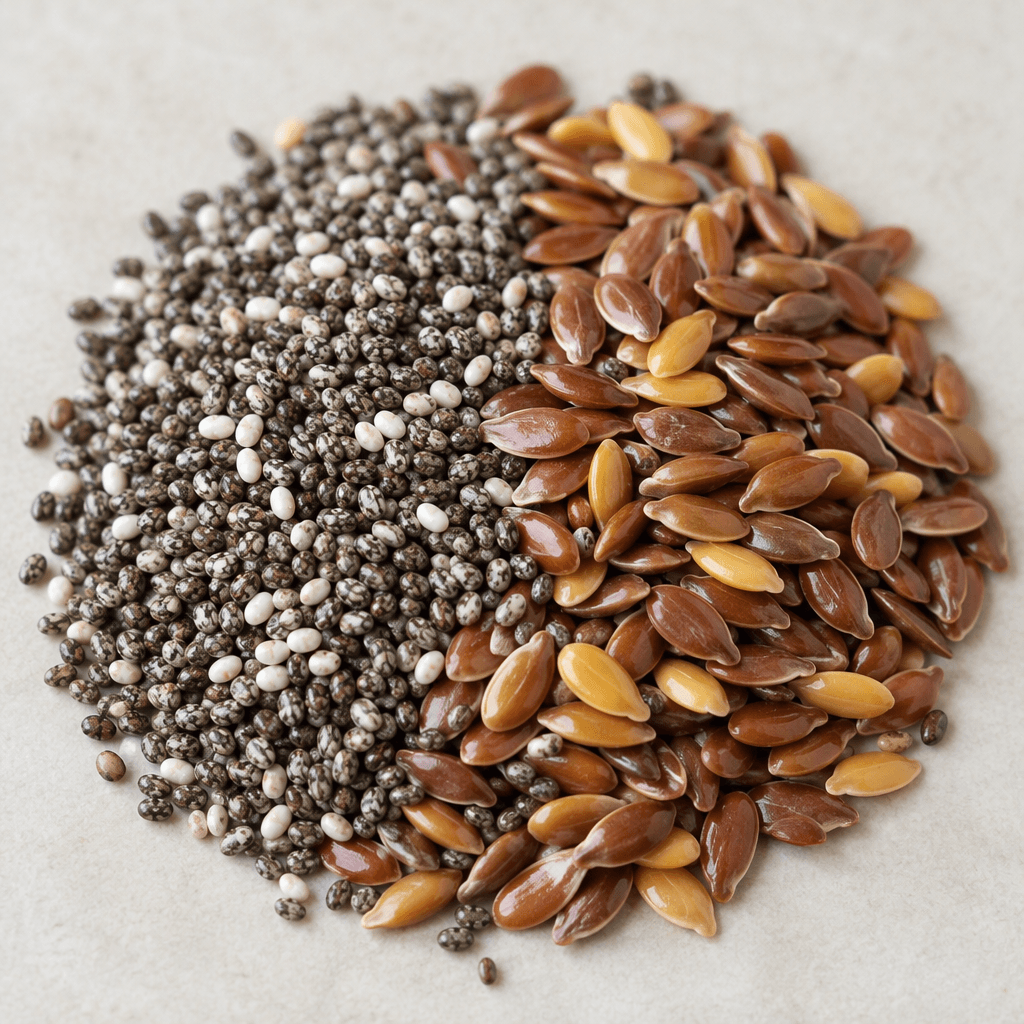
Chia and flaxseed Calories
Chia and flaxseed
In season: Spring · Summer · Autumn · Winter
CALORIES
GI
POTASSIUM
FIBER
Quick answer
2 tablespoon (medium) of Chia and flaxseed (20 g) has 96 calories. That works out to 480 calories per 100 g. It contains 3.4 g of carbs, 3.4 g of protein, 7.2 g of fat and 6.8 g of fiber. Its 0.2 mg of Copper covers 27% of the Daily Value. Its glycemic index is 2 (low), so it raises blood sugar slowly.
What is Chia and flaxseed?
Chia and flaxseed are small edible seeds from different plants. Chia comes from a plant native to Central America, while flax has been cultivated for its seeds across many regions. Both have mild, earthy flavours, though flaxseed tastes more distinctly nutty. Chia thickens into a gel when soaked; flaxseed stays more textured, especially when used whole.
They’re easy to stir into porridge, yoghurt or smoothies, or to use in baking. Soaked chia can also make a simple pudding, while ground flaxseed blends readily into batters and cereal. Both provide plenty of fibre alongside plant-based fats and some protein. For an easy everyday option, add a spoonful to yoghurt with fruit; grind flaxseed shortly before using it for a softer texture.
Chia and flaxseed Nutrition Facts
Selected: 100 g
480
KCAL / 100G
Carbs
17g
· 6% DV
Protein
17g
· 34% DV
Fat
36g
· 46% DV
Fiber
34g
· 121% DV
DV is the share of the daily value covered, on a 2,000 kcal reference diet.
Calories come from: Carbs 15% · Protein 15% · Fat 70%
Chia and flaxseed Vitamins & Minerals
Vitamins
B1
1.2mg · 100% DV
B3
8.5mg · 53% DV
B6
0.6mg · 35% DV
Folate
90µg · 23% DV
Minerals
Copper
1mg · 111% DV
Phosphorus
750mg · 107% DV
Magnesium
380mg · 90% DV
Manganese
2mg · 87% DV
How Nutritious Is Chia and flaxseed?
Nutrient density
Very high
How many vitamins, minerals and how much fiber this food carries per calorie. A high score means a lot of nutrition for few calories.
Satiety score
Medium
An EatBetter score computed from fiber, protein and calorie density. A high score means staying full longer on the same calories.
Both scores are calculated per 100 g and do not change with the selected portion. The satiety score is EatBetter's own calculation, not a clinical measure.
Chia and flaxseed Glycemic Index
GLYCEMIC INDEX
GLYCEMIC LOAD
Accounts for portion size — a more realistic measure than GI alone.
How to Burn Off Chia and flaxseed
To burn the 480 calories in 100 g:
🚶
Walking (5 km/h)
🏃
Running (8 km/h)
🚴
Cycling
🏊
Swimming
Times are calculated with the MET equation for a 70 kg adult. Actual burn varies with your weight, age and pace.
Is Chia and flaxseed Processed?
NOVA 1
Unprocessed
1. Unprocessed
2. Minimally Processed
3. Processed
4. Ultra-Processed
NOVA classifies foods into 4 groups by industrial processing. NOVA 1 (unprocessed) is the healthiest.
Does Chia and flaxseed Contain Allergens?
No known major allergens
Which Diets Is Chia and flaxseed Good For?
Vegan
✓ Suitable
Vegetarian
✓ Suitable
Gluten-Free
✓ Suitable
Dairy-Free
— Not suitable
Mediterranean
✓ Suitable
Paleo
✓ Suitable
Whole30
— Not suitable
DASH
— Not suitable
Keto
✓ Suitable
Low FODMAP
— Not suitable
Chia and flaxseed Fat Profile
SATURATED
3.5g
MONOUNSATURATED
4.5g
POLYUNSATURATED
18g
Omega 6:3 ratio 0.4:1
Below the ideal 4:1 — a good omega balance.
Compare Chia and flaxseed
Foods Similar to Chia and flaxseed
Frequently Asked Questions About Chia and flaxseed
What is the difference between chia and flaxseed?
Chia and flaxseed come from different plants and behave differently in recipes: chia forms a gel when soaked, while flaxseed has a nuttier taste and is usually ground for better nutrient availability. They can be used together, but they are not identical substitutes in every dish.
Can you eat chia and flaxseed together?
Yes, chia and flaxseed can be eaten together in foods such as oatmeal, yogurt, or smoothies. Both add substantial fiber, so increase the amount gradually and drink enough fluids to avoid digestive discomfort.
Do you need to grind flaxseed when using chia and flaxseed?
Grinding the flaxseed is usually helpful because whole flaxseeds may pass through the digestive tract largely intact. Chia seeds do not need grinding. Grind flaxseed in small batches or keep it chilled after grinding, since its oils can turn rancid.
How do you use chia and flaxseed in overnight oats?
Stir chia and flaxseed into the oats with milk or another liquid before refrigerating overnight. Chia thickens the mixture as it absorbs liquid; ground flaxseed blends more evenly than whole seeds. Add extra liquid before serving if the oats become too thick.
Can chia and flaxseed replace eggs in baking?
Yes, chia and flaxseed can each work as an egg substitute in some baked goods because they thicken when mixed with water. Use ground flaxseed for a smoother mixture; the result may be denser than a recipe made with eggs.
Should chia and flaxseed be soaked before eating?
Chia does not have to be soaked, but soaking makes it swell and develop a gel-like texture. Flaxseed does not require soaking, though ground flaxseed is easier to mix into food. Avoid swallowing a spoonful of dry chia, especially if you have difficulty swallowing.
Can chia and flaxseed be cooked or baked?
Yes, chia and flaxseed can be added to breads, muffins, porridge, and other cooked foods. Chia absorbs liquid, so it can change a batter’s consistency; ground flaxseed distributes more evenly than whole seeds. Follow the recipe’s liquid proportions and adjust if needed.
How should you store chia and flaxseed?
Keep chia and whole flaxseed in airtight containers in a cool, dry place away from sunlight. Ground flaxseed spoils more quickly because its oils are exposed to air, so refrigerate it and use it while it still smells fresh and nutty.
Can chia and flaxseed help with constipation?
Chia and flaxseed may support regular bowel movements because both contain fiber, but adding a lot at once can cause bloating. Increase them gradually and drink enough fluids; if constipation persists or is severe, seek medical advice rather than relying on seeds alone.
Can you use chia and flaxseed instead of each other in recipes?
Sometimes, but chia and flaxseed do not behave exactly alike. Chia creates a more pronounced gel, while ground flaxseed has a nuttier flavor and can make mixtures thicker. In baking or egg substitutes, the texture may change, so use a recipe designed for the seed you have.
Have another question about Chia and flaxseed?
Ask the AI nutrition coach — calories, portions, alternatives and more, answered in seconds in the app.

Scan calories with your camera
Instant AI nutrition analysis

Nutrition data compiled from USDA FoodData Central and scientific sources.