

Ready & Packaged Foods
All →Vegetables & Legumes
All →Desserts & Confectionery
All →Meat & Protein
All →Grains & Bakery
All →Beverages
All →Milk & Dairy
All →

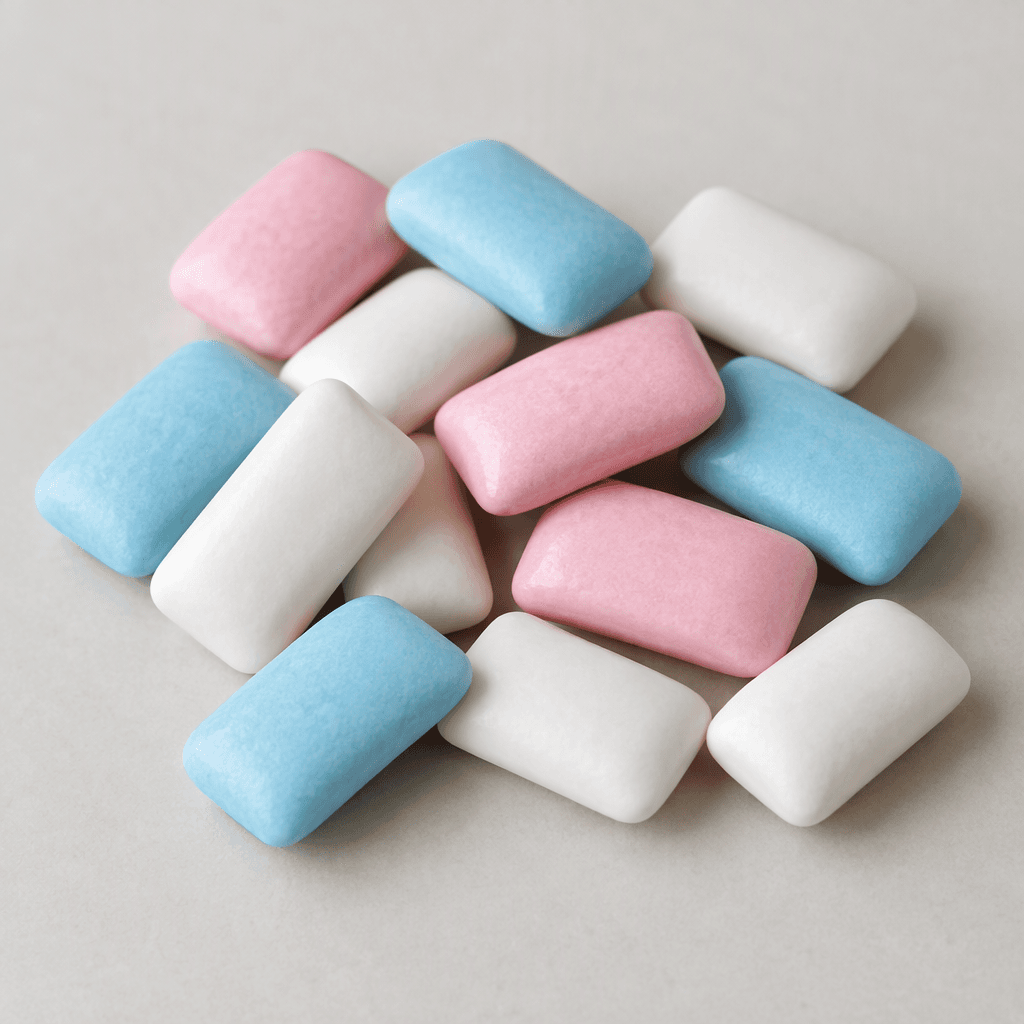
Chewing Gum Calories
Low calorie, sugary or sugar-free, dental health impact
CALORIES
GI
POTASSIUM
FIBER
Quick answer
1 piece (small) of Chewing Gum (3 g) has 8 calories. That works out to 270 calories per 100 g. It contains 2.1 g of carbs, 0 g of protein, 0 g of fat and 0 g of fiber. Its glycemic index is 80 (high), so it raises blood sugar quickly.
What is Chewing Gum?
Chewing gum is a small confection made from a chewable gum base with sweeteners and flavourings. Mint and fruit are common flavours, and it comes in both sugar-sweetened and sugar-free versions. Modern packaged gum is widely available around the world, though recipes and preferred flavours vary by market.
People usually chew it for a fresh taste, often after a meal or while travelling, then discard it rather than swallow it. The figures here show that it is mostly carbohydrate, with very little fat; the balance differs between sugared and sugar-free varieties. If you want to reduce sugar, choose a sugar-free option, and dispose of used gum in a bin rather than leaving it on a surface.
Chewing Gum Nutrition Facts
Selected: 100 g
270
KCAL / 100G
Carbs
70g
· 25% DV
Protein
0g
· 0% DV
Fat
0.5g
· 1% DV
Fiber
0g
· 0% DV
DV is the share of the daily value covered, on a 2,000 kcal reference diet.
Calories come from: Carbs 98% · Protein 0% · Fat 2%
Chewing Gum Vitamins & Minerals
Vitamins
Vitamin A
0µg · 0% DV
B1
0mg · 0% DV
B2
0mg · 0% DV
B3
0mg · 0% DV
Minerals
Calcium
2mg · 0% DV
Iron
0mg · 0% DV
Magnesium
1mg · 0% DV
Zinc
0mg · 0% DV
How Nutritious Is Chewing Gum?
Nutrient density
Low
How many vitamins, minerals and how much fiber this food carries per calorie. A high score means a lot of nutrition for few calories.
Satiety score
Low
An EatBetter score computed from fiber, protein and calorie density. A high score means staying full longer on the same calories.
Both scores are calculated per 100 g and do not change with the selected portion. The satiety score is EatBetter's own calculation, not a clinical measure.
Chewing Gum Glycemic Index
GLYCEMIC INDEX
GLYCEMIC LOAD
Accounts for portion size — a more realistic measure than GI alone.
How to Burn Off Chewing Gum
To burn the 270 calories in 100 g:
🚶
Walking (5 km/h)
🏃
Running (8 km/h)
🚴
Cycling
🏊
Swimming
Times are calculated with the MET equation for a 70 kg adult. Actual burn varies with your weight, age and pace.
Is Chewing Gum Processed?
NOVA 4
Ultra-Processed
1. Unprocessed
2. Minimally Processed
3. Processed
4. Ultra-Processed
NOVA classifies foods into 4 groups by industrial processing. NOVA 1 (unprocessed) is the healthiest.
Does Chewing Gum Contain Allergens?
No known major allergens
Which Diets Is Chewing Gum Good For?
Vegan
✓ Suitable
Vegetarian
✓ Suitable
Gluten-Free
✓ Suitable
Dairy-Free
— Not suitable
Mediterranean
— Not suitable
Paleo
— Not suitable
Whole30
— Not suitable
DASH
— Not suitable
Keto
— Not suitable
Low FODMAP
— Not suitable
Chewing Gum Fat Profile
SATURATED
0.2g
MONOUNSATURATED
0.1g
POLYUNSATURATED
0.1g
Compare Chewing Gum
Foods Similar to Chewing Gum
Frequently Asked Questions About Chewing Gum
What happens if you swallow chewing gum?
Swallowed chewing gum usually passes through your digestive system and leaves your body in your stool; it does not stay in your stomach for years. Swallowing a large amount can rarely cause a blockage, particularly in children.
Is sugar-free chewing gum good for your teeth?
Yes, sugar-free chewing gum can increase saliva after a meal, helping wash away food particles and neutralize acids. It does not replace brushing or flossing, and gum containing sugar can contribute to tooth decay.
Does chewing gum help with weight loss?
No, chewing gum alone does not cause meaningful weight loss. It may briefly distract you from snacking, but it cannot replace filling meals or other habits that support weight management.
Can chewing gum cause bloating?
Yes, chewing gum can make you swallow extra air, which may lead to belching or bloating. Sugar-free gum containing sugar alcohols such as sorbitol can also cause gas or diarrhea when you chew a lot of it.
Does chewing gum expire?
Yes, chewing gum can lose its flavor and become hard or brittle over time, even if it is not usually considered highly perishable. Keep it sealed in a cool, dry place to preserve its texture.
Does chewing gum break a fast?
Chewing gum with sugar breaks a fast because it provides sugar and calories. Sugar-free gum has very few calories, but it may still break a strict fast; avoid it if your fasting rules exclude anything besides water.
What is chewing gum made of?
Chewing gum is made with a chewable gum base, sweeteners, and flavorings; some varieties also contain softeners or colors. The gum base stays largely intact while you chew, which is why the gum does not dissolve like candy.
How do you get chewing gum out of hair?
Work a little cooking oil or olive oil into the gum and surrounding hair, then gently loosen it with your fingers or a wide-tooth comb. This helps the gum slide out without cutting or pulling the hair.
Can chewing gum improve your focus?
Chewing gum may briefly increase alertness or help some people feel more focused, but it is not a reliable way to improve concentration. The effect is short-lived and does not replace sleep or a break.
Can chewing gum damage your jaw?
Yes, frequent or prolonged chewing can overwork the jaw muscles and aggravate jaw-joint pain. If chewing gum brings on soreness, clicking, or stiffness, stop chewing it and give your jaw a rest.
Have another question about Chewing Gum?
Ask the AI nutrition coach — calories, portions, alternatives and more, answered in seconds in the app.

Scan calories with your camera
Instant AI nutrition analysis

Nutrition data compiled from USDA FoodData Central and scientific sources.