

Ready & Packaged Foods
All →Vegetables & Legumes
All →Desserts & Confectionery
All →Meat & Protein
All →Grains & Bakery
All →Beverages
All →Milk & Dairy
All →

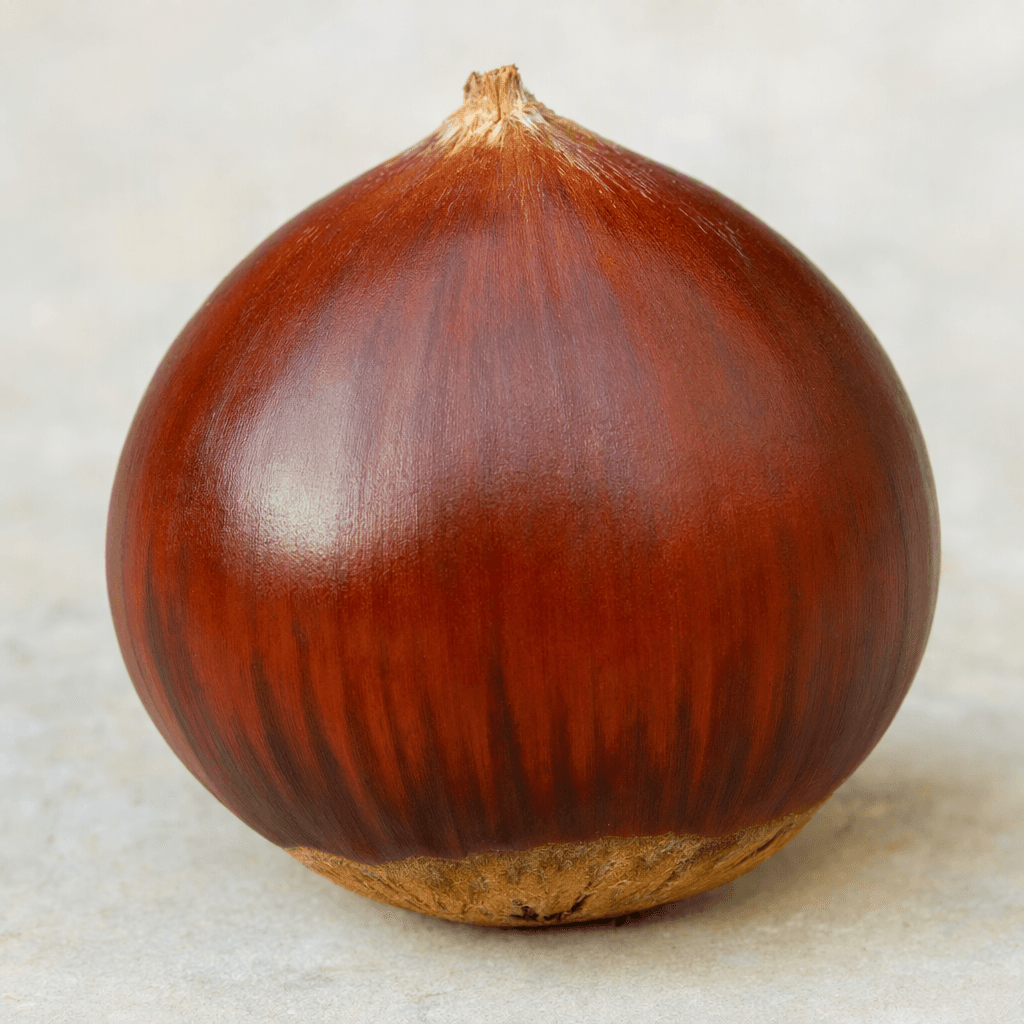
Raw Chestnut Calories
Low fat, good fiber and vitamin C source
In season: Autumn · Winter
CALORIES · 100 G
GI
POTASSIUM · 100 G
FIBER · 100 G
Quick answer
5 piece (medium) of Raw Chestnut (75 g) has 128 calories. That works out to 170 calories per 100 g. It contains 28.1 g of carbs, 1.5 g of protein, 1 g of fat and 5.6 g of fiber. Its 32.3 mg of Vitamin C covers 36% of the Daily Value. Its glycemic index is 54 (medium), so it raises blood sugar at a moderate pace.
Raw Chestnut Nutrition Facts
Selected: 5 piece (medium) · 75 g
128
KCAL / 75G
Carbs
28.1g
· 10% DV
Protein
1.5g
· 3% DV
Fat
1g
· 1% DV
Fiber
5.6g
· 20% DV
DV is the share of the daily value covered, on a 2,000 kcal reference diet.
Calories come from: Carbs 88% · Protein 5% · Fat 7%
Raw Chestnut nutrition facts table · 5 piece (medium) (75 g)
| Nutrient | Amount | % DV |
|---|---|---|
| Calories | 128 kcal | |
| Total fat | 1 g | 1% |
| Saturated fat | 0.19 g | 1% |
| Trans fat | 0 g | |
| Sodium | 2.25 mg | 0% |
| Total carbohydrate | 28.1 g | 10% |
| Fiber | 5.6 g | 20% |
| Protein | 1.5 g | 3% |
Calories: Calories measure energy. Average daily need is 2,000 kcal. Excess calories are stored as fat, too few cause weight loss.
Carbs: Your body's primary energy source. The brain runs exclusively on carbs. Daily need: 275g.
Protein: Essential for muscle repair and cell growth. Daily need: 50g. Keeps you full and boosts metabolism.
Fat: Needed for hormone production and vitamin absorption. Daily need: 78g. Limit saturated fats, choose unsaturated.
Fiber: Critical for digestive health and satiety. Daily need: 28g. Stabilizes blood sugar, lowers cholesterol.

Log this food in EatBetter
100,000+ people use it
- Get your daily calorie target
- Snap your meal, log it in seconds
- See every vitamin and mineral

📸 Scan the code to get the app free.

How Many Calories in 5 Pieces of Raw Chestnut?
| Serving | Amount | Calories |
|---|---|---|
| 5 piece (medium) | 75 g | 128 kcal |
| 1 piece (small) | 15 g | 26 kcal |
| 1 piece (large) | 25 g | 43 kcal |
| 1 serving (small) | 50 g | 85 kcal |
| 100 g | 100 g | 170 kcal |
| 1 serving (medium) | 100 g | 170 kcal |
| 1 cup (chopped) | 120 g | 204 kcal |
| 10 piece (large) | 150 g | 255 kcal |
Calculated from 170 calories per 100 g.
Frequently Asked Questions About Raw Chestnut
Can you eat raw chestnuts?
Yes, raw chestnuts can be eaten, but they are firmer and may be harder to digest than cooked chestnuts. Their flavor can also be somewhat bitter. Discard any chestnut that smells off or shows mold, and never confuse edible chestnuts with horse chestnuts.
How do you roast raw chestnuts?
To roast raw chestnuts, cut a deep slit through the shell on the rounded side, then spread them on a baking tray and roast until the shells open and the flesh softens. The slit lets steam escape and helps prevent the chestnuts from bursting.
Why do you cut raw chestnuts before roasting them?
You cut raw chestnuts before roasting to let steam escape as they heat. Without a slit through the shell, pressure can build up and make a chestnut burst in the oven. The cut also gives you a starting point for peeling it afterward.
How do you peel raw chestnuts easily?
The easiest way to peel raw chestnuts is to score the shells and cook them first by roasting or boiling. Peel them while they are still warm, removing both the hard outer shell and the thin, bitter inner skin; both are much harder to remove once cold.
How should raw chestnuts be stored?
Store raw chestnuts in a cool, dry, well-ventilated place if you plan to use them soon. For longer storage, refrigerate them in a breathable bag rather than a sealed, damp container, which can encourage mold. Remove any chestnuts that become soft or moldy.
Can you freeze raw chestnuts?
Yes, raw chestnuts can be frozen. Sort out damaged ones, dry the rest, and seal them in a freezer-safe bag with as much air removed as possible. You can cook them from frozen or thaw them first, depending on the recipe.
Are raw chestnuts the same as water chestnuts?
No, raw chestnuts and water chestnuts are different foods. Edible chestnuts are tree nuts with a firm, starchy interior inside a brown shell; water chestnuts are aquatic corms with crisp, pale flesh, often sold canned or fresh for stir-fries.
Are raw chestnuts the same as horse chestnuts?
No. Raw chestnuts sold for eating come from edible chestnut trees, while horse chestnuts are not edible and can cause poisoning. Do not eat a nut gathered from a tree unless you can confidently identify it as an edible chestnut.
Can people with diabetes eat raw chestnuts?
People with diabetes can include chestnuts in a meal, but should account for their starch and carbohydrates, whether the chestnuts are raw or cooked. Pairing a measured portion with the rest of the meal and following an individual food plan can help manage carbohydrate intake.
Do raw chestnuts need to be soaked before cooking?
No, raw chestnuts do not have to be soaked before roasting or boiling. Rinse off surface dirt, dry them, and score each shell before cooking. Soaking is optional and does not replace scoring, which allows steam to escape as the chestnuts heat.
Raw Chestnut Vitamins & Minerals
Vitamins
Vitamin C
32.25mg · 36% DV
B1
0.18mg · 15% DV
B6
0.22mg · 13% DV
Folate
46.5µg · 12% DV
Minerals
Manganese
0.83mg · 36% DV
Copper
0.3mg · 33% DV
Potassium ⭐
536mg · 16% DV
Phosphorus
53mg · 8% DV
Sodium
2.25mg · 0% DV
Raw Chestnut Glycemic Index
GLYCEMIC INDEX
GLYCEMIC LOAD
Accounts for portion size — a more realistic measure than GI alone.
How to Burn Off Raw Chestnut
To burn the 128 calories in 5 piece (medium) (75 g):
🚶
Walking (5 km/h)
🏃
Running (8 km/h)
🚴
Cycling
🏊
Swimming
Times are calculated with the MET equation for a 70 kg adult. Actual burn varies with your weight, age and pace.
What is Raw Chestnut?
Raw chestnuts are the starchy seeds of the chestnut tree, enclosed in a smooth, brown shell. Although they can be eaten raw, their firm, mildly sweet flesh is more often cooked: roasting and boiling are common, and cooked chestnuts also appear in seasonal dishes, stuffings and purées. In many places, they’re a familiar autumn and winter snack, sold hot from street stalls or prepared at home.
Roasting brings out a sweeter, drier texture, while boiling leaves them moist and tender. They’re relatively low in fat and provide carbohydrates and fibre, making them quite different from most other nuts. For a simple, lighter snack, roast or boil them without added sugar; score the shell first so it’s easier to peel after cooking.
How Nutritious Is Raw Chestnut?
Nutrient density
High
How many vitamins, minerals and how much fiber this food carries per calorie. A high score means a lot of nutrition for few calories.
Satiety score
Medium
An EatBetter score computed from fiber, protein and calorie density. A high score means staying full longer on the same calories.
Both scores are calculated per 100 g and do not change with the selected portion. The satiety score is EatBetter's own calculation, not a clinical measure.
Is Raw Chestnut Processed?
NOVA 1
Unprocessed
1. Unprocessed
2. Minimally Processed
3. Processed
4. Ultra-Processed
NOVA classifies foods into 4 groups by industrial processing. NOVA 1 (unprocessed) is the healthiest.
Does Raw Chestnut Contain Allergens?
No known major allergens
Which Diets Is Raw Chestnut Good For?
Vegan
✓ Suitable
Vegetarian
✓ Suitable
Gluten-Free
✓ Suitable
Dairy-Free
— Not suitable
Mediterranean
✓ Suitable
Paleo
✓ Suitable
Whole30
— Not suitable
DASH
— Not suitable
Keto
— Not suitable
Low FODMAP
— Not suitable
Raw Chestnut Fat Profile
SATURATED
0.19g
MONOUNSATURATED
0.38g
POLYUNSATURATED
0.3g
Omega 6:3 ratio 13:1
Above the ideal 4:1 (13:1).
Compare Raw Chestnut
Foods Similar to Raw Chestnut
Have another question about Raw Chestnut?
Ask the AI nutrition coach — calories, portions, alternatives and more, answered in seconds in the app.

Scan calories with your camera
Instant AI nutrition analysis

Nutrition data compiled from USDA FoodData Central and scientific sources.