

Ready & Packaged Foods
All →Vegetables & Legumes
All →Desserts & Confectionery
All →Meat & Protein
All →Grains & Bakery
All →Beverages
All →Milk & Dairy
All →

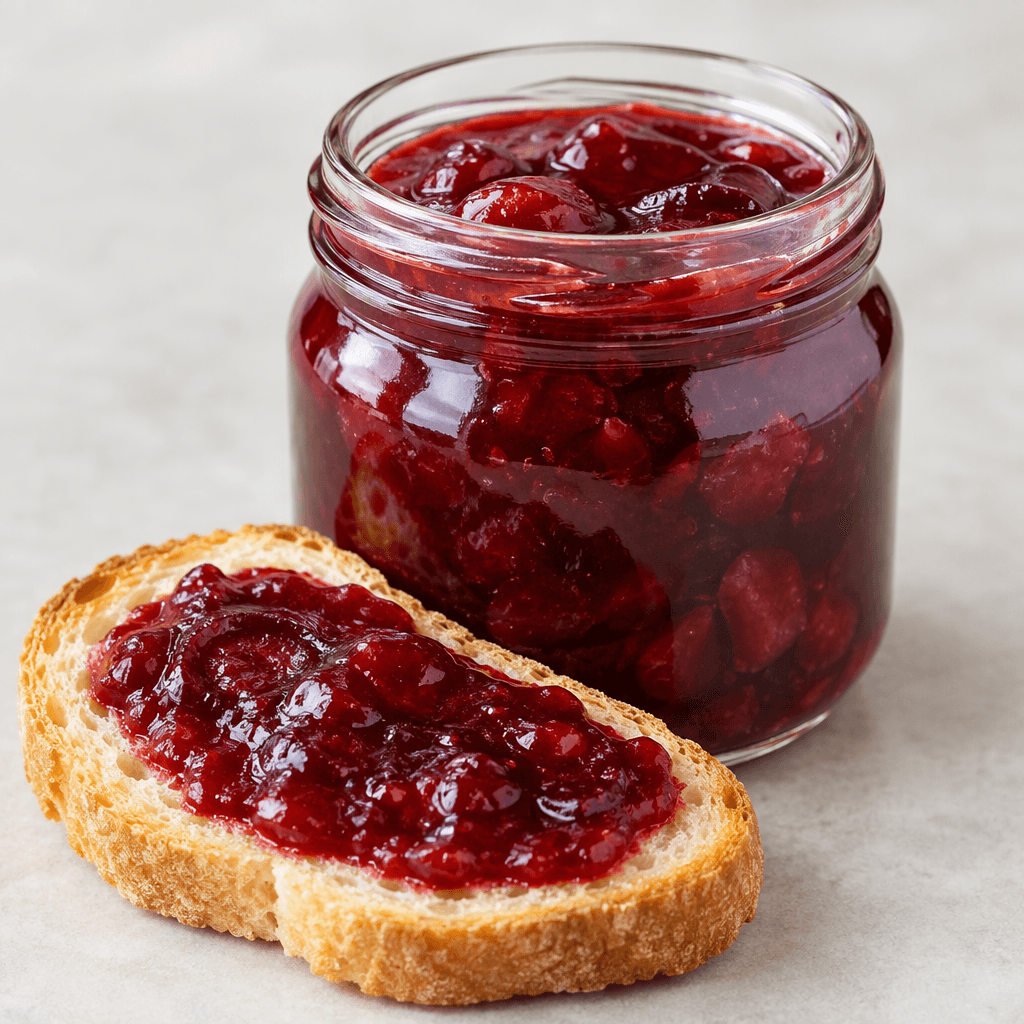
Cherry jam Calories
Sweet, fruity, breakfast spread
In season: Summer
CALORIES
GI
POTASSIUM
FIBER
Quick answer
1 tablespoon (medium) of Cherry jam (20 g) has 52 calories. That works out to 260 calories per 100 g. It contains 13 g of carbs, 0.1 g of protein, 0 g of fat and 0.2 g of fiber. Its glycemic index is 65 (high), so it raises blood sugar quickly.
What is Cherry jam?
Cherry jam is a fruit preserve made by simmering cherries with sugar until soft and thick; some versions keep whole or partly softened pieces of fruit. It is made in many places where cherries grow, with recipes varying from smooth to chunky.
Its sweet, fruity flavour and spoonable texture make it a familiar spread for toast, bread and scones, and it can also be stirred into porridge or plain yoghurt. It is mostly carbohydrate, with very little protein or fat, so a small spoonful adds sweetness rather than much nourishment. For a less-sweet breakfast, spread it thinly and pair it with plain yoghurt or another unsweetened food.
Cherry jam Nutrition Facts
Selected: 100 g
260
KCAL / 100G
Carbs
65g
· 24% DV
Protein
0.4g
· 1% DV
Fat
0.1g
· 0% DV
Fiber
1.2g
· 4% DV
DV is the share of the daily value covered, on a 2,000 kcal reference diet.
Calories come from: Carbs 99% · Protein 1% · Fat 0%
Cherry jam Vitamins & Minerals
Vitamins
B2
0.02mg · 2% DV
B5
0.08mg · 2% DV
B6
0.04mg · 2% DV
Vitamin C
2mg · 2% DV
Minerals
Magnesium
7mg · 2% DV
Potassium ⭐
60mg · 2% DV
Calcium
12mg · 1% DV
Phosphorus
10mg · 1% DV
How Nutritious Is Cherry jam?
Nutrient density
Low
How many vitamins, minerals and how much fiber this food carries per calorie. A high score means a lot of nutrition for few calories.
Satiety score
Low
An EatBetter score computed from fiber, protein and calorie density. A high score means staying full longer on the same calories.
Both scores are calculated per 100 g and do not change with the selected portion. The satiety score is EatBetter's own calculation, not a clinical measure.
Cherry jam Glycemic Index
GLYCEMIC INDEX
GLYCEMIC LOAD
Accounts for portion size — a more realistic measure than GI alone.
How to Burn Off Cherry jam
To burn the 260 calories in 100 g:
🚶
Walking (5 km/h)
🏃
Running (8 km/h)
🚴
Cycling
🏊
Swimming
Times are calculated with the MET equation for a 70 kg adult. Actual burn varies with your weight, age and pace.
Is Cherry jam Processed?
NOVA 3
Processed
1. Unprocessed
2. Minimally Processed
3. Processed
4. Ultra-Processed
NOVA classifies foods into 4 groups by industrial processing. NOVA 1 (unprocessed) is the healthiest.
Does Cherry jam Contain Allergens?
No known major allergens
Which Diets Is Cherry jam Good For?
Vegan
✓ Suitable
Vegetarian
✓ Suitable
Gluten-Free
— Not suitable
Dairy-Free
— Not suitable
Mediterranean
✓ Suitable
Paleo
— Not suitable
Whole30
— Not suitable
DASH
— Not suitable
Keto
— Not suitable
Low FODMAP
— Not suitable
Cherry jam Fat Profile
SATURATED
0.01g
MONOUNSATURATED
0.02g
POLYUNSATURATED
0.04g
Omega 6:3 ratio 3:1
Below the ideal 4:1 — a good omega balance.
Compare Cherry jam
Foods Similar to Cherry jam
Frequently Asked Questions About Cherry jam
How do you make cherry jam?
Cherry jam is made by cooking pitted cherries with sugar until the fruit softens and the mixture thickens. Stir as it simmers, skim off any foam, and add lemon juice near the end. Spoon it into clean jars while hot.
Does cherry jam need pectin?
No, cherry jam can set without added pectin, although cherries are naturally relatively low in it. Lemon juice helps the mixture set, and simmering it until it reaches the desired thickness gives a softer, fruit-forward jam.
Why is my cherry jam runny?
Cherry jam is often runny because it has not been cooked long enough for excess liquid to evaporate or has not cooled completely. Simmer it a little longer, then test a small amount on a chilled plate; it thickens further as it cools.
Do you have to pit cherries to make cherry jam?
Yes, cherries are usually pitted before making cherry jam so the finished spread is easy and safe to eat. A cherry pitter speeds up the job, but you can also halve each cherry and remove the pit with a small knife.
Can you make cherry jam with frozen cherries?
Yes, frozen cherries work for cherry jam. Thaw them first and include their juice in the pot, since it contains flavor; the extra liquid may mean the jam needs a little longer to simmer and thicken.
Why does cherry jam crystallize?
Cherry jam can crystallize when undissolved sugar remains on the pan or jar, or when too much water evaporates during cooking. Stir until the sugar dissolves, avoid scraping dry crystals from the sides into the mixture, and do not overcook the jam.
How do you know when cherry jam is set?
Cherry jam is ready when a small spoonful wrinkles after being cooled on a chilled plate. It should still look slightly loose in the pot, because the jam thickens as it cools in the jar.
How long does homemade cherry jam last after opening?
Keep opened homemade cherry jam refrigerated and use a clean spoon each time. Discard it if you see mold, notice fermentation or an unusual smell, rather than scraping the affected surface and eating the rest.
What can you eat with cherry jam besides toast?
Cherry jam goes well with yogurt, oatmeal, pancakes, waffles, and soft cheeses. You can also stir a spoonful into cake fillings or use it as a topping for ice cream, where its tart-sweet fruit flavor balances creamy desserts.
Can you make cherry jam with less sugar?
Yes, cherry jam can be made with less sugar, but it may taste tarter and set less firmly than a traditional batch. Sugar also helps preserve jam, so refrigerate a reduced-sugar version and use it sooner.
Have another question about Cherry jam?
Ask the AI nutrition coach — calories, portions, alternatives and more, answered in seconds in the app.

Scan calories with your camera
Instant AI nutrition analysis

Nutrition data compiled from USDA FoodData Central and scientific sources.