

Ready & Packaged Foods
All →Vegetables & Legumes
All →Desserts & Confectionery
All →Meat & Protein
All →Grains & Bakery
All →Beverages
All →Milk & Dairy
All →

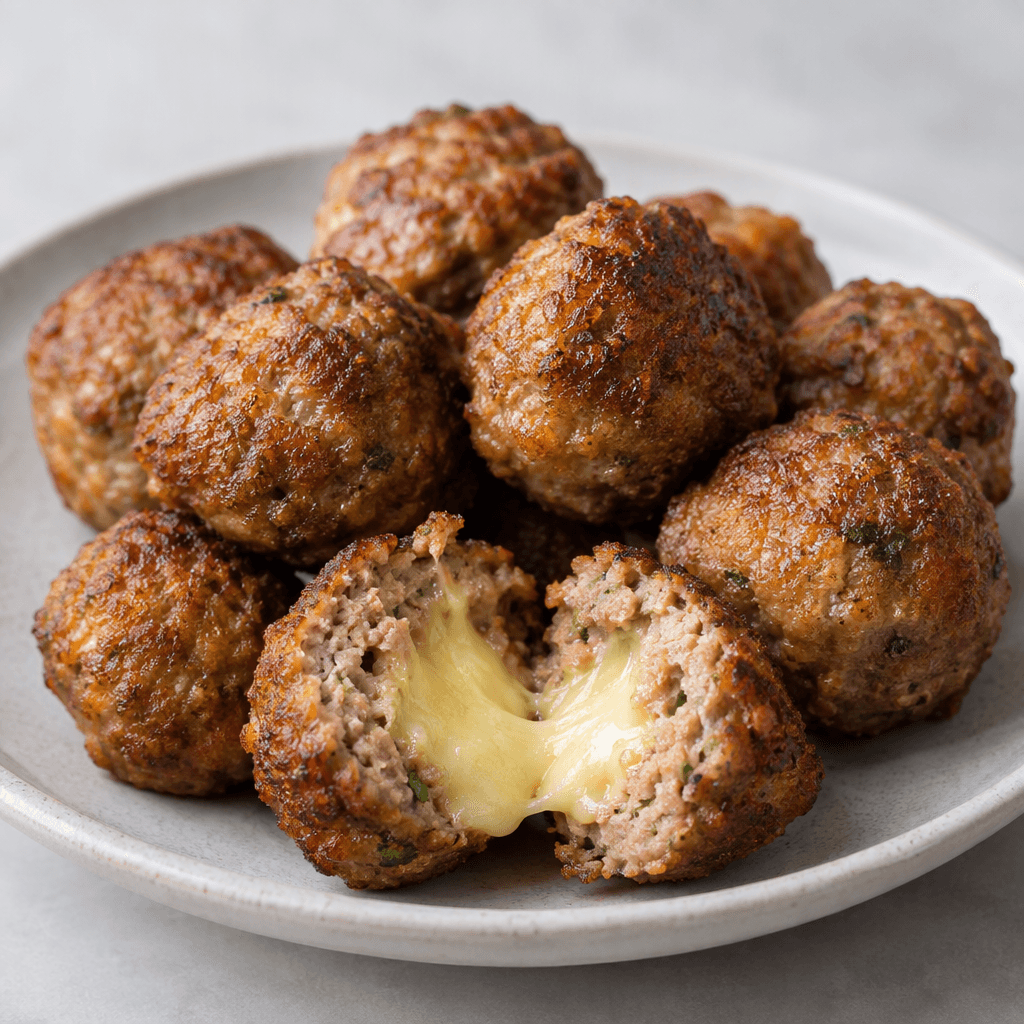
Cheese Meatball Calories
Rich in protein and calcium, hearty main dish
In season: Spring · Summer · Autumn · Winter
CALORIES
GI
POTASSIUM
FIBER
Quick answer
3 piece (medium) of Cheese Meatball (120 g) has 276 calories. That works out to 230 calories per 100 g. It contains 7.2 g of carbs, 19.2 g of protein, 18 g of fat and 0.8 g of fiber. Its 1.6 µg of B12 covers 65% of the Daily Value. Its glycemic index is 35 (low), so it raises blood sugar slowly.
What is Cheese Meatball?
Cheese Meatball is a Turkish-style meatball made from seasoned ground meat with kaşar, a mild Turkish cheese, tucked inside or worked into the mixture. It is cooked until browned on the outside, with the cheese turning soft and yielding in the middle. The exact shape and seasoning vary from one home or restaurant to another.
Serve it hot, when the cheese is still melted, with rice, potatoes or a crisp salad for a hearty main meal. Smaller pieces can also be shared as part of a spread. It is filling and provides protein; a 100 g portion has 16 g. For a lighter plate, bake the meatballs rather than frying them and pair them with vegetables.
Cheese Meatball Nutrition Facts
Selected: 100 g
230
KCAL / 100G
Carbs
6g
· 2% DV
Protein
16g
· 32% DV
Fat
15g
· 19% DV
Fiber
0.7g
· 3% DV
DV is the share of the daily value covered, on a 2,000 kcal reference diet.
Calories come from: Carbs 11% · Protein 29% · Fat 60%
Cheese Meatball Vitamins & Minerals
Vitamins
B12
1.3µg · 54% DV
B2
0.22mg · 17% DV
B5
0.8mg · 16% DV
Biotin
4.5µg · 15% DV
Minerals
Zinc
3mg · 27% DV
Phosphorus
180mg · 26% DV
Calcium
210mg · 21% DV
Sodium
480mg · 21% DV
How Nutritious Is Cheese Meatball?
Nutrient density
Medium
How many vitamins, minerals and how much fiber this food carries per calorie. A high score means a lot of nutrition for few calories.
Satiety score
Medium
An EatBetter score computed from fiber, protein and calorie density. A high score means staying full longer on the same calories.
Both scores are calculated per 100 g and do not change with the selected portion. The satiety score is EatBetter's own calculation, not a clinical measure.
Cheese Meatball Glycemic Index
GLYCEMIC INDEX
GLYCEMIC LOAD
Accounts for portion size — a more realistic measure than GI alone.
How to Burn Off Cheese Meatball
To burn the 230 calories in 100 g:
🚶
Walking (5 km/h)
🏃
Running (8 km/h)
🚴
Cycling
🏊
Swimming
Times are calculated with the MET equation for a 70 kg adult. Actual burn varies with your weight, age and pace.
Is Cheese Meatball Processed?
NOVA 3
Processed
1. Unprocessed
2. Minimally Processed
3. Processed
4. Ultra-Processed
NOVA classifies foods into 4 groups by industrial processing. NOVA 1 (unprocessed) is the healthiest.
Does Cheese Meatball Contain Allergens?
Contains these allergens:
Which Diets Is Cheese Meatball Good For?
Vegan
— Not suitable
Vegetarian
— Not suitable
Gluten-Free
— Not suitable
Dairy-Free
— Not suitable
Mediterranean
✓ Suitable
Paleo
— Not suitable
Whole30
— Not suitable
DASH
— Not suitable
Keto
— Not suitable
Low FODMAP
— Not suitable
Cheese Meatball Fat Profile
SATURATED
7.2g
MONOUNSATURATED
5.3g
POLYUNSATURATED
0.6g
Omega 6:3 ratio 2.8:1
Below the ideal 4:1 — a good omega balance.
Compare Cheese Meatball
Foods Similar to Cheese Meatball
Frequently Asked Questions About Cheese Meatball
How do you make cheese meatballs?
Cheese meatballs are made by wrapping seasoned ground meat around small pieces of cheese, then cooking them until browned and cooked through. Seal the meat completely around the filling so the cheese stays inside. You can pan-fry, bake, or grill them.
What cheese works best in cheese meatballs?
A mild, semi-hard cheese that melts well works best in cheese meatballs. Kaşar, the cheese traditionally used in this Turkish dish, gives a creamy centre without an overpowering flavor. Cut it into small pieces so you can seal the meat around it easily.
How do you stop cheese from leaking out of cheese meatballs?
Seal the cheese completely inside each cheese meatball, with no cracks or thin spots in the meat. Use a modest piece of filling, press the seams firmly closed, and chill the shaped meatballs before cooking. Turn them gently rather than piercing them with a fork.
Can you bake cheese meatballs instead of frying them?
Yes, you can bake cheese meatballs instead of frying them. Arrange them with space between each one on a baking tray so they brown evenly. Check that the meat is cooked through, and avoid overcooking, which can make the meat dry and cause the cheese to escape.
What should you serve with cheese meatballs?
Cheese meatballs pair well with roasted potatoes, rice, or a simple green salad. Roasted vegetables or a tomato-based sauce also work well, while a crisp salad can balance the rich, melted filling. Choose sides that suit how the meatballs are seasoned.
Are cheese meatballs made with beef or pork?
Cheese meatballs can be made with beef, pork, or a mixture, depending on the recipe. Turkish kaşarlı köfte is commonly made with beef, sometimes mixed with lamb. Choose a ground meat with some fat so the cooked meatballs are less likely to turn dry.
Can you grill cheese meatballs?
Yes, you can grill cheese meatballs, but they need to be sealed well so the filling does not leak onto the grill. Use a grill basket or cook them over a less intense part of the grill, and turn them gently once they hold their shape.
Can you freeze cheese meatballs?
Yes, uncooked cheese meatballs can be frozen. Arrange them separately until firm, then transfer them to a sealed freezer container so they do not stick together. Thaw them in the refrigerator before cooking, rather than leaving raw meat at room temperature.
How long do cooked cheese meatballs keep in the fridge?
Cooked cheese meatballs keep in the refrigerator for three to four days when placed in a covered container within two hours of cooking. Keep the fridge cold and discard them if their smell or appearance changes. Reheat only the portion you plan to eat.
How do you reheat cheese meatballs without drying them out?
Reheat cheese meatballs gently in a covered pan or oven so moisture stays around the meat. Warm them until the centre is hot, without leaving them on the heat longer than needed. A microwave works too; use short bursts because the cheese can become very hot.
Have another question about Cheese Meatball?
Ask the AI nutrition coach — calories, portions, alternatives and more, answered in seconds in the app.

Scan calories with your camera
Instant AI nutrition analysis

Nutrition data compiled from USDA FoodData Central and scientific sources.