

Ready & Packaged Foods
All →Vegetables & Legumes
All →Desserts & Confectionery
All →Meat & Protein
All →Grains & Bakery
All →Beverages
All →Milk & Dairy
All →

Pecans Calories
Rich in healthy fats, minerals, vitamin E, and manganese
In season: Autumn · Winter
CALORIES
GI
POTASSIUM
FIBER
Quick answer
1 ounce (medium) of Pecans (28 g) has 193 calories. That works out to 691 calories per 100 g. It contains 3.9 g of carbs, 2.6 g of protein, 20.2 g of fat and 2.7 g of fiber. Its 1.3 mg of Manganese covers 55% of the Daily Value. Its glycemic index is 10 (low), so it raises blood sugar slowly.
What is Pecans?
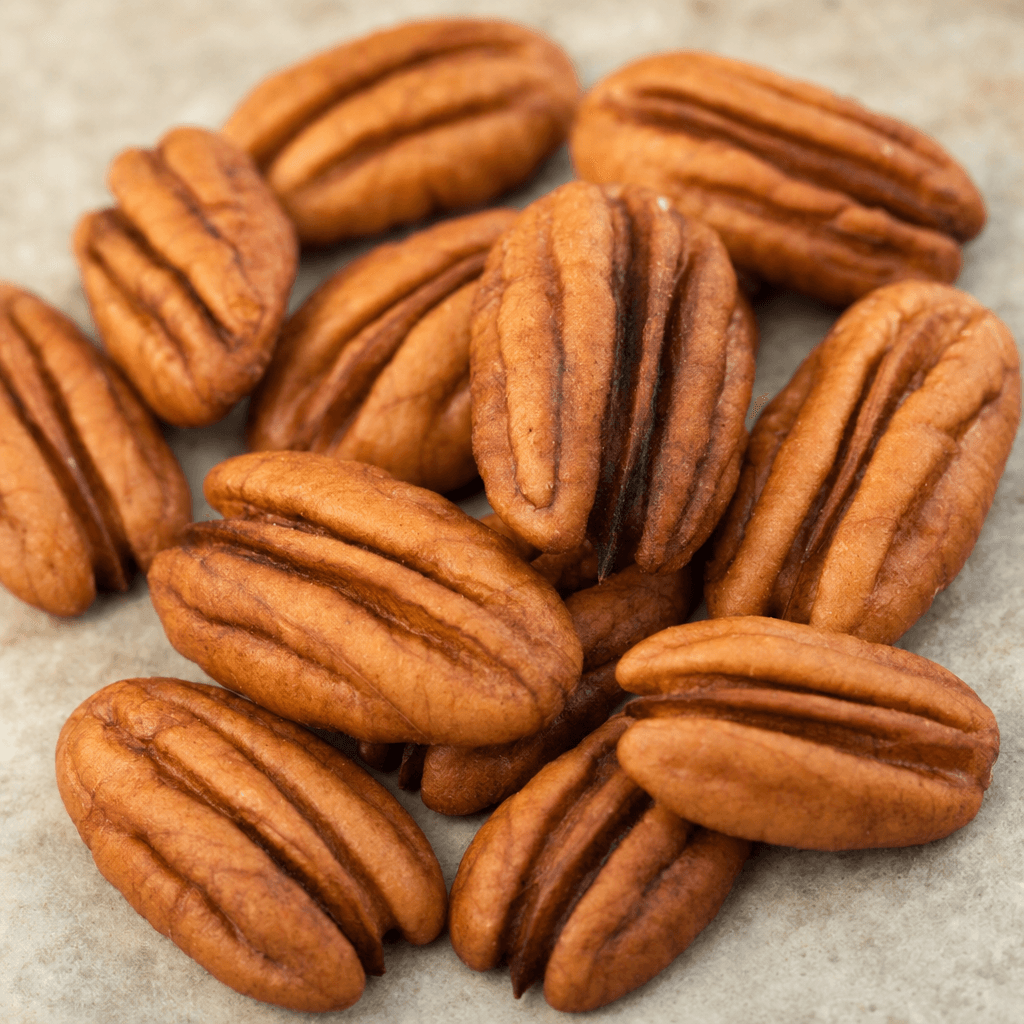
Pecans are the edible kernels of an elongated, ridged-shelled tree nut native to North America. Their flavour is naturally sweet and buttery, with a tender crunch; they’re sold raw or roasted, often whole or chopped.
In the United States, pecans are especially familiar in pies and other baked desserts, but they also work well in salads, oatmeal and savoury dishes. In other English-speaking kitchens, try a small handful as a snack or scatter them over yoghurt. They’re rich in fats and provide fibre, so a modest portion can be satisfying; pair them with fresh fruit for a simple snack.
Pecans Nutrition Facts
Selected: 100 g
691
KCAL / 100G
Carbs
13.9g
· 5% DV
Protein
9.2g
· 18% DV
Fat
72g
· 92% DV
Fiber
9.6g
· 34% DV
DV is the share of the daily value covered, on a 2,000 kcal reference diet.
Calories come from: Carbs 8% · Protein 5% · Fat 87%
Pecans Vitamins & Minerals
Vitamins
B1
0.66mg · 55% DV
Biotin
9.5µg · 32% DV
B5
0.86mg · 17% DV
B6
0.21mg · 12% DV
Minerals
Manganese
5mg · 217% DV
Copper
1mg · 111% DV
Zinc
5mg · 45% DV
Phosphorus
277mg · 40% DV
How Nutritious Is Pecans?
Nutrient density
High
How many vitamins, minerals and how much fiber this food carries per calorie. A high score means a lot of nutrition for few calories.
Satiety score
Medium
An EatBetter score computed from fiber, protein and calorie density. A high score means staying full longer on the same calories.
Both scores are calculated per 100 g and do not change with the selected portion. The satiety score is EatBetter's own calculation, not a clinical measure.
Pecans Glycemic Index
GLYCEMIC INDEX
GLYCEMIC LOAD
Accounts for portion size — a more realistic measure than GI alone.
How to Burn Off Pecans
To burn the 691 calories in 100 g:
🚶
Walking (5 km/h)
🏃
Running (8 km/h)
🚴
Cycling
🏊
Swimming
Times are calculated with the MET equation for a 70 kg adult. Actual burn varies with your weight, age and pace.
Is Pecans Processed?
NOVA 1
Unprocessed
1. Unprocessed
2. Minimally Processed
3. Processed
4. Ultra-Processed
NOVA classifies foods into 4 groups by industrial processing. NOVA 1 (unprocessed) is the healthiest.
Does Pecans Contain Allergens?
Contains these allergens:
Which Diets Is Pecans Good For?
Vegan
✓ Suitable
Vegetarian
✓ Suitable
Gluten-Free
✓ Suitable
Dairy-Free
— Not suitable
Mediterranean
✓ Suitable
Paleo
✓ Suitable
Whole30
— Not suitable
DASH
— Not suitable
Keto
— Not suitable
Low FODMAP
— Not suitable
Pecans Fat Profile
SATURATED
6.2g
MONOUNSATURATED
40.8g
POLYUNSATURATED
21.6g
Omega 6:3 ratio 20.8:1
Above the ideal 4:1 (20.8:1).
Compare Pecans
Foods Similar to Pecans
Frequently Asked Questions About Pecans
What are pecans?
Pecans are the edible nuts of a North American hickory tree, with a smooth, rich, mildly sweet flavor. They can be eaten raw or toasted and are commonly used in baking, salads, and savory dishes.
Are pecans and walnuts the same thing?
No. Pecans and walnuts come from different trees and have different flavors and shapes. Pecans are typically longer, sweeter, and more buttery, while English walnuts have a more pronounced, slightly bitter taste.
Can you eat pecans raw?
Yes, pecans can be eaten raw; they do not need to be cooked first. Add the kernels to oatmeal, yogurt, or salads, or eat them as a snack. Discard any that smell rancid or stale.
How do you crack pecan shells?
Use a nutcracker to squeeze a pecan near the middle of its shell, applying enough pressure to split it without crushing the kernel. Remove shell fragments before eating, since the thin pieces can be easy to miss.
How should you store pecans?
Store pecans in an airtight container in a cool, dark place. Their high oil content makes them prone to going rancid, so refrigeration is a better choice for longer storage, especially in a warm kitchen.
Can you freeze pecans?
Yes, pecans freeze well. Put the kernels in an airtight, freezer-safe container to protect them from moisture and odors. Take out only what you need, then thaw it before using in recipes or eating.
How do you toast pecans?
Toast pecans in a dry skillet over moderate heat or spread them on a baking sheet in the oven. Stir or turn them frequently, since their oils make them prone to burning; remove them as soon as they smell fragrant.
What are pecans used for besides pecan pie?
Pecans work well in cookies, granola, salads, and roasted vegetables, as well as in pecan pie. Their sweet, buttery flavor pairs especially well with apples, cinnamon, maple, and sharp cheeses.
Are pecans good for you?
Yes, pecans provide unsaturated fats, minerals, vitamin E, and manganese. They are also energy-dense, so a modest portion is a practical choice when you want to include them as part of a snack or meal.
Can dogs eat pecans?
No, it is best not to give pecans to dogs. They can pose a choking risk, and moldy nuts may contain toxins; the high fat content can also upset a dog’s stomach. Contact a veterinarian if your dog has eaten them and seems unwell.
Have another question about Pecans?
Ask the AI nutrition coach — calories, portions, alternatives and more, answered in seconds in the app.

Scan calories with your camera
Instant AI nutrition analysis

Nutrition data compiled from USDA FoodData Central and scientific sources.