

Ready & Packaged Foods
All →Vegetables & Legumes
All →Desserts & Confectionery
All →Meat & Protein
All →Grains & Bakery
All →Beverages
All →Milk & Dairy
All →

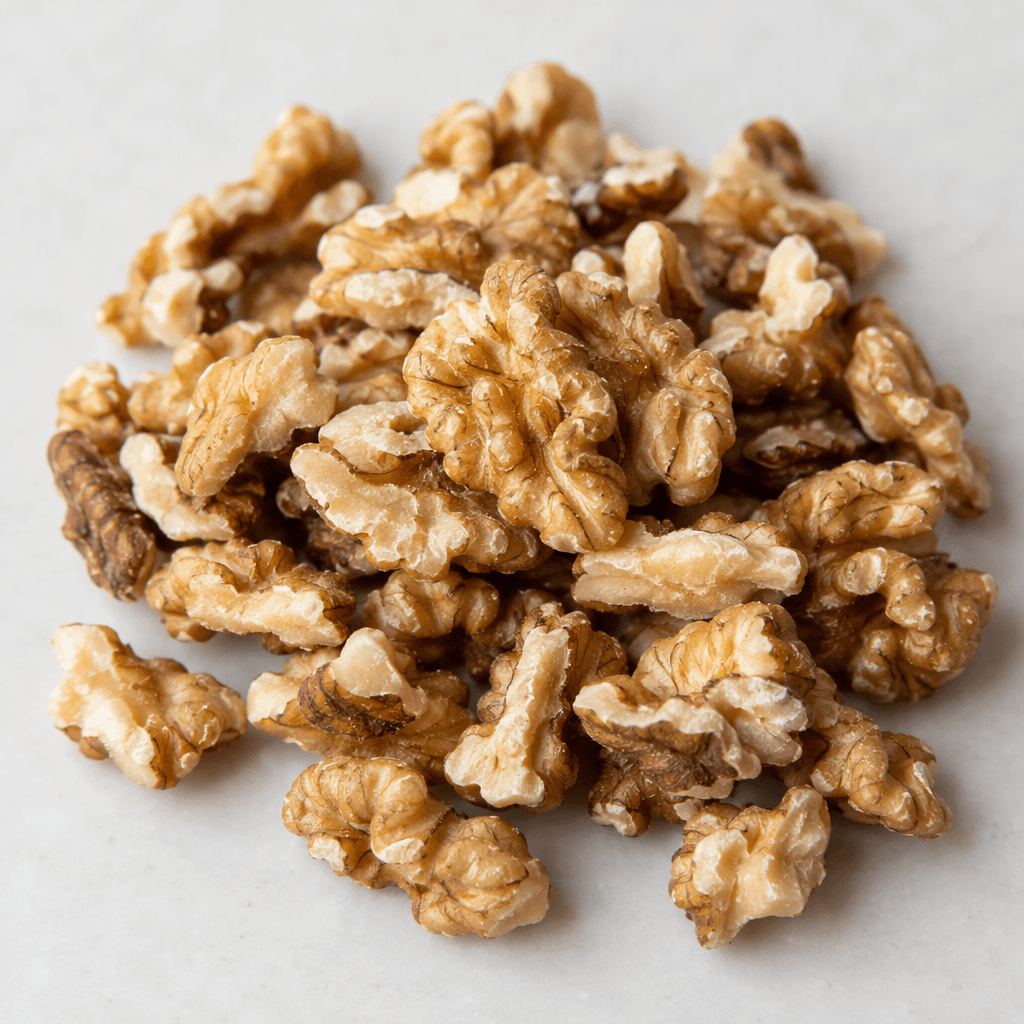
Walnut pieces Calories
Rich in omega-3, healthy fats, protein source
In season: Autumn · Winter
CALORIES · 100 G
GI
POTASSIUM · 100 G
FIBER · 100 G
Quick answer
1 piece (medium) of Walnut pieces (30 g) has 196 calories. That works out to 654 calories per 100 g. It contains 4.1 g of carbs, 4.6 g of protein, 19.6 g of fat and 2 g of fiber. Its 0.5 mg of Copper covers 53% of the Daily Value. Its glycemic index is 15 (low), so it raises blood sugar slowly.
Walnut pieces Nutrition Facts
Selected: 1 piece (medium) · 30 g
196
KCAL / 30G
Carbs
4.1g
· 1% DV
Protein
4.6g
· 9% DV
Fat
19.6g
· 25% DV
Fiber
2g
· 7% DV
DV is the share of the daily value covered, on a 2,000 kcal reference diet.
Calories come from: Carbs 8% · Protein 9% · Fat 83%
Walnut pieces nutrition facts table · 1 piece (medium) (30 g)
| Nutrient | Amount | % DV |
|---|---|---|
| Calories | 196 kcal | |
| Total fat | 19.6 g | 25% |
| Saturated fat | 1.83 g | 9% |
| Trans fat | 0 g | |
| Sodium | 0.6 mg | 0% |
| Total carbohydrate | 4.1 g | 1% |
| Fiber | 2 g | 7% |
| Protein | 4.6 g | 9% |
Calories: Calories measure energy. Average daily need is 2,000 kcal. Excess calories are stored as fat, too few cause weight loss.
Carbs: Your body's primary energy source. The brain runs exclusively on carbs. Daily need: 275g.
Protein: Essential for muscle repair and cell growth. Daily need: 50g. Keeps you full and boosts metabolism.
Fat: Needed for hormone production and vitamin absorption. Daily need: 78g. Limit saturated fats, choose unsaturated.
Fiber: Critical for digestive health and satiety. Daily need: 28g. Stabilizes blood sugar, lowers cholesterol.

Log this food in EatBetter
100,000+ people use it
- Get your daily calorie target
- Snap your meal, log it in seconds
- See every vitamin and mineral

📸 Scan the code to get the app free.

How Many Calories in 1 Medium Walnut pieces?
| Serving | Amount | Calories |
|---|---|---|
| 1 piece (medium) | 30 g | 196 kcal |
| 1 tablespoon (chopped) | 8 g | 52 kcal |
| 1 piece (small) | 10 g | 65 kcal |
| 1 serving (medium) | 28 g | 183 kcal |
| 1 cup (chopped) | 30 g | 196 kcal |
| 1 piece (large) | 50 g | 327 kcal |
| 1 serving (large) | 50 g | 327 kcal |
| 1 cup (whole) | 80 g | 523 kcal |
| 100 g | 100 g | 654 kcal |
| 1 pack (medium) | 100 g | 654 kcal |
| 1 pack (large) | 200 g | 1308 kcal |
Calculated from 654 calories per 100 g.
Frequently Asked Questions About Walnut pieces
How should you store walnut pieces?
Store walnut pieces in an airtight container in a cool, dark place. Their oils can turn stale when exposed to heat, light, and air, so refrigerate them if you want to keep them fresh for longer.
Can you freeze walnut pieces?
Yes, walnut pieces freeze well. Seal them in a freezer-safe airtight bag or container, removing as much air as possible. Take out only what you need and let it thaw; avoid repeatedly thawing and refreezing them.
How do you toast walnut pieces?
Toast walnut pieces in a dry skillet over low to medium heat, stirring often until fragrant. They brown faster than whole walnuts, so watch them closely and transfer them off the hot pan as soon as they smell toasted.
How do you stop walnut pieces from sinking in a cake?
Toss walnut pieces with a little of the recipe’s flour before folding them into the batter at the end. This can help distribute them, though very thin batter may still let them sink; larger pieces can also hold their position better.
Can walnut pieces replace pecans in a recipe?
Yes, walnut pieces can replace pecans in most baked goods and toppings. They have a more pronounced, slightly bitter flavor, so the finished recipe may taste less sweet and more earthy than it would with pecans.
Can you add walnut pieces to oatmeal?
Yes, walnut pieces work well in oatmeal. Stir them in near the end of cooking for a softer texture, or sprinkle them on just before serving to keep them crunchy. They also pair well with fruit and cinnamon.
Can walnut pieces be used in pesto?
Yes, walnut pieces can stand in for pine nuts in pesto. Blend them with basil, garlic, cheese, and olive oil, then taste before adding extra salt; walnuts bring a deeper, more robust flavor than pine nuts.
Do walnut pieces need to be soaked before eating?
No, walnut pieces do not need soaking before you eat them. Soaking softens their texture and can make them easier to blend into sauces, but it is not necessary for ordinary snacking or cooking.
Are walnut pieces safe to eat raw?
Yes, walnut pieces can be eaten raw. Choose pieces that smell fresh and have no signs of dampness or mold; if they smell sharply rancid or taste unpleasantly bitter, discard them rather than trying to mask the flavor.
Are walnut pieces good for weight loss?
Walnut pieces can fit into a weight-loss eating plan, especially when they replace less filling toppings or snacks. They are energy-dense, so adding large handfuls on top of usual meals can make it harder to maintain a calorie deficit.
Walnut pieces Vitamins & Minerals
Vitamins
Biotin
5.7µg · 19% DV
B6
0.16mg · 9% DV
B1
0.1mg · 8% DV
Folate
29.4µg · 7% DV
Minerals
Copper
0.48mg · 53% DV
Manganese
1.02mg · 44% DV
Phosphorus
104mg · 15% DV
Magnesium
47mg · 11% DV
Potassium ⭐
132mg · 4% DV
Sodium
0.6mg · 0% DV
Walnut pieces Glycemic Index
GLYCEMIC INDEX
GLYCEMIC LOAD
Accounts for portion size — a more realistic measure than GI alone.
How to Burn Off Walnut pieces
To burn the 196 calories in 1 piece (medium) (30 g):
🚶
Walking (5 km/h)
🏃
Running (8 km/h)
🚴
Cycling
🏊
Swimming
Times are calculated with the MET equation for a 70 kg adult. Actual burn varies with your weight, age and pace.
What is Walnut pieces?
Walnut pieces are chopped kernels of the walnut tree’s fruit, used as a pantry ingredient for both sweet and savoury dishes. They have a rich, earthy flavour, a slight bitterness and a pleasantly crunchy bite. Sprinkle them over porridge, yoghurt or salads, fold them into cakes and breads, or use them in sauces and baked goods. In Turkey and across the Mediterranean, walnuts also feature in dishes such as baklava; elsewhere, they are a familiar addition to breakfasts and snacks.
They are rich in unsaturated fats, including plant-based omega-3, and also provide fibre and protein. A small handful with fruit makes a substantial snack, while toasting briefly can deepen their flavour.
How Nutritious Is Walnut pieces?
Nutrient density
Very high
How many vitamins, minerals and how much fiber this food carries per calorie. A high score means a lot of nutrition for few calories.
Satiety score
Medium
An EatBetter score computed from fiber, protein and calorie density. A high score means staying full longer on the same calories.
Both scores are calculated per 100 g and do not change with the selected portion. The satiety score is EatBetter's own calculation, not a clinical measure.
Is Walnut pieces Processed?
NOVA 2
Minimally Processed
1. Unprocessed
2. Minimally Processed
3. Processed
4. Ultra-Processed
NOVA classifies foods into 4 groups by industrial processing. NOVA 1 (unprocessed) is the healthiest.
Does Walnut pieces Contain Allergens?
Contains these allergens:
Which Diets Is Walnut pieces Good For?
Vegan
✓ Suitable
Vegetarian
✓ Suitable
Gluten-Free
✓ Suitable
Dairy-Free
— Not suitable
Mediterranean
✓ Suitable
Paleo
✓ Suitable
Whole30
— Not suitable
DASH
— Not suitable
Keto
✓ Suitable
Low FODMAP
— Not suitable
Walnut pieces Fat Profile
SATURATED
1.83g
MONOUNSATURATED
2.67g
POLYUNSATURATED
14.16g
Omega 6:3 ratio 4.2:1
Above the ideal 4:1 (4.2:1).
Compare Walnut pieces
Foods Similar to Walnut pieces
Have another question about Walnut pieces?
Ask the AI nutrition coach — calories, portions, alternatives and more, answered in seconds in the app.

Scan calories with your camera
Instant AI nutrition analysis

Nutrition data compiled from USDA FoodData Central and scientific sources.