

Ready & Packaged Foods
All →Vegetables & Legumes
All →Desserts & Confectionery
All →Meat & Protein
All →Grains & Bakery
All →Beverages
All →Milk & Dairy
All →

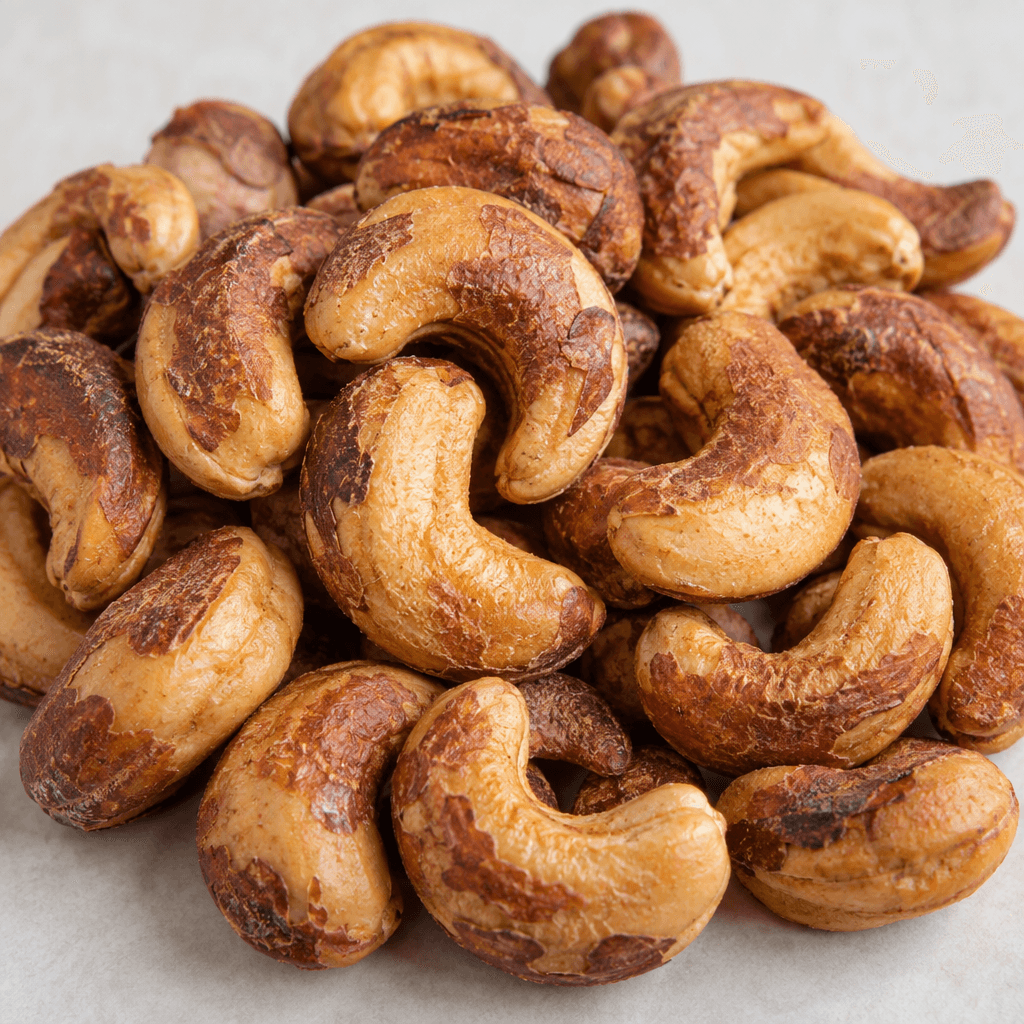
Roasted Cashews (Skin-On) Calories
Source of healthy fats, protein, magnesium and zinc
In season: Spring · Summer · Autumn · Winter
CALORIES
GI
POTASSIUM
FIBER
Quick answer
1 piece (medium) of Roasted Cashews (Skin-On) (8 g) has 46 calories. That works out to 574 calories per 100 g. It contains 2.4 g of carbs, 1.2 g of protein, 3.7 g of fat and 0.3 g of fiber. Its 0.2 mg of Copper covers 20% of the Daily Value. Its glycemic index is 22 (low), so it raises blood sugar slowly.
What is Roasted Cashews (Skin-On)?
Roasted Cashews (Skin-On) are cashew kernels roasted with their thin reddish-brown skin left in place; the cashew tree is native to Brazil. The skin is not the hard outer shell. Roasting brings out the nut’s mild sweetness and buttery flavour, with a crisp bite and occasional darker, more deeply toasted patches.
They’re commonly eaten as a snack, added to nut mixes, or scattered over salads and savoury dishes. Their nutritional profile is rich in fats and includes a useful amount of protein, making them satisfying but energy-dense. Enjoy a modest handful between meals, or pair them with fresh fruit for a simple snack.
Roasted Cashews (Skin-On) Nutrition Facts
Selected: 100 g
574
KCAL / 100G
Carbs
30.2g
· 11% DV
Protein
15.3g
· 31% DV
Fat
46.4g
· 59% DV
Fiber
3.3g
· 12% DV
DV is the share of the daily value covered, on a 2,000 kcal reference diet.
Calories come from: Carbs 20% · Protein 10% · Fat 70%
Roasted Cashews (Skin-On) Vitamins & Minerals
Vitamins
B1
0.42mg · 35% DV
Vitamin K
34.1µg · 28% DV
B6
0.42mg · 25% DV
Biotin
7µg · 23% DV
Minerals
Copper
2mg · 222% DV
Manganese
2mg · 87% DV
Phosphorus
593mg · 85% DV
Magnesium
292mg · 70% DV
How Nutritious Is Roasted Cashews (Skin-On)?
Nutrient density
High
How many vitamins, minerals and how much fiber this food carries per calorie. A high score means a lot of nutrition for few calories.
Satiety score
Medium
An EatBetter score computed from fiber, protein and calorie density. A high score means staying full longer on the same calories.
Both scores are calculated per 100 g and do not change with the selected portion. The satiety score is EatBetter's own calculation, not a clinical measure.
Roasted Cashews (Skin-On) Glycemic Index
GLYCEMIC INDEX
GLYCEMIC LOAD
Accounts for portion size — a more realistic measure than GI alone.
How to Burn Off Roasted Cashews (Skin-On)
To burn the 574 calories in 100 g:
🚶
Walking (5 km/h)
🏃
Running (8 km/h)
🚴
Cycling
🏊
Swimming
Times are calculated with the MET equation for a 70 kg adult. Actual burn varies with your weight, age and pace.
Is Roasted Cashews (Skin-On) Processed?
NOVA 2
Minimally Processed
1. Unprocessed
2. Minimally Processed
3. Processed
4. Ultra-Processed
NOVA classifies foods into 4 groups by industrial processing. NOVA 1 (unprocessed) is the healthiest.
Does Roasted Cashews (Skin-On) Contain Allergens?
Contains these allergens:
Which Diets Is Roasted Cashews (Skin-On) Good For?
Vegan
✓ Suitable
Vegetarian
✓ Suitable
Gluten-Free
✓ Suitable
Dairy-Free
— Not suitable
Mediterranean
✓ Suitable
Paleo
✓ Suitable
Whole30
— Not suitable
DASH
— Not suitable
Keto
— Not suitable
Low FODMAP
— Not suitable
Roasted Cashews (Skin-On) Fat Profile
SATURATED
9.2g
MONOUNSATURATED
27.3g
POLYUNSATURATED
8.2g
Omega 6:3 ratio 130:1
Above the ideal 4:1 (130:1).
Compare Roasted Cashews (Skin-On)
Foods Similar to Roasted Cashews (Skin-On)
Frequently Asked Questions About Roasted Cashews (Skin-On)
Can you eat the skin on skin-on roasted cashews?
Yes, the thin reddish-brown skin on skin-on roasted cashews is edible. It is not the hard outer shell, which is removed during processing. You can eat the cashews as they are or rub off any loose skin.
Are skin-on roasted cashews actually roasted with their shells on?
No. Skin-on roasted cashews have the thin inner skin attached, not the hard outer shell. The hard shell is removed before the cashew is sold, so the skin-on version is ready to eat.
Do skin-on roasted cashews taste different from skinless roasted cashews?
Yes. The thin skin can give skin-on roasted cashews a slightly earthy or astringent note, while skinless roasted cashews taste milder. Both have a roasted flavor, but the skin changes the finish.
Why do some skin-on roasted cashews have loose or missing skins?
The thin skins on roasted cashews can loosen or flake off as the nuts are roasted, handled, or packaged. A few bare patches or skin fragments are normal and do not mean the cashews are spoiled.
Can you make cashew butter with skin-on roasted cashews?
Yes, skin-on roasted cashews can be blended into cashew butter. The skin may make the result slightly darker and more textured, with a more pronounced roasted taste; blend gradually and scrape down the sides of the processor.
Can you make cashew milk from skin-on roasted cashews?
Yes, but skin-on roasted cashews make a more roasted-tasting drink than raw cashews. Blend them with water and strain through a fine cloth or nut-milk bag if you want a smoother texture.
Should you soak skin-on roasted cashews before eating them?
No, soaking is not necessary for skin-on roasted cashews. They are ready to eat, and soaking softens their crisp texture. Soaking is only useful when a recipe specifically calls for softened cashews, such as a blended sauce.
How should you store skin-on roasted cashews after opening the bag?
Keep skin-on roasted cashews in a tightly sealed container in a cool, dry, dark place. For longer storage, refrigerate or freeze them in an airtight container; protect them from moisture and odors from other foods.
Can skin-on roasted cashews help with weight loss?
They can fit into a weight-loss eating pattern, but skin-on roasted cashews are easy to overeat because they are compact and energy-dense. Put a portion in a bowl instead of snacking straight from the bag.
Can you eat skin-on roasted cashews at night?
Yes, you can eat skin-on roasted cashews at night; they have no special property that makes them unsuitable before bed. A small portion is practical, since a large serving may feel heavy close to bedtime.
Have another question about Roasted Cashews (Skin-On)?
Ask the AI nutrition coach — calories, portions, alternatives and more, answered in seconds in the app.

Scan calories with your camera
Instant AI nutrition analysis

Nutrition data compiled from USDA FoodData Central and scientific sources.