

Ready & Packaged Foods
All →Vegetables & Legumes
All →Desserts & Confectionery
All →Meat & Protein
All →Grains & Bakery
All →Beverages
All →Milk & Dairy
All →

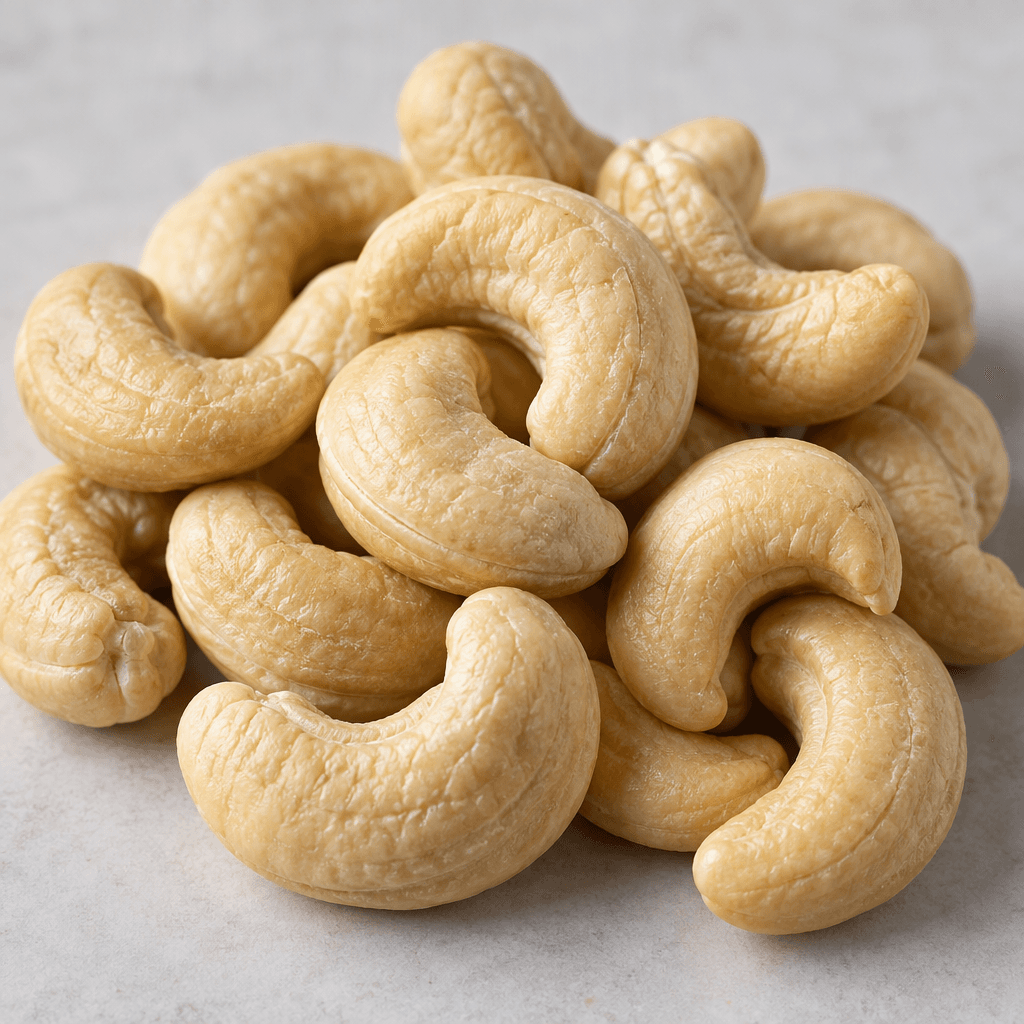
Cashew (Unsalted) Calories
Source of magnesium and copper, healthy fats, protein, no added salt
In season: Spring · Summer · Autumn · Winter
CALORIES
GI
POTASSIUM
FIBER
Quick answer
1 ounce (medium) of Cashew (Unsalted) (28 g) has 155 calories. That works out to 553 calories per 100 g. It contains 8.5 g of carbs, 5.1 g of protein, 12.3 g of fat and 0.9 g of fiber. Its 0.6 mg of Copper covers 69% of the Daily Value. Its glycemic index is 22 (low), so it raises blood sugar slowly.
What is Cashew (Unsalted)?
Unsalted cashews are the kidney-shaped seeds of the cashew tree, which originated in Brazil and is now grown across tropical regions. They’re sold raw or roasted, and without added salt their mild sweetness and creamy flavour come through clearly.
They work as an everyday snack, stirred into trail mix, or added to salads, curries and stir-fries for a tender crunch. In many places, cashews are also blended into creamy sauces and dairy-free dishes. They provide protein and mostly unsaturated fats, though they’re energy-dense, so a small handful is a useful portion. Pair them with fruit or plain yoghurt for a more filling snack.
Cashew (Unsalted) Nutrition Facts
Selected: 100 g
553
KCAL / 100G
Carbs
30.2g
· 11% DV
Protein
18.2g
· 36% DV
Fat
43.9g
· 56% DV
Fiber
3.3g
· 12% DV
DV is the share of the daily value covered, on a 2,000 kcal reference diet.
Calories come from: Carbs 21% · Protein 12% · Fat 67%
Cashew (Unsalted) Vitamins & Minerals
Vitamins
B1
0.42mg · 35% DV
Vitamin K
34.1µg · 28% DV
B6
0.42mg · 25% DV
Biotin
7µg · 23% DV
Minerals
Copper
2mg · 222% DV
Manganese
2mg · 87% DV
Phosphorus
593mg · 85% DV
Magnesium
292mg · 70% DV
How Nutritious Is Cashew (Unsalted)?
Nutrient density
High
How many vitamins, minerals and how much fiber this food carries per calorie. A high score means a lot of nutrition for few calories.
Satiety score
Medium
An EatBetter score computed from fiber, protein and calorie density. A high score means staying full longer on the same calories.
Both scores are calculated per 100 g and do not change with the selected portion. The satiety score is EatBetter's own calculation, not a clinical measure.
Cashew (Unsalted) Glycemic Index
GLYCEMIC INDEX
GLYCEMIC LOAD
Accounts for portion size — a more realistic measure than GI alone.
How to Burn Off Cashew (Unsalted)
To burn the 553 calories in 100 g:
🚶
Walking (5 km/h)
🏃
Running (8 km/h)
🚴
Cycling
🏊
Swimming
Times are calculated with the MET equation for a 70 kg adult. Actual burn varies with your weight, age and pace.
Is Cashew (Unsalted) Processed?
NOVA 2
Minimally Processed
1. Unprocessed
2. Minimally Processed
3. Processed
4. Ultra-Processed
NOVA classifies foods into 4 groups by industrial processing. NOVA 1 (unprocessed) is the healthiest.
Does Cashew (Unsalted) Contain Allergens?
Contains these allergens:
Which Diets Is Cashew (Unsalted) Good For?
Vegan
✓ Suitable
Vegetarian
✓ Suitable
Gluten-Free
✓ Suitable
Dairy-Free
— Not suitable
Mediterranean
✓ Suitable
Paleo
✓ Suitable
Whole30
— Not suitable
DASH
— Not suitable
Keto
✓ Suitable
Low FODMAP
— Not suitable
Cashew (Unsalted) Fat Profile
SATURATED
7.8g
MONOUNSATURATED
23.8g
POLYUNSATURATED
7.8g
Omega 6:3 ratio 130:1
Above the ideal 4:1 (130:1).
Compare Cashew (Unsalted)
Foods Similar to Cashew (Unsalted)
Frequently Asked Questions About Cashew (Unsalted)
Are unsalted cashews healthy?
Yes, unsalted cashews can be a nutritious snack: they provide protein and mostly unsaturated fats, along with minerals such as magnesium and copper. Choose a portion rather than eating from the bag, since they are easy to overeat.
How many unsalted cashews should you eat a day?
A serving of about 28 grams—a small handful—is a practical daily portion for many people. It is not a required amount; use less if you are adding cashews to a meal that already contains other nuts or calorie-dense foods.
Do unsalted cashews cause weight gain?
Unsalted cashews do not cause weight gain on their own, but eating large amounts can add substantial energy to your diet. Their mild flavor makes them easy to snack on mindlessly, so portion them into a bowl instead of eating straight from the packet.
Can you eat raw cashews?
Yes, cashews sold for eating can be eaten as they are, but “raw” cashews are generally heat-treated during processing to remove the irritating oil in the shell. Do not eat freshly harvested cashews in their shell.
Should you soak unsalted cashews before eating them?
No, soaking unsalted cashews is not necessary before eating them. Soaking softens them and can help make a smooth cashew cream or sauce, but it is optional for a snack and changes their texture.
How should you store unsalted cashews?
Keep unsalted cashews in an airtight container in a cool, dry place, away from sunlight and heat. Refrigerate them for longer storage. A stale, bitter, or paint-like smell can indicate that their natural oils have turned rancid.
Can you roast unsalted cashews at home?
Yes, you can roast unsalted cashews at home in an oven or a dry skillet. Stir or turn them often and watch closely near the end, because their natural oils make them brown quickly; add seasoning after roasting if desired.
Are cashews nuts or seeds?
Cashews are seeds, botanically speaking, although they are commonly grouped with tree nuts in cooking and nutrition. They grow attached to the bottom of the cashew apple, and the hard shell around each seed must be removed before sale.
Can people with diabetes eat unsalted cashews?
Yes, people with diabetes can usually include unsalted cashews in a measured portion; pairing them with a meal can make them easier to fit into a blood-sugar plan. If medication or an individual meal plan affects your choices, ask your diabetes care professional.
Can unsalted cashews cause an allergic reaction?
Yes, cashews can trigger reactions in people with a tree-nut allergy, and removing salt does not remove the allergen. Avoid them if you have a known cashew allergy; trouble breathing or throat swelling requires emergency care.
Have another question about Cashew (Unsalted)?
Ask the AI nutrition coach — calories, portions, alternatives and more, answered in seconds in the app.

Scan calories with your camera
Instant AI nutrition analysis

Nutrition data compiled from USDA FoodData Central and scientific sources.