

Ready & Packaged Foods
All →Vegetables & Legumes
All →Desserts & Confectionery
All →Meat & Protein
All →Grains & Bakery
All →Beverages
All →Milk & Dairy
All →

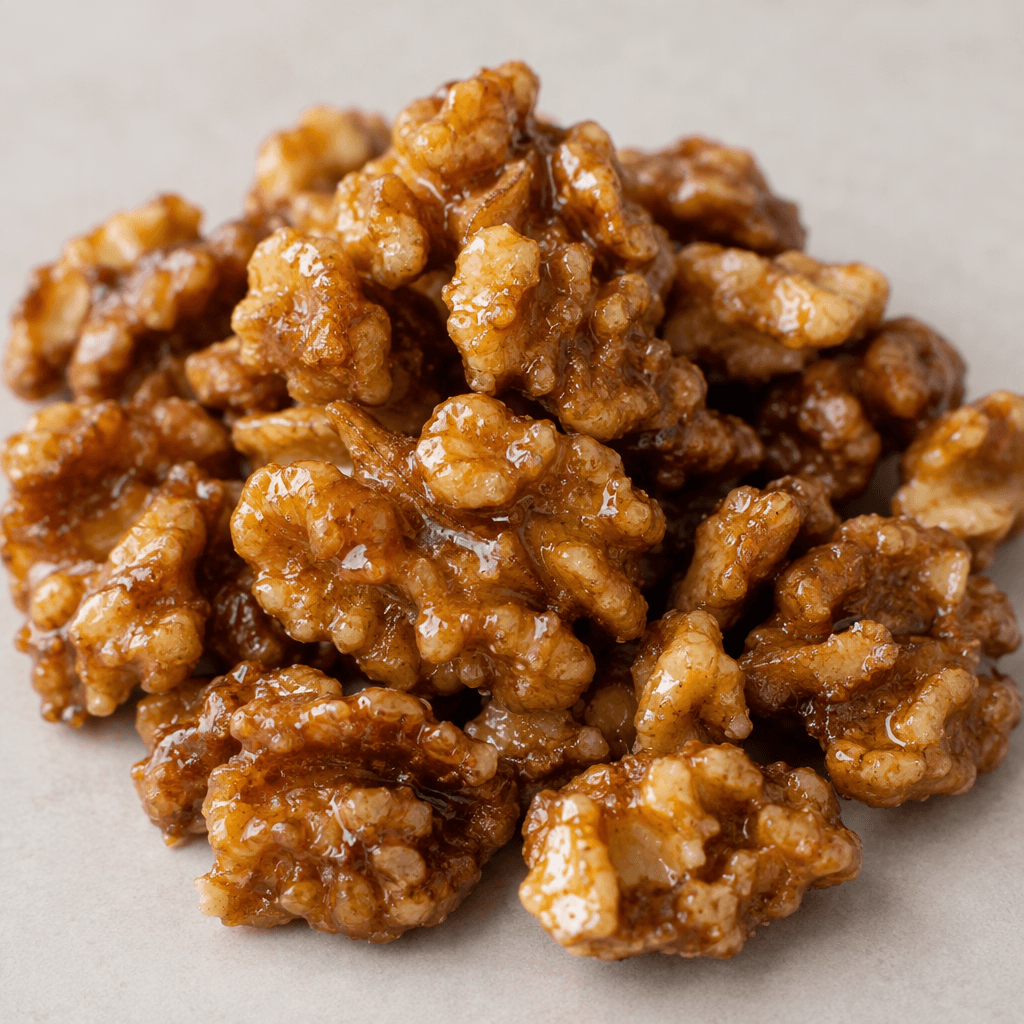
Caramelized Walnut Calories
Energy and healthy fats, walnuts coated in caramelized sugar
In season: Autumn · Winter
CALORIES · 100 G
GI
POTASSIUM · 100 G
FIBER · 100 G
Quick answer
1 piece (medium) of Caramelized Walnut (20 g) has 108 calories. That works out to 540 calories per 100 g. It contains 6.8 g of carbs, 1.7 g of protein, 8 g of fat and 0.9 g of fiber. Its 0.3 mg of Copper covers 33% of the Daily Value. Its glycemic index is 55 (medium), so it raises blood sugar at a moderate pace.
Caramelized Walnut Nutrition Facts
Selected: 1 piece (medium) · 20 g
108
KCAL / 20G
Carbs
6.8g
· 2% DV
Protein
1.7g
· 3% DV
Fat
8g
· 10% DV
Fiber
0.9g
· 3% DV
DV is the share of the daily value covered, on a 2,000 kcal reference diet.
Calories come from: Carbs 26% · Protein 6% · Fat 68%
Caramelized Walnut nutrition facts table · 1 piece (medium) (20 g)
| Nutrient | Amount | % DV |
|---|---|---|
| Calories | 108 kcal | |
| Total fat | 8 g | 10% |
| Saturated fat | 0.7 g | 3% |
| Trans fat | 0 g | |
| Sodium | 0.4 mg | 0% |
| Total carbohydrate | 6.8 g | 2% |
| Fiber | 0.9 g | 3% |
| Protein | 1.7 g | 3% |
Calories: Calories measure energy. Average daily need is 2,000 kcal. Excess calories are stored as fat, too few cause weight loss.
Carbs: Your body's primary energy source. The brain runs exclusively on carbs. Daily need: 275g.
Protein: Essential for muscle repair and cell growth. Daily need: 50g. Keeps you full and boosts metabolism.
Fat: Needed for hormone production and vitamin absorption. Daily need: 78g. Limit saturated fats, choose unsaturated.
Fiber: Critical for digestive health and satiety. Daily need: 28g. Stabilizes blood sugar, lowers cholesterol.

Log this food in EatBetter
100,000+ people use it
- Get your daily calorie target
- Snap your meal, log it in seconds
- See every vitamin and mineral

📸 Scan the code to get the app free.

How Many Calories in 1 Medium Caramelized Walnut?
| Serving | Amount | Calories |
|---|---|---|
| 1 piece (medium) | 20 g | 108 kcal |
| 1 piece (small) | 10 g | 54 kcal |
| 1 tablespoon (chopped) | 12 g | 65 kcal |
| 1 serving (medium) | 30 g | 162 kcal |
| 1 piece (large) | 35 g | 189 kcal |
| 1 pack (mini) | 40 g | 216 kcal |
| 1 serving (large) | 50 g | 270 kcal |
| 1 cup (chopped) | 90 g | 486 kcal |
| 100 g | 100 g | 540 kcal |
Calculated from 540 calories per 100 g.
Frequently Asked Questions About Caramelized Walnut
How do you make caramelized walnuts?
Make caramelized walnuts by coating walnut pieces in melted sugar, then cooling them until crisp. Melt sugar in a pan over medium heat, add the walnuts, stir to coat, and spread them on parchment paper to cool without touching.
How do you keep caramelized walnuts crunchy?
Keep caramelized walnuts crunchy by letting them cool completely and storing them away from moisture. Seal them in an airtight container at room temperature; adding them to a moist dessert or salad too early softens the coating.
Why is the coating on caramelized walnuts grainy?
A grainy coating on caramelized walnuts usually means the sugar crystallized instead of forming a smooth caramel. Avoid stirring once the sugar has dissolved and begun boiling, and remove any sugar crystals clinging to the pan’s sides.
How long do caramelized walnuts last?
Caramelized walnuts usually keep their best texture for about two weeks when fully cooled and stored in an airtight container in a cool, dry place. Discard them if they develop an off smell, visible mold, or a rancid taste.
Can you freeze caramelized walnuts?
Yes, caramelized walnuts can be frozen in an airtight freezer-safe container, but condensation during thawing may make the sugar coating sticky. Thaw them while still sealed, then let them come to room temperature before opening the container.
Can you make caramelized walnuts in an air fryer?
Yes, you can make caramelized walnuts in an air fryer, but the sugar can burn quickly in the concentrated heat. Use a lined, air-fryer-safe tray, cook at a low temperature, and check frequently rather than leaving the nuts unattended.
Do caramelized walnuts need egg white?
No, caramelized walnuts do not need egg white when made with a melted-sugar coating. Some oven recipes use egg white to help sugar and spices cling to the nuts, producing a different, lighter crust rather than a hard caramel shell.
How can you use caramelized walnuts in a salad?
Add caramelized walnuts to a salad just before serving so the coating stays crisp. They pair especially well with bitter greens, sliced pear or apple, and tangy cheese, where their sweetness contrasts with the sharper flavors.
Are caramelized walnuts healthy?
Caramelized walnuts provide the fats and nutrients found in walnuts, but their added sugar makes them a sweeter, more energy-dense snack than plain walnuts. Enjoy them as a topping or small treat rather than assuming the caramel coating makes them a health food.
Can caramelized walnuts be made spicy?
Yes, caramelized walnuts can be made spicy by adding a pinch of cayenne or chili flakes to the coating. Mix the spice in after the sugar has melted, then spread the walnuts out promptly so the hot caramel does not clump as it cools.
Caramelized Walnut Vitamins & Minerals
Vitamins
B6
0.1mg · 6% DV
B1
0.07mg · 6% DV
Biotin
1.2µg · 4% DV
Folate
13µg · 3% DV
Minerals
Copper
0.3mg · 33% DV
Manganese
0.58mg · 25% DV
Phosphorus
64mg · 9% DV
Magnesium
24mg · 6% DV
Potassium ⭐
84mg · 2% DV
Sodium
0.4mg · 0% DV
Caramelized Walnut Glycemic Index
GLYCEMIC INDEX
GLYCEMIC LOAD
Accounts for portion size — a more realistic measure than GI alone.
How to Burn Off Caramelized Walnut
To burn the 108 calories in 1 piece (medium) (20 g):
🚶
Walking (5 km/h)
🏃
Running (8 km/h)
🚴
Cycling
🏊
Swimming
Times are calculated with the MET equation for a 70 kg adult. Actual burn varies with your weight, age and pace.
What is Caramelized Walnut?
Caramelized Walnut is made by coating walnut pieces in sugar and heating them until the sugar turns into a crisp, glossy shell. The contrast is the appeal: a sweet crunch outside, with the rich, slightly earthy flavour of the walnut underneath. It is sold as a confection or made at home, and can be kept for snacking or used as a dessert topping.
Enjoy it by itself with coffee or tea, or chop it over ice cream, cakes and yoghurt. The sugar coating makes it an energy-dense treat; 100 g provides 540 calories. A small handful adds plenty of crunch to a snack, while pairing a few pieces with fresh fruit keeps the serving lighter.
How Nutritious Is Caramelized Walnut?
Nutrient density
High
How many vitamins, minerals and how much fiber this food carries per calorie. A high score means a lot of nutrition for few calories.
Satiety score
Medium
An EatBetter score computed from fiber, protein and calorie density. A high score means staying full longer on the same calories.
Both scores are calculated per 100 g and do not change with the selected portion. The satiety score is EatBetter's own calculation, not a clinical measure.
Is Caramelized Walnut Processed?
NOVA 3
Processed
1. Unprocessed
2. Minimally Processed
3. Processed
4. Ultra-Processed
NOVA classifies foods into 4 groups by industrial processing. NOVA 1 (unprocessed) is the healthiest.
Does Caramelized Walnut Contain Allergens?
Contains these allergens:
Which Diets Is Caramelized Walnut Good For?
Vegan
✓ Suitable
Vegetarian
✓ Suitable
Gluten-Free
✓ Suitable
Dairy-Free
— Not suitable
Mediterranean
✓ Suitable
Paleo
— Not suitable
Whole30
— Not suitable
DASH
— Not suitable
Keto
— Not suitable
Low FODMAP
— Not suitable
Caramelized Walnut Fat Profile
SATURATED
0.7g
MONOUNSATURATED
1.9g
POLYUNSATURATED
6.4g
Omega 6:3 ratio 3.3:1
Below the ideal 4:1 — a good omega balance.
Compare Caramelized Walnut
Foods Similar to Caramelized Walnut
Have another question about Caramelized Walnut?
Ask the AI nutrition coach — calories, portions, alternatives and more, answered in seconds in the app.

Scan calories with your camera
Instant AI nutrition analysis

Nutrition data compiled from USDA FoodData Central and scientific sources.