

Ready & Packaged Foods
All →Vegetables & Legumes
All →Desserts & Confectionery
All →Meat & Protein
All →Grains & Bakery
All →Beverages
All →Milk & Dairy
All →

Candies Calories
Candies
CALORIES
GI
POTASSIUM
FIBER
Quick answer
5 piece (medium) of Candies (20 g) has 77 calories. That works out to 387 calories per 100 g. It contains 19.4 g of carbs, 0 g of protein, 0 g of fat and 0 g of fiber. Its glycemic index is 80 (high), so it raises blood sugar quickly.
What is Candies?
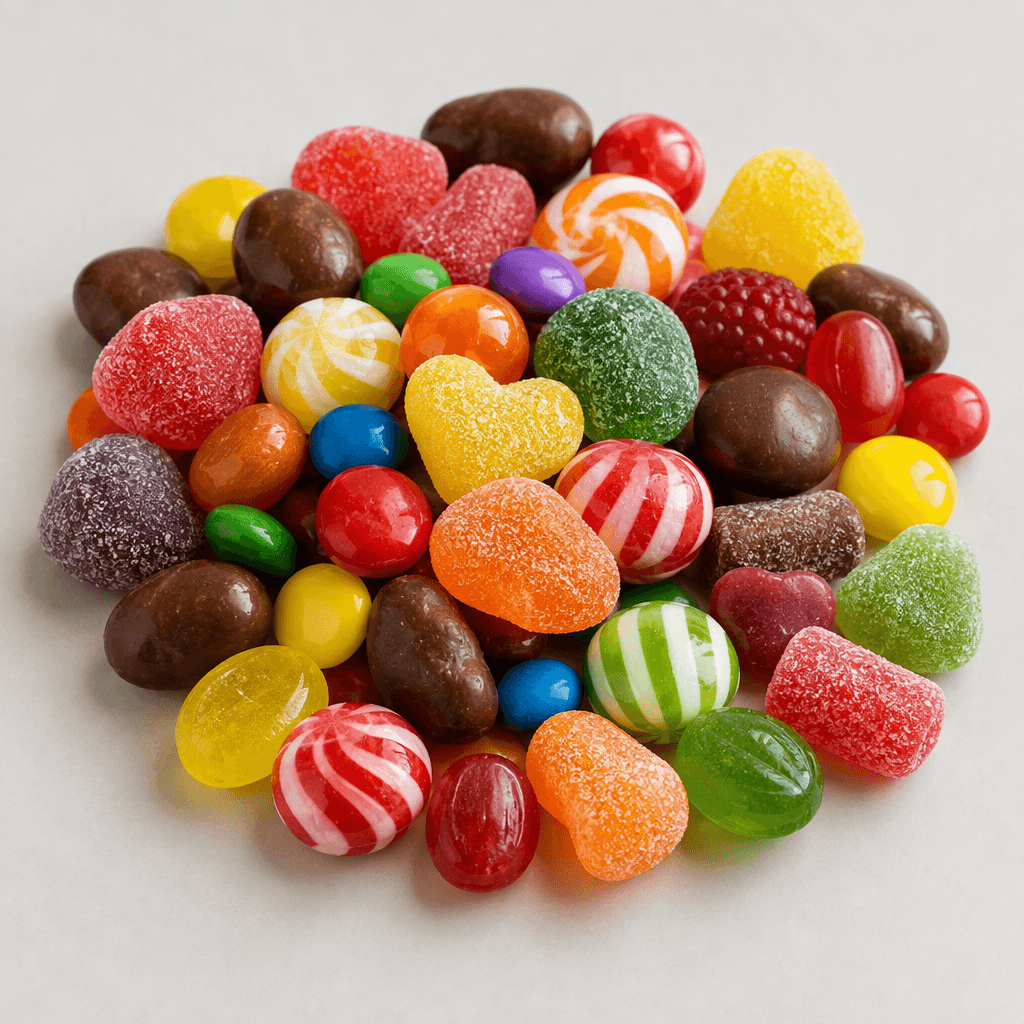
Candies are a broad family of sweets, usually made with sugar or syrup rather than a single recipe. They range from glossy hard sweets to chewy, sugar-coated pieces, with flavours, shapes and coatings varying by type and region; some assortments also include chocolate-like bites.
Around the world, candies are commonly offered to guests, shared at celebrations or enjoyed a piece at a time with tea or coffee. Their texture can be crisp, smooth or chewy, and they tend to taste distinctly sweet. They are predominantly carbohydrate, with 97 g per 100 g in the figures for this food. For a lighter-feeling snack, keep to a few pieces and pair them with fresh fruit rather than making them the main part of a snack.
Candies Nutrition Facts
Selected: 100 g
387
KCAL / 100G
Carbs
97g
· 35% DV
Protein
0.1g
· 0% DV
Fat
0.1g
· 0% DV
Fiber
0g
· 0% DV
DV is the share of the daily value covered, on a 2,000 kcal reference diet.
Calories come from: Carbs 100% · Protein 0% · Fat 0%
Candies Vitamins & Minerals
Vitamins
Vitamin A
0µg · 0% DV
B1
0mg · 0% DV
B2
0mg · 0% DV
B3
0mg · 0% DV
Minerals
Calcium
1mg · 0% DV
Iron
0mg · 0% DV
Magnesium
0mg · 0% DV
Zinc
0mg · 0% DV
How Nutritious Is Candies?
Nutrient density
Low
How many vitamins, minerals and how much fiber this food carries per calorie. A high score means a lot of nutrition for few calories.
Satiety score
Low
An EatBetter score computed from fiber, protein and calorie density. A high score means staying full longer on the same calories.
Both scores are calculated per 100 g and do not change with the selected portion. The satiety score is EatBetter's own calculation, not a clinical measure.
Candies Glycemic Index
GLYCEMIC INDEX
GLYCEMIC LOAD
Accounts for portion size — a more realistic measure than GI alone.
How to Burn Off Candies
To burn the 387 calories in 100 g:
🚶
Walking (5 km/h)
🏃
Running (8 km/h)
🚴
Cycling
🏊
Swimming
Times are calculated with the MET equation for a 70 kg adult. Actual burn varies with your weight, age and pace.
Is Candies Processed?
NOVA 4
Ultra-Processed
1. Unprocessed
2. Minimally Processed
3. Processed
4. Ultra-Processed
NOVA classifies foods into 4 groups by industrial processing. NOVA 1 (unprocessed) is the healthiest.
Does Candies Contain Allergens?
No known major allergens
Which Diets Is Candies Good For?
Vegan
✓ Suitable
Vegetarian
✓ Suitable
Gluten-Free
✓ Suitable
Dairy-Free
— Not suitable
Mediterranean
— Not suitable
Paleo
— Not suitable
Whole30
— Not suitable
DASH
— Not suitable
Keto
— Not suitable
Low FODMAP
— Not suitable
Candies Fat Profile
SATURATED
0g
MONOUNSATURATED
0g
POLYUNSATURATED
0g
Compare Candies
Foods Similar to Candies
Frequently Asked Questions About Candies
What are candies made of?
Most candies are made with sugar or corn syrup, but the ingredients vary by type. Gummies may contain gelatin or pectin, while chocolate candies use cocoa; flavorings, colors, milk ingredients, or nuts may also be added.
How are hard candies made?
Hard candies are made by heating sugar syrup until most of its water evaporates, then cooling it until it sets into a brittle, glass-like solid. Flavor and color are usually added before the mixture is shaped.
Why do candies get sticky?
Candies get sticky when they absorb moisture from the air or their packaging. Keep them sealed in a cool, dry place; humid conditions can make their surfaces tacky and cause pieces to clump together.
Do candies expire?
Yes, candies can lose quality and eventually become unpleasant or unsafe to eat. Hard candies often keep their texture longer than soft, creamy, or filled candies; discard them if you notice an unusual smell, appearance, or texture.
Can candies be frozen?
Yes, many candies can be frozen, but freezing may change their texture or cause condensation when they thaw. Seal them airtight, thaw the package before opening it, and avoid freezing candies with delicate coatings or creamy fillings if texture matters.
Why do hard candies turn cloudy or white?
Hard candies can turn cloudy when moisture or temperature changes cause sugar crystals to form on the surface. The change is often cosmetic, but candies that are also sticky, damaged, or unusual in smell should be discarded.
Are candies and sweets the same thing?
Usually, yes: “candies” is the common US term, while “sweets” is more common in the UK and some other English-speaking regions. Both can refer to small sugary treats, though local usage and the range of products included may differ.
Do candies cause cavities?
Yes, frequent candy eating can raise the risk of cavities. Mouth bacteria turn sugar into acids that damage tooth enamel, and candies that stick to teeth can prolong that exposure; having them less often helps limit it.
Can hard candies be melted in the microwave?
Yes, hard candies can be melted in a microwave, but they heat unevenly and can become dangerously hot. Use a microwave-safe bowl, heat in short intervals, and let the melted sugar cool before touching or tasting it.
Do candies make children hyperactive?
There is no strong evidence that candies directly cause hyperactivity in children. Candy is often eaten at parties or other exciting events, so the setting and activity may explain behavior that people attribute to sugar.
Have another question about Candies?
Ask the AI nutrition coach — calories, portions, alternatives and more, answered in seconds in the app.

Scan calories with your camera
Instant AI nutrition analysis

Nutrition data compiled from USDA FoodData Central and scientific sources.