

Ready & Packaged Foods
All →Vegetables & Legumes
All →Desserts & Confectionery
All →Meat & Protein
All →Grains & Bakery
All →Beverages
All →Milk & Dairy
All →

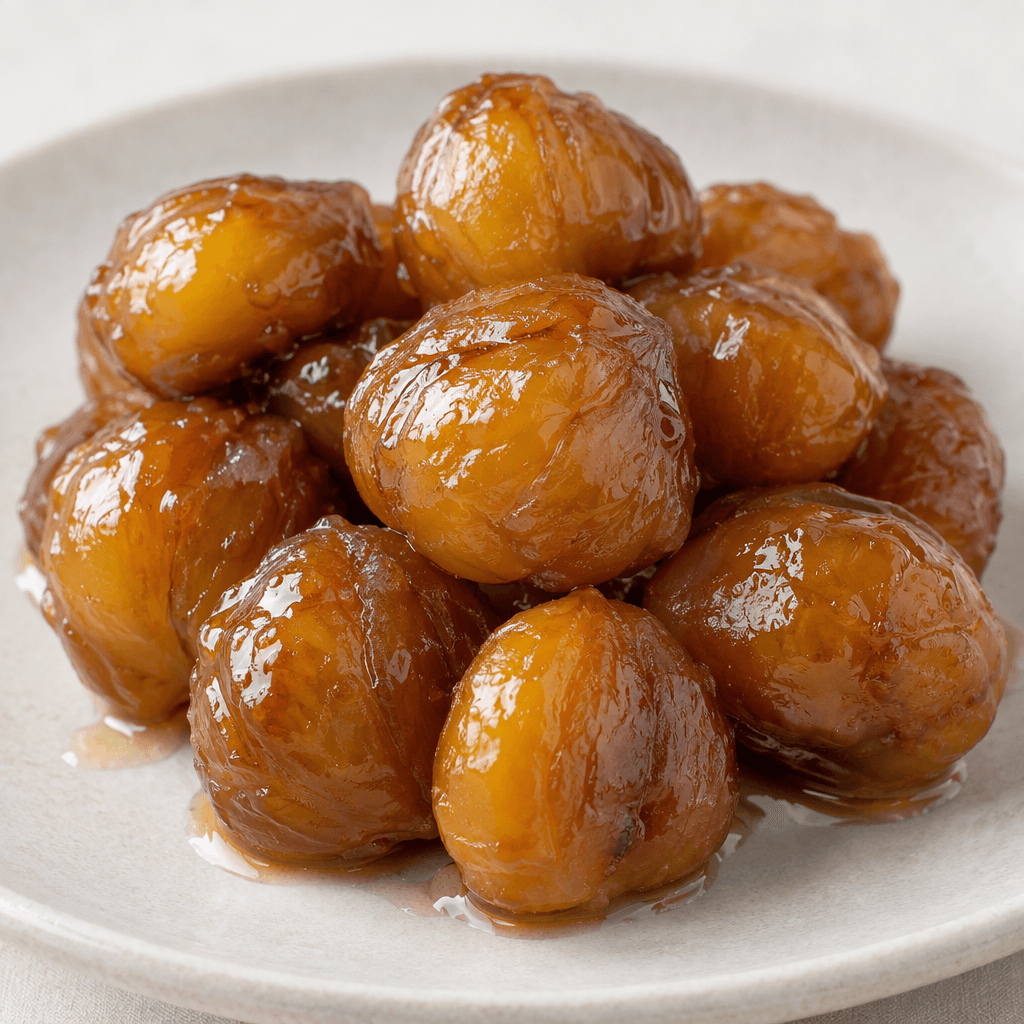
Candied Chestnut Calories
Sweet, sugar-coated chestnut, famous Turkish treat
In season: Autumn · Winter
CALORIES
GI
POTASSIUM
FIBER
Quick answer
3 piece (medium) of Candied Chestnut (60 g) has 192 calories. That works out to 320 calories per 100 g. It contains 46.8 g of carbs, 0.9 g of protein, 0.2 g of fat and 2.1 g of fiber. Its 0.1 mg of Copper covers 13% of the Daily Value. Its glycemic index is 75 (high), so it raises blood sugar quickly.
What is Candied Chestnut?
Candied chestnut is a Turkish confection especially associated with Bursa, made by peeling whole chestnuts and cooking them in sugar syrup until glossy and tender. The syrup seeps into the chestnuts, giving them a soft, slightly sticky centre beneath their smooth coating.
Its sweetness is rich, with the earthy, mellow flavour of chestnut still coming through. In Turkey, it is often offered with tea or coffee, boxed as a gift, or served as part of a dessert spread. It is mostly carbohydrate and sugar, with very little fat. For a less-heavy treat, serve a few pieces with unsweetened tea or coffee rather than alongside other sweets.
Candied Chestnut Nutrition Facts
Selected: 100 g
320
KCAL / 100G
Carbs
78g
· 28% DV
Protein
1.5g
· 3% DV
Fat
0.4g
· 1% DV
Fiber
3.5g
· 13% DV
DV is the share of the daily value covered, on a 2,000 kcal reference diet.
Calories come from: Carbs 97% · Protein 2% · Fat 1%
Candied Chestnut Vitamins & Minerals
Vitamins
Vitamin C
10mg · 11% DV
B6
0.15mg · 9% DV
Folate
30µg · 8% DV
B1
0.08mg · 7% DV
Minerals
Iron
1mg · 6% DV
Phosphorus
40mg · 6% DV
Magnesium
20mg · 5% DV
Potassium ⭐
170mg · 5% DV
How Nutritious Is Candied Chestnut?
Nutrient density
Low
How many vitamins, minerals and how much fiber this food carries per calorie. A high score means a lot of nutrition for few calories.
Satiety score
Low
An EatBetter score computed from fiber, protein and calorie density. A high score means staying full longer on the same calories.
Both scores are calculated per 100 g and do not change with the selected portion. The satiety score is EatBetter's own calculation, not a clinical measure.
Candied Chestnut Glycemic Index
GLYCEMIC INDEX
GLYCEMIC LOAD
Accounts for portion size — a more realistic measure than GI alone.
How to Burn Off Candied Chestnut
To burn the 320 calories in 100 g:
🚶
Walking (5 km/h)
🏃
Running (8 km/h)
🚴
Cycling
🏊
Swimming
Times are calculated with the MET equation for a 70 kg adult. Actual burn varies with your weight, age and pace.
Is Candied Chestnut Processed?
NOVA 3
Processed
1. Unprocessed
2. Minimally Processed
3. Processed
4. Ultra-Processed
NOVA classifies foods into 4 groups by industrial processing. NOVA 1 (unprocessed) is the healthiest.
Does Candied Chestnut Contain Allergens?
No known major allergens
Which Diets Is Candied Chestnut Good For?
Vegan
— Not suitable
Vegetarian
✓ Suitable
Gluten-Free
— Not suitable
Dairy-Free
— Not suitable
Mediterranean
— Not suitable
Paleo
— Not suitable
Whole30
— Not suitable
DASH
— Not suitable
Keto
— Not suitable
Low FODMAP
— Not suitable
Candied Chestnut Fat Profile
SATURATED
0.08g
MONOUNSATURATED
0.1g
POLYUNSATURATED
0.07g
Omega 6:3 ratio 5:1
Above the ideal 4:1 (5:1).
Compare Candied Chestnut
Foods Similar to Candied Chestnut
Frequently Asked Questions About Candied Chestnut
What is candied chestnut?
Candied chestnut is a peeled chestnut cooked in sugar syrup until tender and coated with a glossy sweet glaze. It is eaten as a confection on its own or used as a dessert topping.
How are candied chestnuts made?
Candied chestnuts are made by peeling whole chestnuts and gently cooking them in sugar syrup until they absorb the sweetness without falling apart. Slow, careful cooking helps the chestnuts stay intact and develop their characteristic glossy coating.
Are candied chestnuts the same as marrons glacés?
Marrons glacés are a French-style form of candied chestnut, usually made from whole chestnuts slowly candied in syrup and given a glossy finish. The names are often used for the same kind of confection, though recipes and presentation can vary.
Why do candied chestnuts break apart while cooking?
Candied chestnuts can break apart if they are cracked before cooking, handled roughly, or boiled too vigorously. Keep the syrup at a gentle simmer and avoid stirring the chestnuts; large, intact chestnuts are more likely to hold their shape.
How should candied chestnuts be stored after opening?
After opening, keep candied chestnuts in a clean, airtight container away from heat and sunlight. Refrigerate moist or syrup-packed chestnuts, and let them sit briefly at room temperature before serving if you prefer a softer texture.
How long do candied chestnuts last?
There is no single shelf life for candied chestnuts because packaging and syrup content vary. Follow the date on a packaged product; once opened, keep the chestnuts sealed and refrigerated if moist, and discard them if you notice mold or an off smell.
Can you freeze candied chestnuts?
Yes, candied chestnuts can be frozen in an airtight container, although thawing may soften the chestnuts or make the syrup watery. Thaw them in the refrigerator and do not refreeze them after thawing.
How can you tell if candied chestnuts have gone bad?
Discard candied chestnuts if you see mold, notice a sour or fermented smell, or find an unusual color change or slimy texture. A sugary, sticky coating is normal, but it should not be mistaken for spoilage signs.
Are candied chestnuts healthy?
Candied chestnuts provide chestnut solids, but their sugar coating makes them more of a sweet treat than an everyday source of nutrition. Enjoying a small portion occasionally is a practical way to include them alongside less-sugary foods.
Do candied chestnuts raise blood sugar?
Yes, the sugar syrup on candied chestnuts can raise blood sugar, so they may affect glucose levels more than plain chestnuts. If you have diabetes, choose a portion that fits your care plan and monitor your response.
Have another question about Candied Chestnut?
Ask the AI nutrition coach — calories, portions, alternatives and more, answered in seconds in the app.

Scan calories with your camera
Instant AI nutrition analysis

Nutrition data compiled from USDA FoodData Central and scientific sources.