

Ready & Packaged Foods
All →Vegetables & Legumes
All →Desserts & Confectionery
All →Meat & Protein
All →Grains & Bakery
All →Beverages
All →Milk & Dairy
All →

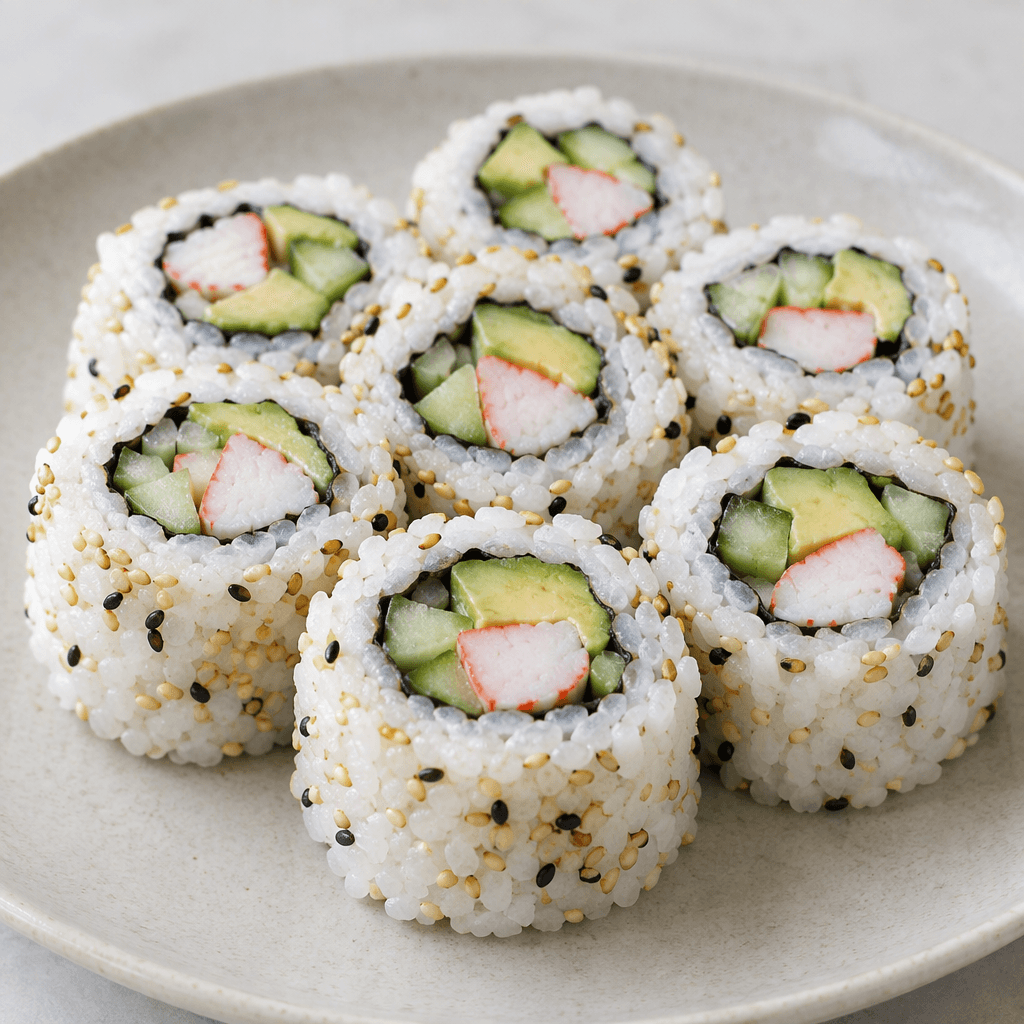
California Roll Sushi Calories
Popular sushi roll, contains avocado, crab, cucumber, sesame
In season: Spring · Summer · Autumn · Winter
CALORIES
GI
POTASSIUM
FIBER
Quick answer
1 piece (medium) of California Roll Sushi (35 g) has 49 calories. That works out to 140 calories per 100 g. It contains 8.9 g of carbs, 1.5 g of protein, 1 g of fat and 0.6 g of fiber. Its 112 mg of Sodium covers 5% of the Daily Value. Its glycemic index is 55 (medium), so it raises blood sugar at a moderate pace.
What is California Roll Sushi?
California Roll Sushi is an American-style sushi roll, generally made with imitation crab (surimi), avocado and cucumber wrapped in nori. It is often prepared inside-out, with seasoned rice on the outside and sesame sprinkled over it. The roll is associated with the United States, where it became a familiar way to enjoy sushi beyond Japan.
Its soft, slightly tangy rice contrasts with creamy avocado and crisp cucumber, making each bite mild and fresh. It is commonly served in sushi restaurants with soy sauce, pickled ginger and wasabi, and works well as part of a shared platter or a light lunch. At about 140 calories per 100 g, it is mostly a carbohydrate-based choice; pair it with edamame or a salad for a more rounded meal.
California Roll Sushi Nutrition Facts
Selected: 100 g
140
KCAL / 100G
Carbs
25.5g
· 9% DV
Protein
4.2g
· 8% DV
Fat
2.8g
· 4% DV
Fiber
1.7g
· 6% DV
DV is the share of the daily value covered, on a 2,000 kcal reference diet.
Calories come from: Carbs 71% · Protein 12% · Fat 17%
California Roll Sushi Vitamins & Minerals
Vitamins
B12
0.3µg · 13% DV
B3
1.1mg · 7% DV
B5
0.3mg · 6% DV
Vitamin K
7µg · 6% DV
Minerals
Sodium
320mg · 14% DV
Selenium
4.5µg · 8% DV
Phosphorus
48mg · 7% DV
Iron
1mg · 6% DV
How Nutritious Is California Roll Sushi?
Nutrient density
Medium
How many vitamins, minerals and how much fiber this food carries per calorie. A high score means a lot of nutrition for few calories.
Satiety score
Medium
An EatBetter score computed from fiber, protein and calorie density. A high score means staying full longer on the same calories.
Both scores are calculated per 100 g and do not change with the selected portion. The satiety score is EatBetter's own calculation, not a clinical measure.
California Roll Sushi Glycemic Index
GLYCEMIC INDEX
GLYCEMIC LOAD
Accounts for portion size — a more realistic measure than GI alone.
How to Burn Off California Roll Sushi
To burn the 140 calories in 100 g:
🚶
Walking (5 km/h)
🏃
Running (8 km/h)
🚴
Cycling
🏊
Swimming
Times are calculated with the MET equation for a 70 kg adult. Actual burn varies with your weight, age and pace.
Is California Roll Sushi Processed?
NOVA 3
Processed
1. Unprocessed
2. Minimally Processed
3. Processed
4. Ultra-Processed
NOVA classifies foods into 4 groups by industrial processing. NOVA 1 (unprocessed) is the healthiest.
Does California Roll Sushi Contain Allergens?
Contains these allergens:
Which Diets Is California Roll Sushi Good For?
Vegan
— Not suitable
Vegetarian
— Not suitable
Gluten-Free
— Not suitable
Dairy-Free
— Not suitable
Mediterranean
✓ Suitable
Paleo
— Not suitable
Whole30
— Not suitable
DASH
— Not suitable
Keto
— Not suitable
Low FODMAP
— Not suitable
California Roll Sushi Fat Profile
SATURATED
0.6g
MONOUNSATURATED
1.1g
POLYUNSATURATED
0.7g
Omega 6:3 ratio 2.3:1
Below the ideal 4:1 — a good omega balance.
Compare California Roll Sushi
Foods Similar to California Roll Sushi
Frequently Asked Questions About California Roll Sushi
What is in a California Roll Sushi?
California Roll Sushi usually contains sushi rice, nori, avocado, cucumber, and imitation crab called surimi. The rice is often on the outside, with nori wrapped around the filling; restaurants may change the ingredients or use real crab.
Is California Roll Sushi cooked or raw?
California Roll Sushi is usually made without raw fish. Its crab-like filling is commonly surimi, a cooked fish paste shaped to resemble crab, while the avocado and cucumber are served fresh.
Is the crab in California Roll Sushi real crab?
Usually, no: California Roll Sushi commonly uses surimi, a crab-style product made from fish, rather than crab meat. Some restaurants offer versions with real crab, so ask what the filling is before ordering if it matters to you.
Why is it called California Roll Sushi?
California Roll Sushi is named for its association with California, where this style became popular. Accounts of its exact invention differ, but its avocado-and-surimi filling and rice-outside presentation helped make it a familiar sushi option beyond Japan.
Why is the rice on the outside of California Roll Sushi?
The rice is placed outside in California Roll Sushi to make an inside-out roll, keeping the nori around the filling. This presentation also shows off the avocado and crab-style filling, and sesame seeds are sometimes sprinkled over the rice.
How do you make California Roll Sushi at home?
To make California Roll Sushi, spread sushi rice over nori, add surimi, avocado, and cucumber, then roll it tightly. For the rice-outside style, turn the sheet over before adding the filling; a bamboo mat helps shape the roll evenly.
How should you eat California Roll Sushi with soy sauce?
Dip California Roll Sushi lightly in soy sauce rather than soaking it. Touching the filling side to the sauce helps keep the rice from absorbing too much liquid and makes the pieces less likely to fall apart.
What is the difference between California Roll Sushi and a traditional maki roll?
California Roll Sushi is typically an inside-out roll with rice on the outside and nori around the filling. Traditional maki usually has nori on the outside, and its fillings vary widely rather than relying on the California roll’s familiar avocado and surimi combination.
How long does California Roll Sushi last in the fridge?
California Roll Sushi is best eaten fresh; if necessary, refrigerate it in a covered container and eat it the same day. The rice firms up and the avocado browns as it sits, and seafood fillings should not be left at room temperature for long.
Can you eat California Roll Sushi during pregnancy?
California Roll Sushi can be an option during pregnancy when its ingredients are cooked or otherwise ready to eat and kept safely chilled; most versions do not contain raw fish. Restaurant handling matters, so ask about the filling and seek individual medical advice if needed.
Have another question about California Roll Sushi?
Ask the AI nutrition coach — calories, portions, alternatives and more, answered in seconds in the app.

Scan calories with your camera
Instant AI nutrition analysis

Nutrition data compiled from USDA FoodData Central and scientific sources.