

Ready & Packaged Foods
All →Vegetables & Legumes
All →Desserts & Confectionery
All →Meat & Protein
All →Grains & Bakery
All →Beverages
All →Milk & Dairy
All →

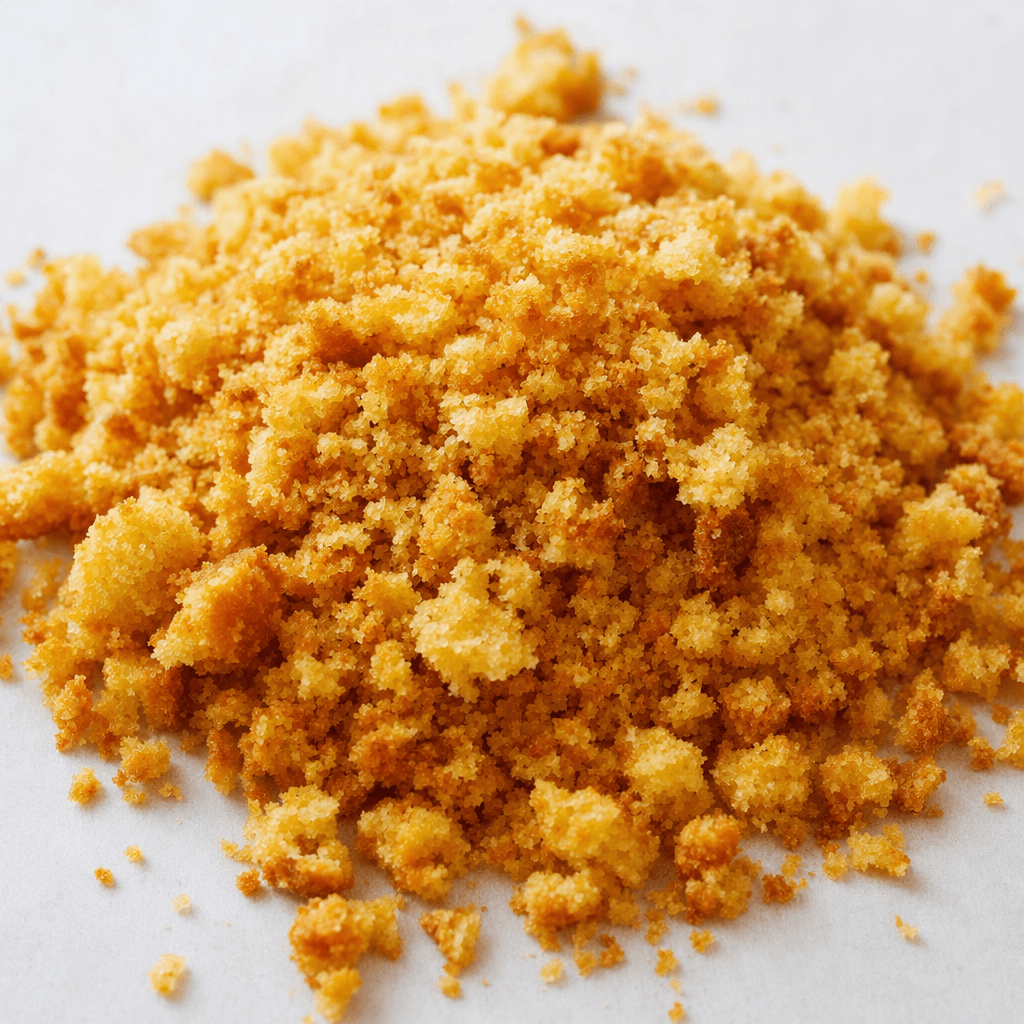
Cake crumbs Calories
Energy-dense cake crumbs made from sweet baked cake, typically high in refined carbs and sugar.
CALORIES · 100 G
GI
POTASSIUM · 100 G
FIBER · 100 G
Quick answer
1 tablespoon (shredded) of Cake crumbs (12 g) has 52 calories. That works out to 430 calories per 100 g. It contains 7.6 g of carbs, 0.7 g of protein, 2.1 g of fat and 0.2 g of fiber. Its glycemic index is 68 (high), so it raises blood sugar quickly.
Cake crumbs Nutrition Facts
Selected: 1 tablespoon (shredded) · 12 g
52
KCAL / 12G
Carbs
7.6g
· 3% DV
Protein
0.7g
· 1% DV
Fat
2.1g
· 3% DV
Fiber
0.2g
· 1% DV
DV is the share of the daily value covered, on a 2,000 kcal reference diet.
Calories come from: Carbs 58% · Protein 5% · Fat 37%
Cake crumbs nutrition facts table · 1 tablespoon (shredded) (12 g)
| Nutrient | Amount | % DV |
|---|---|---|
| Calories | 52 kcal | |
| Total fat | 2.1 g | 3% |
| Saturated fat | 0.58 g | 3% |
| Trans fat | 0.01 g | |
| Sodium | 38 mg | 2% |
| Total carbohydrate | 7.6 g | 3% |
| Fiber | 0.2 g | 1% |
| Protein | 0.7 g | 1% |
Calories: Calories measure energy. Average daily need is 2,000 kcal. Excess calories are stored as fat, too few cause weight loss.
Carbs: Your body's primary energy source. The brain runs exclusively on carbs. Daily need: 275g.
Protein: Essential for muscle repair and cell growth. Daily need: 50g. Keeps you full and boosts metabolism.
Fat: Needed for hormone production and vitamin absorption. Daily need: 78g. Limit saturated fats, choose unsaturated.
Fiber: Critical for digestive health and satiety. Daily need: 28g. Stabilizes blood sugar, lowers cholesterol.

Log this food in EatBetter
100,000+ people use it
- Get your daily calorie target
- Snap your meal, log it in seconds
- See every vitamin and mineral

📸 Scan the code to get the app free.

How Many Calories in 1 Tablespoon of Shredded Cake crumbs?
| Serving | Amount | Calories |
|---|---|---|
| 1 tablespoon (shredded) | 12 g | 52 kcal |
| 1 piece (small) | 8 g | 34 kcal |
| 2 tablespoon (shredded) | 24 g | 103 kcal |
| 1 ounce (medium) | 28 g | 120 kcal |
| 0.25 cup (shredded) | 30 g | 129 kcal |
| 1 serving (medium) | 40 g | 172 kcal |
| ½ cup (shredded) | 60 g | 258 kcal |
| 100 g | 100 g | 430 kcal |
| 1 cup (shredded) | 120 g | 516 kcal |
Calculated from 430 calories per 100 g.
Frequently Asked Questions About Cake crumbs
What can you make with cake crumbs?
Cake crumbs are useful in cake pops, truffles, dessert layers, and as a topping for frosted cakes or ice cream. Choose a use that suits the cake’s flavor, and add crumbs near serving time when you want them to stay crisp.
How do you make cake crumbs from leftover cake?
To make cake crumbs, let leftover cake cool, remove any frosting or filling, and crumble the cake by hand or pulse it briefly in a food processor. Stop when it reaches the texture you need; over-processing can turn it pasty.
How do you make cake pops with cake crumbs?
Mix cake crumbs with a little frosting, cream cheese, or ganache until the mixture holds together, then roll it into balls. Chill the balls before dipping them in melted chocolate, and add the binder gradually so they do not become sticky.
Can cake crumbs replace graham cracker crumbs in a dessert crust?
Yes, cake crumbs can replace graham cracker crumbs in some dessert crusts, especially for sweet fillings. Combine them with melted butter and press firmly into the pan; because cake crumbs are already sweet and soft, the crust may be more delicate.
How do you use cake crumbs as a trifle layer?
Use cake crumbs as a trifle layer by scattering them between fruit, custard, or whipped cream. Larger pieces provide more texture, while fine crumbs make a softer layer; assemble close to serving if you want the cake to retain some structure.
Can you use cake crumbs to decorate a cake?
Yes, cake crumbs make an easy coating for the sides or top of a frosted cake. Press them gently into fresh frosting so they adhere, or sprinkle them over the cake just before serving for a looser finish.
How should you store cake crumbs?
Store fully cooled, dry cake crumbs in an airtight container in a cool, dry place. Crumbs from cake with cream or fruit need refrigeration and should not be kept for extended periods; discard them if they smell off or show mold.
Can you freeze cake crumbs?
Yes, you can freeze dry cake crumbs in a sealed freezer-safe container. Thaw them before use and check that they have not become damp. Crumbs mixed with frosting or fresh fruit are better used promptly rather than stored as dry crumbs.
Why are my cake crumbs too wet to shape?
Cake crumbs become too wet to shape when the cake is very moist or too much frosting or binder has been added. Mix in more dry crumbs a little at a time, then chill the mixture so it firms up before rolling.
How do you keep cake crumbs crunchy on a dessert?
To keep cake crumbs crunchy, spread them out and dry them in a low oven, then cool completely before storing in an airtight container. Sprinkle them onto cream, frosting, or pudding just before serving, since moisture quickly softens them.
Cake crumbs Vitamins & Minerals
Vitamins
B2
0.02mg · 2% DV
Biotin
0.48µg · 2% DV
Vitamin A
11.04µg · 1% DV
B1
0.01mg · 1% DV
Minerals
Selenium
1.08µg · 2% DV
Sodium
38mg · 2% DV
Phosphorus
11mg · 2% DV
Iron
0.22mg · 1% DV
Potassium ⭐
14mg · 0% DV
Cake crumbs Glycemic Index
GLYCEMIC INDEX
GLYCEMIC LOAD
Accounts for portion size — a more realistic measure than GI alone.
How to Burn Off Cake crumbs
To burn the 52 calories in 1 tablespoon (shredded) (12 g):
🚶
Walking (5 km/h)
🏃
Running (8 km/h)
🚴
Cycling
🏊
Swimming
Times are calculated with the MET equation for a 70 kg adult. Actual burn varies with your weight, age and pace.
What is Cake crumbs?
Cake crumbs are small pieces of baked cake, often saved from a homemade cake or made by crumbling one for another recipe. Their flavour depends on the cake they come from, while the texture can range from soft and moist to dry and fine. They are usually an ingredient rather than a dessert on their own.
Use them in cake pops or truffles, press them into a dessert base, or scatter them over ice cream and puddings. They are energy-dense and mainly provide refined carbohydrates and sugar, with little fibre. If you want a less rich dessert, use a light coating or topping rather than making crumbs the main component.
How Nutritious Is Cake crumbs?
Nutrient density
Low
How many vitamins, minerals and how much fiber this food carries per calorie. A high score means a lot of nutrition for few calories.
Satiety score
Low
An EatBetter score computed from fiber, protein and calorie density. A high score means staying full longer on the same calories.
Both scores are calculated per 100 g and do not change with the selected portion. The satiety score is EatBetter's own calculation, not a clinical measure.
Is Cake crumbs Processed?
NOVA 3
Processed
1. Unprocessed
2. Minimally Processed
3. Processed
4. Ultra-Processed
NOVA classifies foods into 4 groups by industrial processing. NOVA 1 (unprocessed) is the healthiest.
Does Cake crumbs Contain Allergens?
Contains these allergens:
Which Diets Is Cake crumbs Good For?
Vegan
— Not suitable
Vegetarian
✓ Suitable
Gluten-Free
— Not suitable
Dairy-Free
— Not suitable
Mediterranean
— Not suitable
Paleo
— Not suitable
Whole30
— Not suitable
DASH
— Not suitable
Keto
— Not suitable
Low FODMAP
— Not suitable
Cake crumbs Fat Profile
SATURATED
0.58g
MONOUNSATURATED
0.85g
POLYUNSATURATED
0.35g
Compare Cake crumbs
Foods Similar to Cake crumbs
Have another question about Cake crumbs?
Ask the AI nutrition coach — calories, portions, alternatives and more, answered in seconds in the app.

Scan calories with your camera
Instant AI nutrition analysis

Nutrition data compiled from USDA FoodData Central and scientific sources.