

Ready & Packaged Foods
All →Vegetables & Legumes
All →Desserts & Confectionery
All →Meat & Protein
All →Grains & Bakery
All →Beverages
All →Milk & Dairy
All →

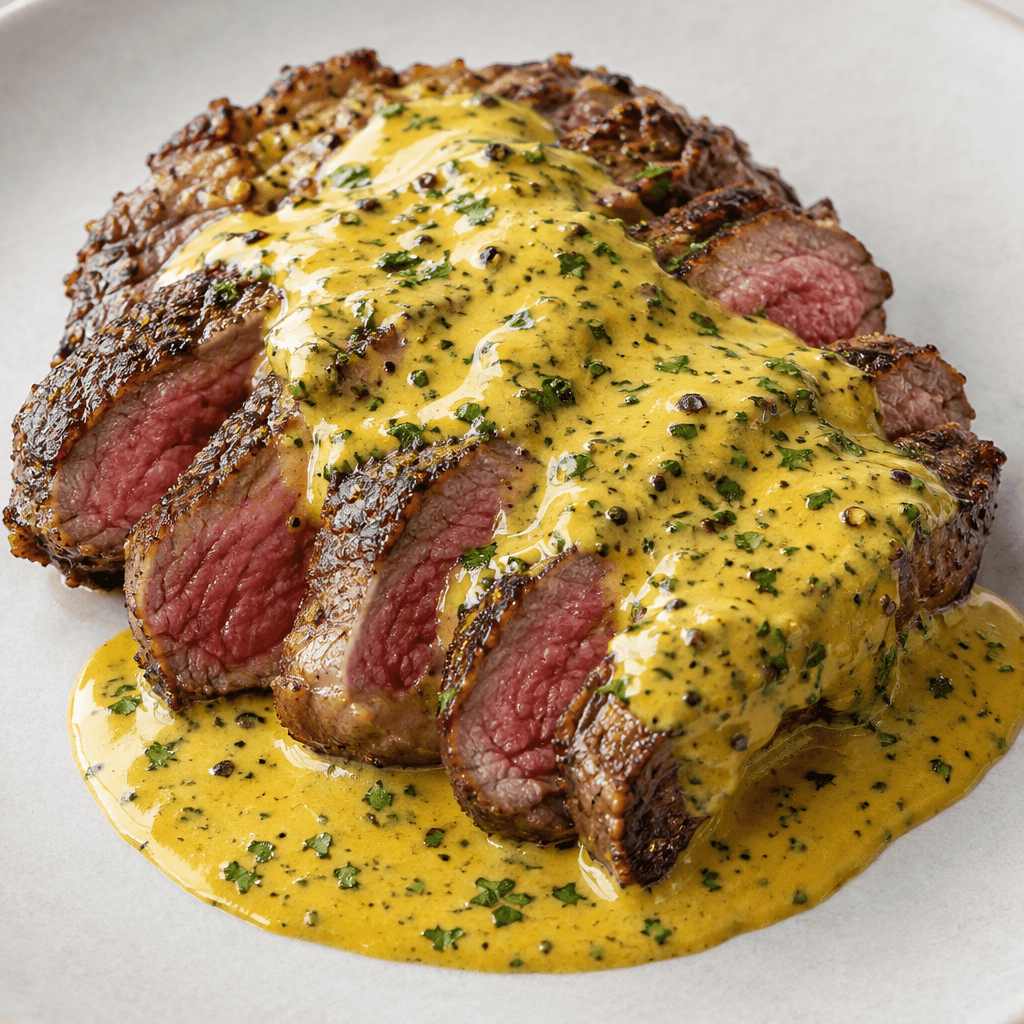
Cafe de Paris sauce Calories
Classic butter-based sauce enriched with herbs and spices.
In season: Spring · Summer · Autumn · Winter
CALORIES
GI
POTASSIUM
FIBER
Quick answer
2 tablespoon (medium) of Cafe de Paris sauce (30 g) has 126 calories. That works out to 420 calories per 100 g. It contains 1.7 g of carbs, 0.6 g of protein, 13.2 g of fat and 0.2 g of fiber. Its 129 µg of Vitamin A covers 14% of the Daily Value. Its glycemic index is 35 (low), so it raises blood sugar slowly.
What is Cafe de Paris sauce?
Cafe de Paris sauce is a rich, buttery sauce associated with Geneva, Switzerland, despite its Parisian-sounding name. Recipes vary, but herbs and spices give it its savoury flavour and often speckled appearance. It became especially well known served with steak at a Geneva restaurant.
It is typically spooned over grilled steak or served alongside it, often with fries; the smooth, glossy sauce also works with other grilled meats. Butter makes it energy-dense and high in fat: it contains 44 g of fat per 100 g. A modest spoonful adds plenty of flavour, so serve it on the side if you want more control over how much you use.
Cafe de Paris sauce Nutrition Facts
Selected: 100 g
420
KCAL / 100G
Carbs
5.5g
· 2% DV
Protein
2.1g
· 4% DV
Fat
44g
· 56% DV
Fiber
0.6g
· 2% DV
DV is the share of the daily value covered, on a 2,000 kcal reference diet.
Calories come from: Carbs 5% · Protein 2% · Fat 93%
Cafe de Paris sauce Vitamins & Minerals
Vitamins
Vitamin A
430µg · 48% DV
Vitamin K
18µg · 15% DV
B2
0.18mg · 14% DV
B12
0.18µg · 8% DV
Minerals
Sodium
650mg · 28% DV
Phosphorus
47mg · 7% DV
Calcium
55mg · 6% DV
Iron
1mg · 6% DV
How Nutritious Is Cafe de Paris sauce?
Nutrient density
Low
How many vitamins, minerals and how much fiber this food carries per calorie. A high score means a lot of nutrition for few calories.
Satiety score
Low
An EatBetter score computed from fiber, protein and calorie density. A high score means staying full longer on the same calories.
Both scores are calculated per 100 g and do not change with the selected portion. The satiety score is EatBetter's own calculation, not a clinical measure.
Cafe de Paris sauce Glycemic Index
GLYCEMIC INDEX
GLYCEMIC LOAD
Accounts for portion size — a more realistic measure than GI alone.
How to Burn Off Cafe de Paris sauce
To burn the 420 calories in 100 g:
🚶
Walking (5 km/h)
🏃
Running (8 km/h)
🚴
Cycling
🏊
Swimming
Times are calculated with the MET equation for a 70 kg adult. Actual burn varies with your weight, age and pace.
Is Cafe de Paris sauce Processed?
NOVA 3
Processed
1. Unprocessed
2. Minimally Processed
3. Processed
4. Ultra-Processed
NOVA classifies foods into 4 groups by industrial processing. NOVA 1 (unprocessed) is the healthiest.
Does Cafe de Paris sauce Contain Allergens?
Contains these allergens:
Which Diets Is Cafe de Paris sauce Good For?
Vegan
— Not suitable
Vegetarian
— Not suitable
Gluten-Free
— Not suitable
Dairy-Free
— Not suitable
Mediterranean
✓ Suitable
Paleo
— Not suitable
Whole30
— Not suitable
DASH
— Not suitable
Keto
— Not suitable
Low FODMAP
— Not suitable
Cafe de Paris sauce Fat Profile
SATURATED
28g
MONOUNSATURATED
11g
POLYUNSATURATED
2.2g
Omega 6:3 ratio 3.1:1
Below the ideal 4:1 — a good omega balance.
Compare Cafe de Paris sauce
Foods Similar to Cafe de Paris sauce
Frequently Asked Questions About Cafe de Paris sauce
What is Cafe de Paris sauce?
Cafe de Paris sauce is a rich, herb-and-spice butter sauce, best known as an accompaniment to grilled steak. Recipes vary, but the sauce is usually served melting over hot meat rather than as a thin, pourable gravy.
What is in Cafe de Paris sauce?
Cafe de Paris sauce commonly combines butter with herbs, mustard, garlic, and spices. There is no single fixed ingredient list: some versions add cream, anchovies, or other seasonings, so the flavor can differ between restaurants and recipes.
How do you make Cafe de Paris sauce at home?
To make Cafe de Paris sauce at home, mix softened butter with finely chopped herbs, garlic, mustard, and seasonings, then chill the mixture until firm. Place a slice on freshly grilled steak and let the heat melt it into a sauce.
What do you serve with Cafe de Paris sauce?
Cafe de Paris sauce is most famously served with grilled steak, but it also works with roast potatoes, fries, or grilled chicken. Its rich flavor pairs well with simple sides such as green salad or plain vegetables.
Where did Cafe de Paris sauce originate?
Despite its name, Cafe de Paris sauce is generally associated with Geneva, Switzerland, rather than Paris. It became famous as the butter-based accompaniment served with steak at a restaurant called Café de Paris.
Is Cafe de Paris sauce served hot or cold?
Cafe de Paris sauce is usually served over hot steak, where the butter melts and releases its herbs and spices. For a traditional butter-based version, you can add the chilled mixture directly to the meat instead of heating it separately.
What is the difference between Cafe de Paris sauce and béarnaise sauce?
Cafe de Paris sauce is typically seasoned compound butter, while béarnaise is an emulsified sauce made with egg yolks and butter, usually flavored with tarragon and vinegar. Béarnaise is whisked into a smooth sauce; Cafe de Paris often melts over steak.
Can you make a lighter Cafe de Paris sauce?
Yes. For a lighter take on Cafe de Paris sauce, use less butter and blend herbs and seasonings into a yogurt-based sauce; the result will not have the classic buttery richness. Add it off the heat to keep the yogurt from splitting.
How should you store leftover Cafe de Paris sauce?
Store leftover Cafe de Paris sauce in a covered container in the refrigerator, rather than leaving it out at room temperature. Reheat it gently if needed; high heat can cause a butter-based sauce to separate.
Can you put Cafe de Paris sauce on pasta or potatoes?
Yes, Cafe de Paris sauce can be served with pasta or potatoes, although its buttery flavor is strong. Start with a small amount, toss it through hot pasta or spoon it over cooked potatoes, and serve right away.
Have another question about Cafe de Paris sauce?
Ask the AI nutrition coach — calories, portions, alternatives and more, answered in seconds in the app.

Scan calories with your camera
Instant AI nutrition analysis

Nutrition data compiled from USDA FoodData Central and scientific sources.