

Ready & Packaged Foods
All →Vegetables & Legumes
All →Desserts & Confectionery
All →Meat & Protein
All →Grains & Bakery
All →Beverages
All →Milk & Dairy
All →

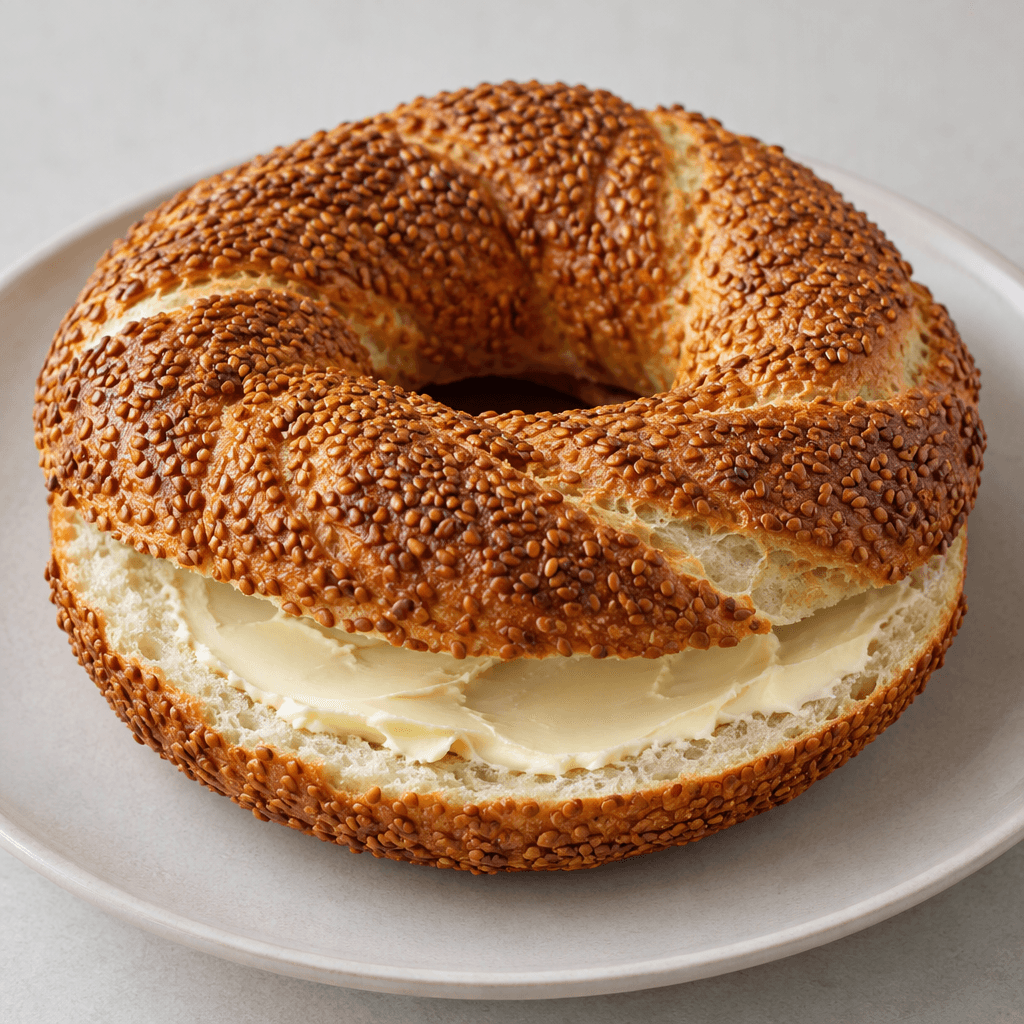
Buttered Simit Calories
Turkish simit with butter spread, crispy and rich.
In season: Spring · Summer · Autumn · Winter
CALORIES
GI
POTASSIUM
FIBER
Quick answer
1 piece (medium) of Buttered Simit (110 g) has 380 calories. That works out to 345 calories per 100 g. It contains 57.2 g of carbs, 9.4 g of protein, 12.7 g of fat and 3.1 g of fiber. Its 407 mg of Sodium covers 18% of the Daily Value. Its glycemic index is 65 (medium), so it raises blood sugar at a moderate pace.
What is Buttered Simit?
Buttered simit is a Turkish sesame bread ring, split and spread with butter. It has a deeply browned, crunchy crust and a soft centre; when the bread is warm, the butter turns creamy between the halves.
In Turkey, simit is a familiar breakfast and tea-time snack, often bought fresh from a bakery or street vendor. Butter makes it richer and more filling, while the bread itself is mainly a source of carbohydrates; a 100 g portion provides 345 calories. For a lighter breakfast, share one or eat half alongside fresh tomatoes and cucumber, or enjoy it with tea as a simple snack.
Buttered Simit Nutrition Facts
Selected: 100 g
345
KCAL / 100G
Carbs
52g
· 19% DV
Protein
8.5g
· 17% DV
Fat
11.5g
· 15% DV
Fiber
2.8g
· 10% DV
DV is the share of the daily value covered, on a 2,000 kcal reference diet.
Calories come from: Carbs 60% · Protein 10% · Fat 30%
Buttered Simit Vitamins & Minerals
Vitamins
B1
0.18mg · 15% DV
Vitamin A
120µg · 13% DV
B3
2.1mg · 13% DV
B2
0.11mg · 8% DV
Minerals
Sodium
370mg · 16% DV
Selenium
7.5µg · 14% DV
Phosphorus
85mg · 12% DV
Iron
2mg · 11% DV
How Nutritious Is Buttered Simit?
Nutrient density
Low
How many vitamins, minerals and how much fiber this food carries per calorie. A high score means a lot of nutrition for few calories.
Satiety score
Low
An EatBetter score computed from fiber, protein and calorie density. A high score means staying full longer on the same calories.
Both scores are calculated per 100 g and do not change with the selected portion. The satiety score is EatBetter's own calculation, not a clinical measure.
Buttered Simit Glycemic Index
GLYCEMIC INDEX
GLYCEMIC LOAD
Accounts for portion size — a more realistic measure than GI alone.
How to Burn Off Buttered Simit
To burn the 345 calories in 100 g:
🚶
Walking (5 km/h)
🏃
Running (8 km/h)
🚴
Cycling
🏊
Swimming
Times are calculated with the MET equation for a 70 kg adult. Actual burn varies with your weight, age and pace.
Is Buttered Simit Processed?
NOVA 3
Processed
1. Unprocessed
2. Minimally Processed
3. Processed
4. Ultra-Processed
NOVA classifies foods into 4 groups by industrial processing. NOVA 1 (unprocessed) is the healthiest.
Does Buttered Simit Contain Allergens?
Contains these allergens:
Which Diets Is Buttered Simit Good For?
Vegan
— Not suitable
Vegetarian
✓ Suitable
Gluten-Free
— Not suitable
Dairy-Free
— Not suitable
Mediterranean
✓ Suitable
Paleo
— Not suitable
Whole30
— Not suitable
DASH
— Not suitable
Keto
— Not suitable
Low FODMAP
— Not suitable
Buttered Simit Fat Profile
SATURATED
4.7g
MONOUNSATURATED
4.2g
POLYUNSATURATED
2.3g
Omega 6:3 ratio 26.3:1
Above the ideal 4:1 (26.3:1).
Compare Buttered Simit
Foods Similar to Buttered Simit
Frequently Asked Questions About Buttered Simit
What is Buttered Simit?
Buttered Simit is Turkish sesame-coated, ring-shaped bread split open and spread with butter. It is commonly served warm, when the butter softens against the bread’s pale interior while the sesame crust stays pleasantly crisp.
Where does Buttered Simit come from?
Buttered Simit is based on simit, a traditional Turkish sesame bread strongly associated with Istanbul and sold by street vendors and bakeries. Adding butter is a simple serving style rather than a separate kind of dough.
How is Buttered Simit different from a bagel?
Buttered Simit has a sesame-covered crust and is typically shaped as a thinner ring; a bagel is usually denser and made using a different preparation method. Buttered Simit is cut and spread with butter, while a bagel may be served with many kinds of fillings.
How do you eat Buttered Simit?
Eat Buttered Simit by pulling or cutting it into pieces and having it while warm. It pairs well with tea, cheese, olives, or fresh vegetables; the butter is already part of the bread, so additional spreads are optional.
How do you make Buttered Simit at home?
To make Buttered Simit, slice a sesame simit across the middle and spread butter on the cut surface. Warm the bread first if you want the butter to soften and spread easily, or toast it lightly for a crisper crust.
What is the best way to reheat Buttered Simit?
Reheat Buttered Simit in an oven or dry pan to bring back some crust crispness. A microwave warms it quickly but tends to make the bread soft, and overheating can cause the butter to melt out.
How should you store Buttered Simit?
For the best texture, eat Buttered Simit soon after it is prepared. Store leftovers covered in the refrigerator rather than leaving the buttered bread out for an extended time; warm it in an oven or pan before serving.
Can you freeze Buttered Simit?
Yes, you can freeze Buttered Simit in an airtight wrap, though thawing may soften its crust. Reheat it in an oven for a better texture. For a fresher result, freeze plain simit and add the butter after thawing.
Why does Buttered Simit turn soggy?
Buttered Simit can turn soggy when warm bread traps steam in a sealed container or the butter softens into the crumb. Let excess heat escape before storing it, and spread the butter shortly before serving to preserve more crunch.
Is Buttered Simit a good choice before a workout?
Buttered Simit can provide carbohydrate before exercise, but its butter-rich topping may feel heavy if eaten immediately before a workout. If you choose it, allow time to digest and see how the portion feels during your activity.
Have another question about Buttered Simit?
Ask the AI nutrition coach — calories, portions, alternatives and more, answered in seconds in the app.

Scan calories with your camera
Instant AI nutrition analysis

Nutrition data compiled from USDA FoodData Central and scientific sources.