

Ready & Packaged Foods
All →Vegetables & Legumes
All →Desserts & Confectionery
All →Meat & Protein
All →Grains & Bakery
All →Beverages
All →Milk & Dairy
All →

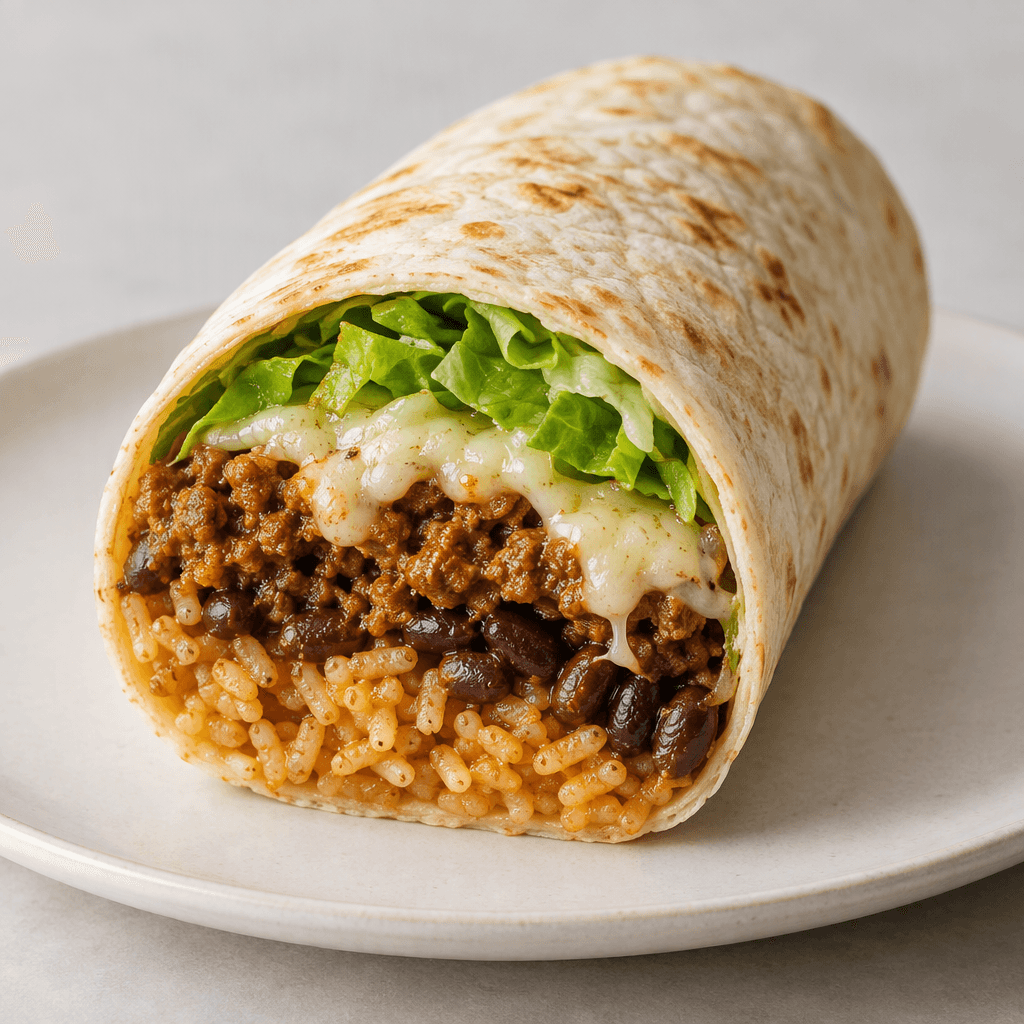
Burrito Calories
Stuffed tortilla with beans, rice, meat or vegetables
In season: Spring · Summer · Autumn · Winter
CALORIES
GI
POTASSIUM
FIBER
Quick answer
1 piece (medium) of Burrito (220 g) has 462 calories. That works out to 210 calories per 100 g. It contains 70.4 g of carbs, 16.5 g of protein, 12.1 g of fat and 9.2 g of fiber. Its 924 mg of Sodium covers 40% of the Daily Value. Its glycemic index is 55 (medium), so it raises blood sugar at a moderate pace.
What is Burrito?
A burrito is a filled flour tortilla, rolled into a compact parcel. It is associated with northern Mexico and has many variations, including the Mexican-American and Tex-Mex styles popular in the United States. Rice, beans and seasoned meat are common fillings; vegetables, cheese and sauces may be added too.
It is usually served warm and eaten by hand, making it a familiar lunch or quick, filling meal in many places. The tortilla and rice provide much of its carbohydrate, while beans contribute fibre and plant protein; meat adds more protein. For a lighter version, choose extra vegetables and beans, go easy on rice and cheese, or serve rich sauces on the side.
Burrito Nutrition Facts
Selected: 100 g
210
KCAL / 100G
Carbs
32g
· 12% DV
Protein
7.5g
· 15% DV
Fat
5.5g
· 7% DV
Fiber
4.2g
· 15% DV
DV is the share of the daily value covered, on a 2,000 kcal reference diet.
Calories come from: Carbs 62% · Protein 14% · Fat 24%
Burrito Vitamins & Minerals
Vitamins
B3
2.1mg · 13% DV
B12
0.3µg · 13% DV
B5
0.6mg · 12% DV
B1
0.13mg · 11% DV
Minerals
Sodium
420mg · 18% DV
Selenium
7.5µg · 14% DV
Phosphorus
95mg · 14% DV
Iron
2mg · 11% DV
How Nutritious Is Burrito?
Nutrient density
Medium
How many vitamins, minerals and how much fiber this food carries per calorie. A high score means a lot of nutrition for few calories.
Satiety score
Medium
An EatBetter score computed from fiber, protein and calorie density. A high score means staying full longer on the same calories.
Both scores are calculated per 100 g and do not change with the selected portion. The satiety score is EatBetter's own calculation, not a clinical measure.
Burrito Glycemic Index
GLYCEMIC INDEX
GLYCEMIC LOAD
Accounts for portion size — a more realistic measure than GI alone.
How to Burn Off Burrito
To burn the 210 calories in 100 g:
🚶
Walking (5 km/h)
🏃
Running (8 km/h)
🚴
Cycling
🏊
Swimming
Times are calculated with the MET equation for a 70 kg adult. Actual burn varies with your weight, age and pace.
Is Burrito Processed?
NOVA 3
Processed
1. Unprocessed
2. Minimally Processed
3. Processed
4. Ultra-Processed
NOVA classifies foods into 4 groups by industrial processing. NOVA 1 (unprocessed) is the healthiest.
Does Burrito Contain Allergens?
Contains these allergens:
Which Diets Is Burrito Good For?
Vegan
— Not suitable
Vegetarian
— Not suitable
Gluten-Free
— Not suitable
Dairy-Free
— Not suitable
Mediterranean
✓ Suitable
Paleo
— Not suitable
Whole30
— Not suitable
DASH
— Not suitable
Keto
— Not suitable
Low FODMAP
— Not suitable
Burrito Fat Profile
SATURATED
1.6g
MONOUNSATURATED
2.1g
POLYUNSATURATED
1g
Omega 6:3 ratio 9.4:1
Above the ideal 4:1 (9.4:1).
Compare Burrito
Foods Similar to Burrito
Frequently Asked Questions About Burrito
What is usually inside a burrito?
A burrito usually wraps fillings such as rice, beans, meat or vegetables, cheese, and salsa in a large flour tortilla. The exact combination varies: some include guacamole, sour cream, or lettuce, while regional styles may focus on just a few ingredients.
What is the difference between a burrito and a taco?
A burrito is typically made with a large tortilla folded closed around its filling, while a taco is usually smaller and left open or folded loosely. Burritos often include rice and beans as substantial fillings; tacos commonly feature a more focused topping combination.
How do you roll a burrito without it falling apart?
Warm the tortilla briefly so it bends easily, then place the filling in a compact line below the center. Fold the bottom over the filling, tuck in both sides, and roll firmly away from you. Avoid overfilling, which is the main reason burritos split.
What is the difference between a Mission burrito and a California burrito?
A Mission burrito is a large, tightly wrapped San Francisco-style burrito, often served in foil and filled with rice, beans, meat, and other options. A California burrito is associated with San Diego and is distinguished by French fries inside, commonly with carne asada and cheese.
Where did the burrito originate?
The burrito is rooted in Mexican cuisine, particularly northern Mexico, where flour tortillas are traditional. Its exact origin is debated, but the large, heavily filled burrito familiar in the United States developed through Mexican-American food traditions.
Can you freeze a burrito?
Yes. Let the burrito cool, wrap it tightly, and freeze it in an airtight bag or container. Burritos without lettuce, sour cream, or fresh salsa freeze best, since those ingredients can become watery or lose their texture after thawing.
How long does a burrito last in the fridge?
A cooked burrito can generally be kept refrigerated for a few days if it is cooled promptly and stored in a covered container. Keep wet toppings such as salsa and sour cream separate when possible, since they can make the tortilla soggy.
What is a wet burrito?
A wet burrito is a burrito covered with sauce, often red or green chile sauce, and sometimes melted cheese. Unlike a regular burrito that can be picked up and eaten by hand, it is usually served on a plate and eaten with a fork.
What is a breakfast burrito made of?
A breakfast burrito commonly contains scrambled eggs with ingredients such as potatoes, cheese, beans, sausage, or vegetables, all wrapped in a tortilla. It can be assembled ahead, but keep fresh salsa separate until serving to prevent the tortilla from becoming soggy.
Is a burrito a healthy meal?
A burrito can be a balanced meal when it combines beans or lean meat with vegetables and a moderate amount of cheese or creamy sauce. Large portions and generous amounts of salty fillings can make it less balanced, so customizing the fillings is useful.
Have another question about Burrito?
Ask the AI nutrition coach — calories, portions, alternatives and more, answered in seconds in the app.

Scan calories with your camera
Instant AI nutrition analysis

Nutrition data compiled from USDA FoodData Central and scientific sources.