

Ready & Packaged Foods
All →Vegetables & Legumes
All →Desserts & Confectionery
All →Meat & Protein
All →Grains & Bakery
All →Beverages
All →Milk & Dairy
All →

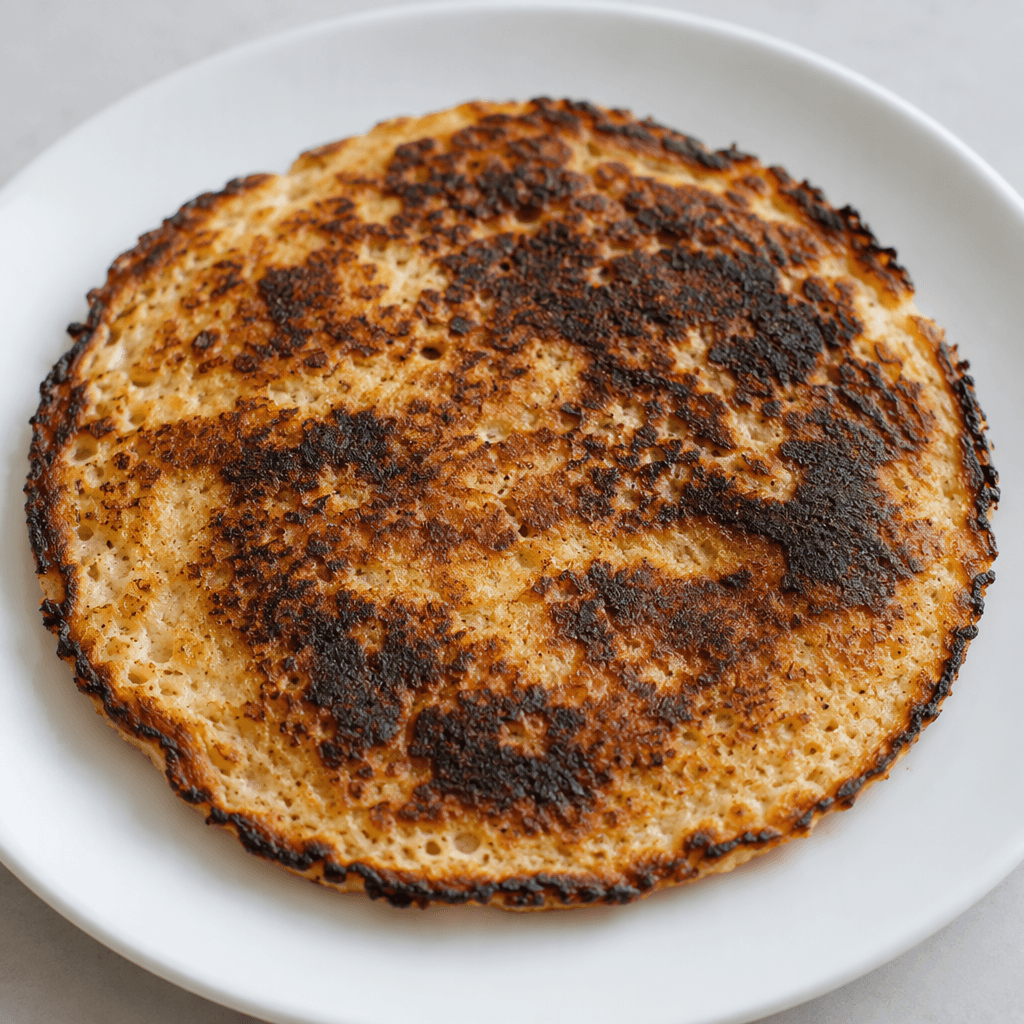
Burnt pancake Calories
Burnt pancake, charred surface, reduced vitamins, increased harmful compounds
In season: Spring · Summer · Autumn · Winter
CALORIES · 100 G
GI
POTASSIUM · 100 G
FIBER · 100 G
Quick answer
1 piece (medium) of Burnt pancake (60 g) has 150 calories. That works out to 250 calories per 100 g. It contains 26.4 g of carbs, 3.6 g of protein, 3.6 g of fat and 0.9 g of fiber. Its 66 mg of Phosphorus covers 9% of the Daily Value. Its glycemic index is 70 (high), so it raises blood sugar quickly.
Burnt pancake Nutrition Facts
Selected: 1 piece (medium) · 60 g
150
KCAL / 60G
Carbs
26.4g
· 10% DV
Protein
3.6g
· 7% DV
Fat
3.6g
· 5% DV
Fiber
0.9g
· 3% DV
DV is the share of the daily value covered, on a 2,000 kcal reference diet.
Calories come from: Carbs 69% · Protein 9% · Fat 22%
Burnt pancake nutrition facts table · 1 piece (medium) (60 g)
| Nutrient | Amount | % DV |
|---|---|---|
| Calories | 150 kcal | |
| Total fat | 3.6 g | 5% |
| Saturated fat | 1.32 g | 7% |
| Trans fat | 0.03 g | |
| Sodium | 204 mg | 9% |
| Total carbohydrate | 26.4 g | 10% |
| Fiber | 0.9 g | 3% |
| Protein | 3.6 g | 7% |
Calories: Calories measure energy. Average daily need is 2,000 kcal. Excess calories are stored as fat, too few cause weight loss.
Carbs: Your body's primary energy source. The brain runs exclusively on carbs. Daily need: 275g.
Protein: Essential for muscle repair and cell growth. Daily need: 50g. Keeps you full and boosts metabolism.
Fat: Needed for hormone production and vitamin absorption. Daily need: 78g. Limit saturated fats, choose unsaturated.
Fiber: Critical for digestive health and satiety. Daily need: 28g. Stabilizes blood sugar, lowers cholesterol.

Log this food in EatBetter
100,000+ people use it
- Get your daily calorie target
- Snap your meal, log it in seconds
- See every vitamin and mineral

📸 Scan the code to get the app free.

How Many Calories in 1 Medium Burnt pancake?
| Serving | Amount | Calories |
|---|---|---|
| 1 piece (medium) | 60 g | 150 kcal |
| 1 piece (extra small) | 30 g | 75 kcal |
| ½ piece (half) | 30 g | 75 kcal |
| 1 piece (small) | 40 g | 100 kcal |
| 1 piece (thin) | 40 g | 100 kcal |
| 1 piece (whole) | 60 g | 150 kcal |
| 1 piece (thick) | 80 g | 200 kcal |
| 1 piece (large) | 90 g | 225 kcal |
| 100 g | 100 g | 250 kcal |
| 2 piece (double) | 120 g | 300 kcal |
| 1 piece (extra large) | 120 g | 300 kcal |
Calculated from 250 calories per 100 g.
Frequently Asked Questions About Burnt pancake
Can you eat a burnt pancake?
Yes, if it is only lightly over-browned; cut away any blackened parts. If the pancake is charred throughout, it is better to throw it away, since the bitter taste cannot be fixed and heavily burnt surfaces are best avoided.
Why do pancakes burn so quickly?
Pancakes often burn because the pan is too hot, especially when the batter contains sugar. Lower the heat to medium-low and let the pan settle before adding more batter; a pan that keeps getting hotter can scorch each pancake faster.
Why is my pancake burnt outside but raw inside?
A very hot pan and thick batter can brown the outside before heat reaches the centre. Lower the heat and make thinner pancakes so the inside has time to cook without the surface turning black.
How do you stop pancakes from burning?
Cook pancakes over medium-low heat in a lightly greased pan, and watch them rather than relying only on a timer. Flip when bubbles appear on top and the edges look set; the second side usually needs less time.
Are burnt pancakes bad for you?
Eating a heavily charred pancake is best avoided. High-temperature cooking can form unwanted compounds, including acrylamide, in starchy foods; a lightly browned pancake eaten occasionally is not the same as regularly eating blackened food.
Can you save a burnt pancake?
You can salvage a mildly burnt pancake by trimming off the dark edges or scraping away a thin burnt layer. If the bitter, smoky taste has spread through it, toppings such as syrup will cover the flavour rather than remove it.
When should you flip a pancake?
Flip a pancake when bubbles have formed across the top and the edges begin to look set. If the underside is already very dark, turn the heat down before cooking the next one instead of waiting for the same signs.
Why does a pancake stick to the pan and burn?
A pancake may stick if the pan is damaged, not properly heated, or insufficiently greased. Use a clean pan with a sound cooking surface, add a thin coating of oil or butter, and wait until the edges release before turning it.
How should you store leftover pancakes?
Let cooked pancakes cool, then refrigerate them in a covered container. Keeping a burnt pancake cold will not remove its scorched taste, so discard it if it is charred or has developed an unpleasant smell or sticky texture.
How do you clean a pan after a pancake burns onto it?
Let the pan cool, then soak it in warm, soapy water until the burnt batter softens. Wipe it with a non-abrasive sponge; scraping a non-stick pan with a knife or metal scourer can damage its coating.
Burnt pancake Vitamins & Minerals
Vitamins
B3
0.72mg · 5% DV
B2
0.05mg · 4% DV
Biotin
1.2µg · 4% DV
B12
0.09µg · 4% DV
Minerals
Phosphorus
66mg · 9% DV
Sodium
204mg · 9% DV
Selenium
3µg · 5% DV
Manganese
0.12mg · 5% DV
Potassium ⭐
72mg · 2% DV
Burnt pancake Glycemic Index
GLYCEMIC INDEX
GLYCEMIC LOAD
Accounts for portion size — a more realistic measure than GI alone.
How to Burn Off Burnt pancake
To burn the 150 calories in 1 piece (medium) (60 g):
🚶
Walking (5 km/h)
🏃
Running (8 km/h)
🚴
Cycling
🏊
Swimming
Times are calculated with the MET equation for a 70 kg adult. Actual burn varies with your weight, age and pace.
What is Burnt pancake?
A burnt pancake is a pancake made from a flour, egg and milk batter that has been left on the pan too long, leaving a dark or charred surface. It is not a separate traditional recipe so much as an overcooked version of a familiar breakfast dish. The outside may taste bitter or feel crisp, while the middle can remain soft.
Pancakes are commonly served at breakfast in many places, with toppings such as fruit, syrup, honey or yoghurt. A burnt pancake is best enjoyed only if the dark patches are mild; you can cut away heavily charred areas rather than masking their taste with extra toppings. It is mainly a source of carbohydrate, with 44 g per 100 g, and pairs well with fruit and yoghurt for a more rounded meal.
How Nutritious Is Burnt pancake?
Nutrient density
Low
How many vitamins, minerals and how much fiber this food carries per calorie. A high score means a lot of nutrition for few calories.
Satiety score
Low
An EatBetter score computed from fiber, protein and calorie density. A high score means staying full longer on the same calories.
Both scores are calculated per 100 g and do not change with the selected portion. The satiety score is EatBetter's own calculation, not a clinical measure.
Is Burnt pancake Processed?
NOVA 3
Processed
1. Unprocessed
2. Minimally Processed
3. Processed
4. Ultra-Processed
NOVA classifies foods into 4 groups by industrial processing. NOVA 1 (unprocessed) is the healthiest.
Does Burnt pancake Contain Allergens?
Contains these allergens:
Which Diets Is Burnt pancake Good For?
Vegan
— Not suitable
Vegetarian
✓ Suitable
Gluten-Free
— Not suitable
Dairy-Free
— Not suitable
Mediterranean
— Not suitable
Paleo
— Not suitable
Whole30
— Not suitable
DASH
— Not suitable
Keto
— Not suitable
Low FODMAP
— Not suitable
Burnt pancake Fat Profile
SATURATED
1.32g
MONOUNSATURATED
1.26g
POLYUNSATURATED
0.36g
Omega 6:3 ratio 30:1
Above the ideal 4:1 (30:1).
Compare Burnt pancake
Foods Similar to Burnt pancake
Have another question about Burnt pancake?
Ask the AI nutrition coach — calories, portions, alternatives and more, answered in seconds in the app.

Scan calories with your camera
Instant AI nutrition analysis

Nutrition data compiled from USDA FoodData Central and scientific sources.