

Ready & Packaged Foods
All →Vegetables & Legumes
All →Desserts & Confectionery
All →Meat & Protein
All →Grains & Bakery
All →Beverages
All →Milk & Dairy
All →

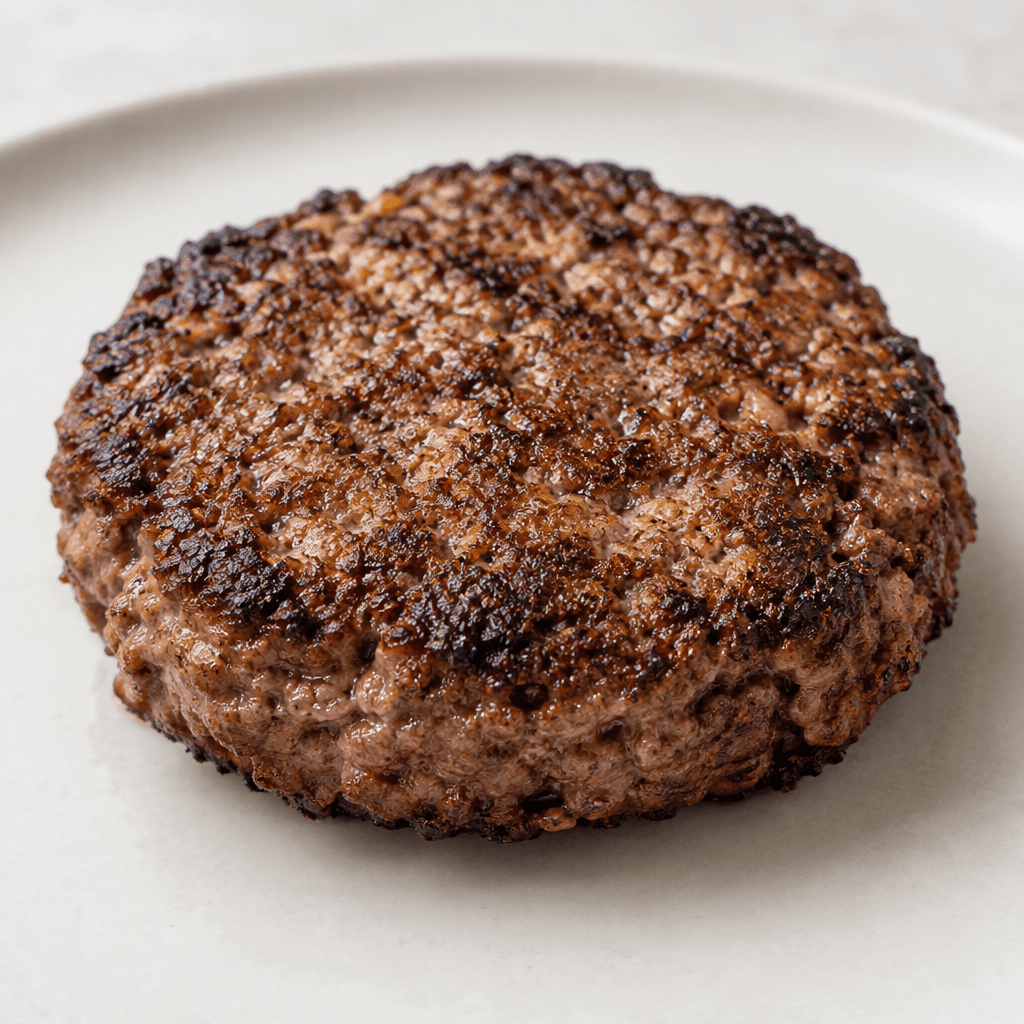
Beef Burger Patty Calories
Classic beef burger patty, high in protein and iron.
CALORIES
GI
POTASSIUM
FIBER
Quick answer
1 piece (medium) of Beef Burger Patty (120 g) has 300 calories. That works out to 250 calories per 100 g. It contains 0.6 g of carbs, 22.2 g of protein, 22.8 g of fat and 0 g of fiber. Its 2.8 µg of B12 covers 115% of the Daily Value. Its glycemic index is 0 (low), so it raises blood sugar slowly.
What is Beef Burger Patty?
A beef burger patty is ground beef shaped into a round, usually seasoned simply with salt and pepper, then cooked on a grill or in a pan. It is closely associated with the American hamburger, though patties are now made and enjoyed around the world, with recipes ranging from loosely packed to firmly shaped.
A good sear gives the outside a browned crust while the middle stays tender and juicy. Serve it in a bun with lettuce, tomato, onion and condiments, or on its own with potatoes or a salad. It provides substantial protein and iron, while its fat content depends on the mince. For a lighter meal, choose leaner ground beef and pair the patty with vegetables.
Beef Burger Patty Nutrition Facts
Selected: 100 g
250
KCAL / 100G
Carbs
0.5g
· 0% DV
Protein
18.5g
· 37% DV
Fat
19g
· 24% DV
Fiber
0g
· 0% DV
DV is the share of the daily value covered, on a 2,000 kcal reference diet.
Calories come from: Carbs 1% · Protein 30% · Fat 69%
Beef Burger Patty Vitamins & Minerals
Vitamins
B12
2.3µg · 96% DV
B3
4.5mg · 28% DV
B6
0.36mg · 21% DV
B2
0.21mg · 16% DV
Minerals
Zinc
5mg · 45% DV
Phosphorus
180mg · 26% DV
Selenium
13µg · 24% DV
Iron
3mg · 17% DV
How Nutritious Is Beef Burger Patty?
Nutrient density
High
How many vitamins, minerals and how much fiber this food carries per calorie. A high score means a lot of nutrition for few calories.
Satiety score
Medium
An EatBetter score computed from fiber, protein and calorie density. A high score means staying full longer on the same calories.
Both scores are calculated per 100 g and do not change with the selected portion. The satiety score is EatBetter's own calculation, not a clinical measure.
Beef Burger Patty Glycemic Index
GLYCEMIC INDEX
GLYCEMIC LOAD
Accounts for portion size — a more realistic measure than GI alone.
How to Burn Off Beef Burger Patty
To burn the 250 calories in 100 g:
🚶
Walking (5 km/h)
🏃
Running (8 km/h)
🚴
Cycling
🏊
Swimming
Times are calculated with the MET equation for a 70 kg adult. Actual burn varies with your weight, age and pace.
Is Beef Burger Patty Processed?
NOVA 2
Minimally Processed
1. Unprocessed
2. Minimally Processed
3. Processed
4. Ultra-Processed
NOVA classifies foods into 4 groups by industrial processing. NOVA 1 (unprocessed) is the healthiest.
Does Beef Burger Patty Contain Allergens?
No known major allergens
Which Diets Is Beef Burger Patty Good For?
Vegan
— Not suitable
Vegetarian
— Not suitable
Gluten-Free
✓ Suitable
Dairy-Free
— Not suitable
Mediterranean
✓ Suitable
Paleo
✓ Suitable
Whole30
— Not suitable
DASH
— Not suitable
Keto
✓ Suitable
Low FODMAP
— Not suitable
Beef Burger Patty Fat Profile
SATURATED
8.2g
MONOUNSATURATED
8.7g
POLYUNSATURATED
0.5g
Omega 6:3 ratio 1.9:1
Below the ideal 4:1 — a good omega balance.
Compare Beef Burger Patty
Foods Similar to Beef Burger Patty
Frequently Asked Questions About Beef Burger Patty
How do you cook a beef burger patty in a pan?
Heat a heavy pan until hot, add the beef burger patty, and let it brown before turning it. Avoid pressing it with a spatula, which squeezes out juices. Cook until the center reaches a safe temperature, then let it rest briefly.
What temperature should a beef burger patty reach?
A beef burger patty should reach 160°F (71°C) in the center. Ground beef needs more thorough cooking than a whole steak because bacteria from the meat’s surface can be mixed throughout when it is minced. Check with a food thermometer.
Why does a beef burger patty shrink when cooked?
A beef burger patty shrinks as its fat and moisture render out under heat, and the meat fibers contract. Make a shallow dimple in the center before cooking to help it stay flatter, and avoid pressing it while it cooks.
How do you keep a beef burger patty juicy?
Handle the beef burger patty as little as possible, shape it gently, and don’t press it on the grill or in the pan. Cook it until safely done rather than leaving it over the heat, then give it a short rest before serving.
What should you season a beef burger patty with?
Salt and black pepper are enough to season a beef burger patty while keeping the beef flavor prominent. Season the outside shortly before cooking instead of kneading salt into the meat well in advance, which can make the texture denser.
Does a beef burger patty need egg or breadcrumbs?
No, a beef burger patty does not need egg or breadcrumbs if the ground beef is shaped gently and kept cold. Those binders make it more like a meatball or meatloaf; they are useful mainly when a mixture is too loose to hold its shape.
Can you freeze a beef burger patty?
Yes, you can freeze a beef burger patty. Freeze patties in a single layer first, then pack them in an airtight freezer bag with parchment between them. This keeps them from sticking together and lets you remove only the portions you need.
Can you cook a beef burger patty from frozen?
Yes, a beef burger patty can be cooked from frozen, but it takes longer than a thawed one. Use moderate heat so the outside does not burn before the center cooks, and check the middle with a thermometer before serving.
How long does a raw beef burger patty last in the fridge?
Keep a raw beef burger patty refrigerated for 1–2 days before cooking. Store it covered on the lowest shelf to prevent meat juices from dripping onto other foods. Freeze it if you will not cook it within that time.
How long can you keep cooked beef burger patty leftovers?
Cooked beef burger patty leftovers keep in the refrigerator for 3–4 days when stored in a covered container. Reheat them until steaming hot throughout, and refrigerate leftovers promptly rather than leaving them at room temperature for an extended period.
Have another question about Beef Burger Patty?
Ask the AI nutrition coach — calories, portions, alternatives and more, answered in seconds in the app.

Scan calories with your camera
Instant AI nutrition analysis

Nutrition data compiled from USDA FoodData Central and scientific sources.