

Ready & Packaged Foods
All →Vegetables & Legumes
All →Desserts & Confectionery
All →Meat & Protein
All →Grains & Bakery
All →Beverages
All →Milk & Dairy
All →

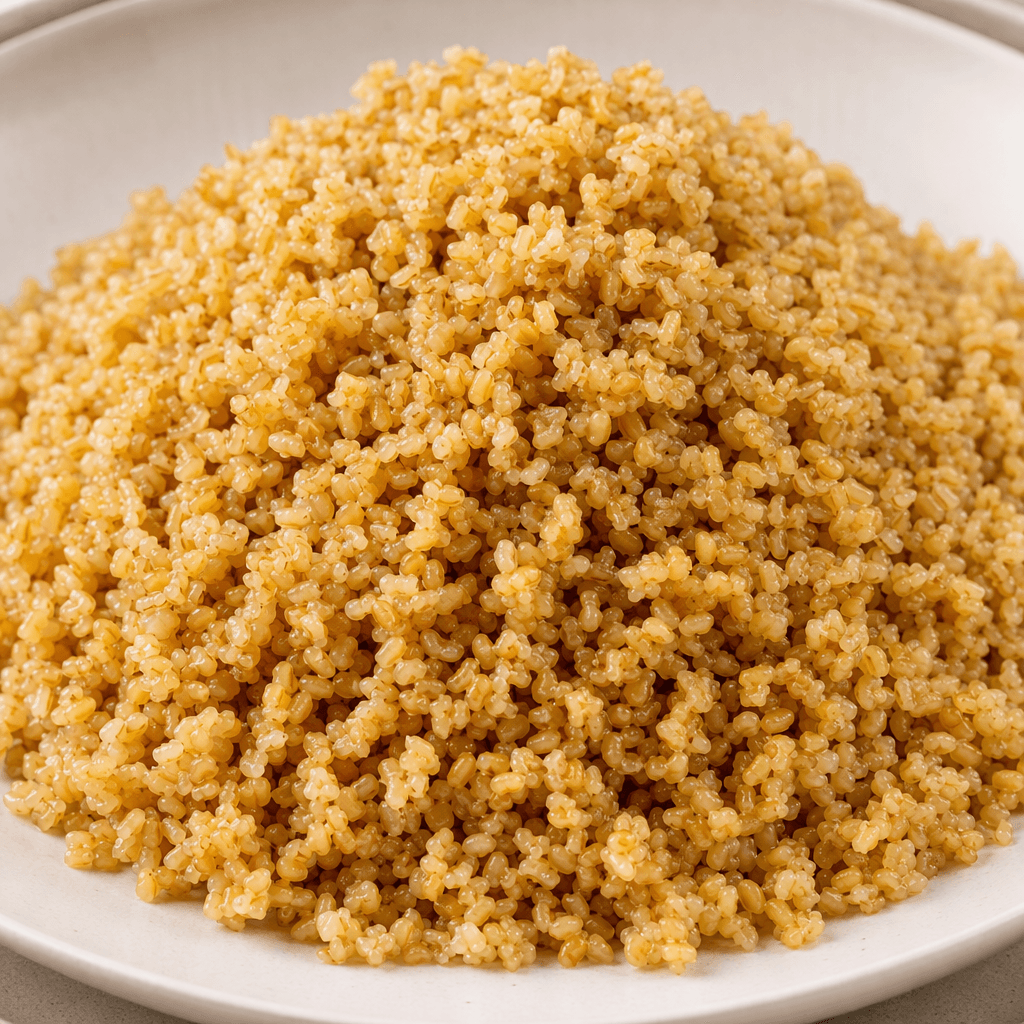
Bulgur (Cooked) Calories
Source of fiber and complex carbs, low fat, contains B vitamins
In season: Spring · Summer · Autumn · Winter
CALORIES
GI
POTASSIUM
FIBER
Quick answer
1 cup (medium) of Bulgur (Cooked) (150 g) has 125 calories. That works out to 83 calories per 100 g. It contains 27.9 g of carbs, 4.7 g of protein, 0.3 g of fat and 6.8 g of fiber. Its 0.5 mg of Manganese covers 20% of the Daily Value. Its glycemic index is 48 (medium), so it raises blood sugar at a moderate pace.
What is Bulgur (Cooked)?
Cooked bulgur is cracked wheat that has been parboiled and dried, then simmered until tender. It is a longstanding staple across Turkey and the wider Middle East, where different grain sizes suit everything from pilafs to salads.
The grains are soft yet pleasantly distinct, with a mild, nutty flavour. Serve it warm as a side with roasted vegetables, beans or grilled meat, or let it cool for a grain salad; it is also the base for dishes such as tabbouleh. Bulgur provides complex carbohydrates and fibre, with 4.5 g of fibre per 100 g. For a lighter meal, pair it with plenty of vegetables and use a modest amount of oil.
Bulgur (Cooked) Nutrition Facts
Selected: 100 g
83
KCAL / 100G
Carbs
18.6g
· 7% DV
Protein
3.1g
· 6% DV
Fat
0.2g
· 0% DV
Fiber
4.5g
· 16% DV
DV is the share of the daily value covered, on a 2,000 kcal reference diet.
Calories come from: Carbs 84% · Protein 14% · Fat 2%

Log this food in EatBetter
100,000+ people use it
- Get your daily calorie target
- Snap your meal, log it in seconds
- See every vitamin and mineral

📸 Scan the code to get the app free.

Bulgur (Cooked) Vitamins & Minerals
Vitamins
B3
1mg · 6% DV
Biotin
1.5µg · 5% DV
B6
0.08mg · 5% DV
Folate
18µg · 5% DV
Minerals
Iron
1mg · 6% DV
Phosphorus
30mg · 4% DV
Potassium ⭐
68mg · 2% DV
Manganese
0mg · 0% DV
Copper
0mg · 0% DV
How Nutritious Is Bulgur (Cooked)?
Nutrient density
Medium
How many vitamins, minerals and how much fiber this food carries per calorie. A high score means a lot of nutrition for few calories.
Satiety score
Medium
An EatBetter score computed from fiber, protein and calorie density. A high score means staying full longer on the same calories.
Both scores are calculated per 100 g and do not change with the selected portion. The satiety score is EatBetter's own calculation, not a clinical measure.
Bulgur (Cooked) Glycemic Index
GLYCEMIC INDEX
GLYCEMIC LOAD
Accounts for portion size — a more realistic measure than GI alone.
How to Burn Off Bulgur (Cooked)
To burn the 83 calories in 100 g:
🚶
Walking (5 km/h)
🏃
Running (8 km/h)
🚴
Cycling
🏊
Swimming
Times are calculated with the MET equation for a 70 kg adult. Actual burn varies with your weight, age and pace.
Is Bulgur (Cooked) Processed?
NOVA 2
Minimally Processed
1. Unprocessed
2. Minimally Processed
3. Processed
4. Ultra-Processed
NOVA classifies foods into 4 groups by industrial processing. NOVA 1 (unprocessed) is the healthiest.
Does Bulgur (Cooked) Contain Allergens?
Contains these allergens:
Which Diets Is Bulgur (Cooked) Good For?
Vegan
✓ Suitable
Vegetarian
✓ Suitable
Gluten-Free
— Not suitable
Dairy-Free
— Not suitable
Mediterranean
✓ Suitable
Paleo
— Not suitable
Whole30
— Not suitable
DASH
— Not suitable
Keto
— Not suitable
Low FODMAP
— Not suitable
Bulgur (Cooked) Fat Profile
SATURATED
0.04g
MONOUNSATURATED
0.03g
POLYUNSATURATED
0.07g
Omega 6:3 ratio 5:1
Above the ideal 4:1 (5:1).
Compare Bulgur (Cooked)
Foods Similar to Bulgur (Cooked)
Frequently Asked Questions About Bulgur (Cooked)
How long does cooked bulgur last in the fridge?
Cooked bulgur keeps for a few days in a covered container in the refrigerator. Cool it and refrigerate it promptly after cooking. Discard it if it develops an unusual smell, a slimy texture, or visible mold.
Can you freeze cooked bulgur?
Yes, cooked bulgur freezes well. Divide it into airtight portions so you can thaw only what you need. The grains may soften slightly after thawing, so frozen cooked bulgur works especially well in soups, stuffed vegetables, and warm bowls.
How do you reheat cooked bulgur without drying it out?
Reheat cooked bulgur in a covered pan with a small splash of water, stirring gently until steaming hot. For the microwave, cover the bowl and stir partway through. Adding a little moisture helps restore its soft, separate-grain texture.
Can you eat cooked bulgur cold?
Yes, cooked bulgur can be eaten cold in salads and grain bowls. Refrigerate it after cooking rather than leaving it out, and use clean utensils when serving. If its smell or appearance has changed, throw it away.
What can you make with cooked bulgur?
Cooked bulgur works in grain bowls, soups, stuffed vegetables, and salads. Stir it into hot dishes near the end so the grains keep their shape. For classic tabbouleh, cooked bulgur may be softer than the usual soaked fine bulgur.
Can cooked bulgur replace rice?
Yes, cooked bulgur can stand in for rice in bowls, pilafs, and as a side dish. It has a nuttier, wheat-like flavor and a chewier texture, so it will change the character of the dish rather than taste exactly like rice.
Why is my cooked bulgur mushy?
Cooked bulgur is often mushy because it absorbed too much liquid, cooked for too long, or was stirred repeatedly. Use a coarser bulgur for a fluffy pilaf, limit stirring, and let it rest covered after the liquid has been absorbed.
Is cooked bulgur good for weight loss?
Cooked bulgur can fit into a weight-loss meal because its fiber may help make a meal more filling. Pair it with vegetables and a protein source, and choose a portion that suits the rest of your meal.
Does cooked bulgur raise blood sugar?
Yes, cooked bulgur can raise blood sugar because it contains carbohydrates. Its fiber can affect how quickly it is digested, and eating it with protein and vegetables may make a meal more balanced. If you have diabetes, ask your care team about portions that suit you.
Can you meal-prep cooked bulgur?
Yes, cooked bulgur is convenient for meal prep because it can be portioned ahead and added to meals through the week. Store it promptly in covered containers in the refrigerator, and add dressings or fresh toppings when you serve it.
Have another question about Bulgur (Cooked)?
Ask the AI nutrition coach — calories, portions, alternatives and more, answered in seconds in the app.

Scan calories with your camera
Instant AI nutrition analysis

Nutrition data compiled from USDA FoodData Central and scientific sources.