

Ready & Packaged Foods
All →Vegetables & Legumes
All →Desserts & Confectionery
All →Meat & Protein
All →Grains & Bakery
All →Beverages
All →Milk & Dairy
All →

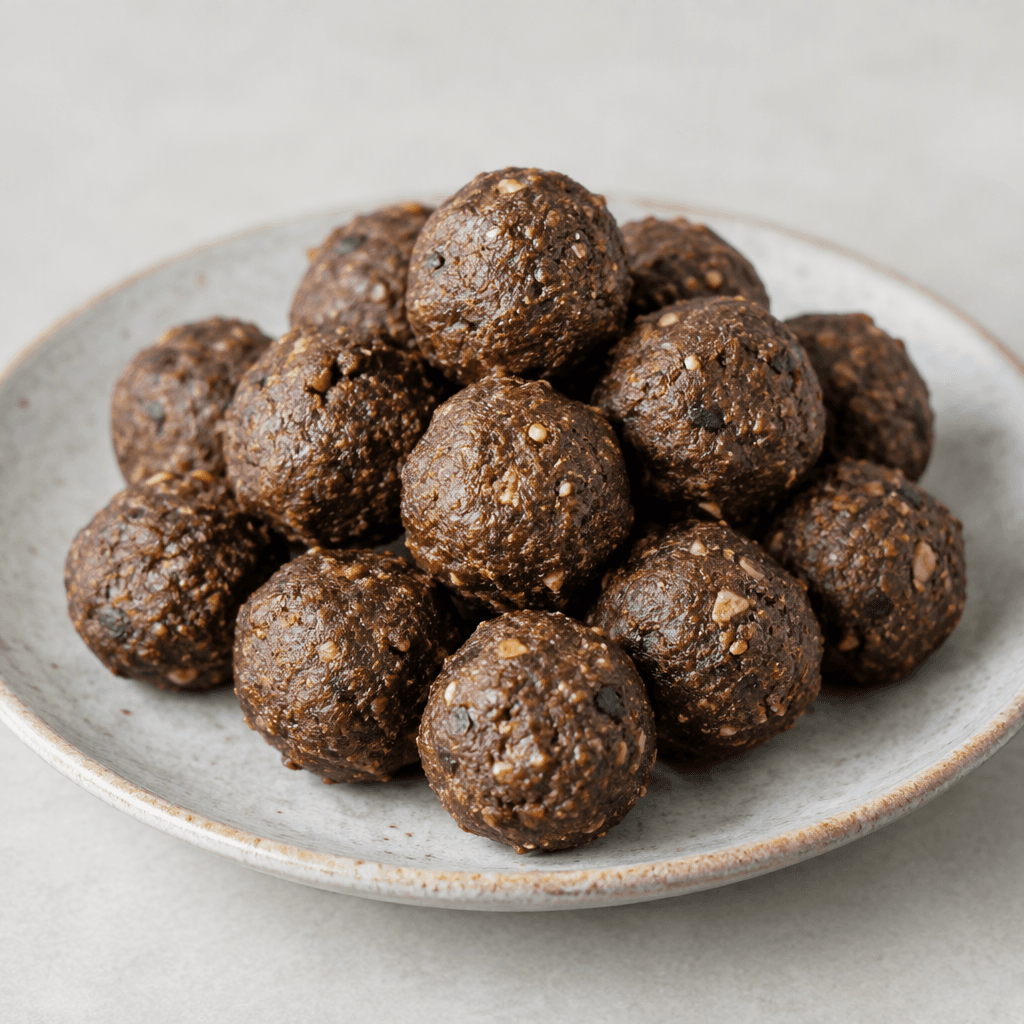
Brownie date ball Calories
Healthy snack with dates, cocoa, and walnuts
In season: Spring · Summer · Autumn · Winter
CALORIES
GI
POTASSIUM
FIBER
Quick answer
1 piece (medium) of Brownie date ball (25 g) has 85 calories. That works out to 340 calories per 100 g. It contains 13.5 g of carbs, 1.3 g of protein, 3.1 g of fat and 1.7 g of fiber. Its 0.1 mg of Copper covers 8% of the Daily Value. Its glycemic index is 45 (medium), so it raises blood sugar at a moderate pace.
What is Brownie date ball?
A brownie date ball is a no-bake bite made by blending soft, pitted dates with cocoa and usually walnuts or another nut, then shaping the mixture into balls. It borrows the rich chocolate flavour of a brownie, but gets much of its sweetness and binding from fruit. It is a modern homemade snack rather than a dish tied to one particular region.
Expect a dense, chewy texture, with mellow date sweetness balanced by cocoa’s slight bitterness and the crunch of nuts. It works alongside coffee or tea, as a small after-lunch treat, or packed for a quick snack. Dates contribute fibre, while the ball is still fairly energy-dense and sweet. Make smaller portions if you want a lighter bite, or serve one with plain yoghurt for a more substantial snack.
Brownie date ball Nutrition Facts
Selected: 100 g
340
KCAL / 100G
Carbs
54g
· 20% DV
Protein
5.2g
· 10% DV
Fat
12.5g
· 16% DV
Fiber
6.8g
· 24% DV
DV is the share of the daily value covered, on a 2,000 kcal reference diet.
Calories come from: Carbs 62% · Protein 6% · Fat 32%
Brownie date ball Vitamins & Minerals
Vitamins
B5
0.44mg · 9% DV
B1
0.09mg · 8% DV
B6
0.13mg · 8% DV
B3
1.1mg · 7% DV
Minerals
Magnesium
68mg · 16% DV
Potassium ⭐
540mg · 16% DV
Phosphorus
92mg · 13% DV
Zinc
1mg · 9% DV
How Nutritious Is Brownie date ball?
Nutrient density
Medium
How many vitamins, minerals and how much fiber this food carries per calorie. A high score means a lot of nutrition for few calories.
Satiety score
Medium
An EatBetter score computed from fiber, protein and calorie density. A high score means staying full longer on the same calories.
Both scores are calculated per 100 g and do not change with the selected portion. The satiety score is EatBetter's own calculation, not a clinical measure.
Brownie date ball Glycemic Index
GLYCEMIC INDEX
GLYCEMIC LOAD
Accounts for portion size — a more realistic measure than GI alone.
How to Burn Off Brownie date ball
To burn the 340 calories in 100 g:
🚶
Walking (5 km/h)
🏃
Running (8 km/h)
🚴
Cycling
🏊
Swimming
Times are calculated with the MET equation for a 70 kg adult. Actual burn varies with your weight, age and pace.
Is Brownie date ball Processed?
NOVA 2
Minimally Processed
1. Unprocessed
2. Minimally Processed
3. Processed
4. Ultra-Processed
NOVA classifies foods into 4 groups by industrial processing. NOVA 1 (unprocessed) is the healthiest.
Does Brownie date ball Contain Allergens?
Contains these allergens:
Which Diets Is Brownie date ball Good For?
Vegan
✓ Suitable
Vegetarian
✓ Suitable
Gluten-Free
— Not suitable
Dairy-Free
— Not suitable
Mediterranean
✓ Suitable
Paleo
— Not suitable
Whole30
— Not suitable
DASH
— Not suitable
Keto
— Not suitable
Low FODMAP
— Not suitable
Brownie date ball Fat Profile
SATURATED
1.6g
MONOUNSATURATED
2.7g
POLYUNSATURATED
7.1g
Omega 6:3 ratio 10.3:1
Above the ideal 4:1 (10.3:1).
Compare Brownie date ball
Foods Similar to Brownie date ball
Frequently Asked Questions About Brownie date ball
What is in a brownie date ball?
A brownie date ball is usually made with dates, cocoa and walnuts. Some recipes also include oats, coconut or other nuts, so the exact ingredients vary; the basic version relies on minimally processed ingredients rather than a baked brownie batter.
How do you make a brownie date ball?
Blend soft, pitted dates with cocoa and walnuts until the mixture holds together, then roll it into balls. Chilling the shaped brownie date balls helps them firm up and makes them less sticky to handle.
Why is my brownie date ball mixture too dry or crumbly?
A brownie date ball mixture usually crumbles when the dates are too dry or the ingredients have not been blended enough. Soften dry dates briefly in warm water, drain them well, and blend again; add a little water only if needed.
What dates work best for brownie date balls?
Soft, moist dates are easiest to blend into brownie date balls; Medjool dates work well but are not essential. If your dates are firm or dry, briefly soak them in warm water and drain thoroughly before blending.
How long do brownie date balls last in the fridge?
Brownie date balls generally keep for about a week in an airtight container in the refrigerator. Recipes containing fresh dairy or fruit may keep for less time; discard them if you notice mold, an off smell or an unusual texture.
Can you freeze brownie date balls?
Yes, brownie date balls freeze well. Freeze them in a single layer first so they do not stick together, then transfer them to a sealed freezer-safe container; thaw in the refrigerator before serving.
Can you make brownie date balls without walnuts?
Yes, you can make brownie date balls without walnuts. Substitute almonds or hazelnuts, or use oats for a nut-free variation; the replacement changes the texture, and oats should be suitable for anyone avoiding nuts.
Do brownie date balls have added sugar?
Not necessarily: many brownie date ball recipes use dates for sweetness without adding sugar. Other versions include honey, syrup or chocolate, so the answer depends on the recipe rather than the name of the snack.
Are brownie date balls a good snack before a workout?
A brownie date ball can be a convenient pre-workout snack because it is portable and provides carbohydrates from dates. Try it with enough time to digest before exercise, especially if the walnuts make it feel heavy.
Can people with diabetes eat brownie date balls?
People with diabetes may need to account for the dates and any added sweeteners in a brownie date ball, since dates contain naturally occurring sugars. Follow your individual meal plan and ask your clinician or dietitian if you need personal guidance.
Have another question about Brownie date ball?
Ask the AI nutrition coach — calories, portions, alternatives and more, answered in seconds in the app.

Scan calories with your camera
Instant AI nutrition analysis

Nutrition data compiled from USDA FoodData Central and scientific sources.