

Ready & Packaged Foods
All →Vegetables & Legumes
All →Desserts & Confectionery
All →Meat & Protein
All →Grains & Bakery
All →Beverages
All →Milk & Dairy
All →

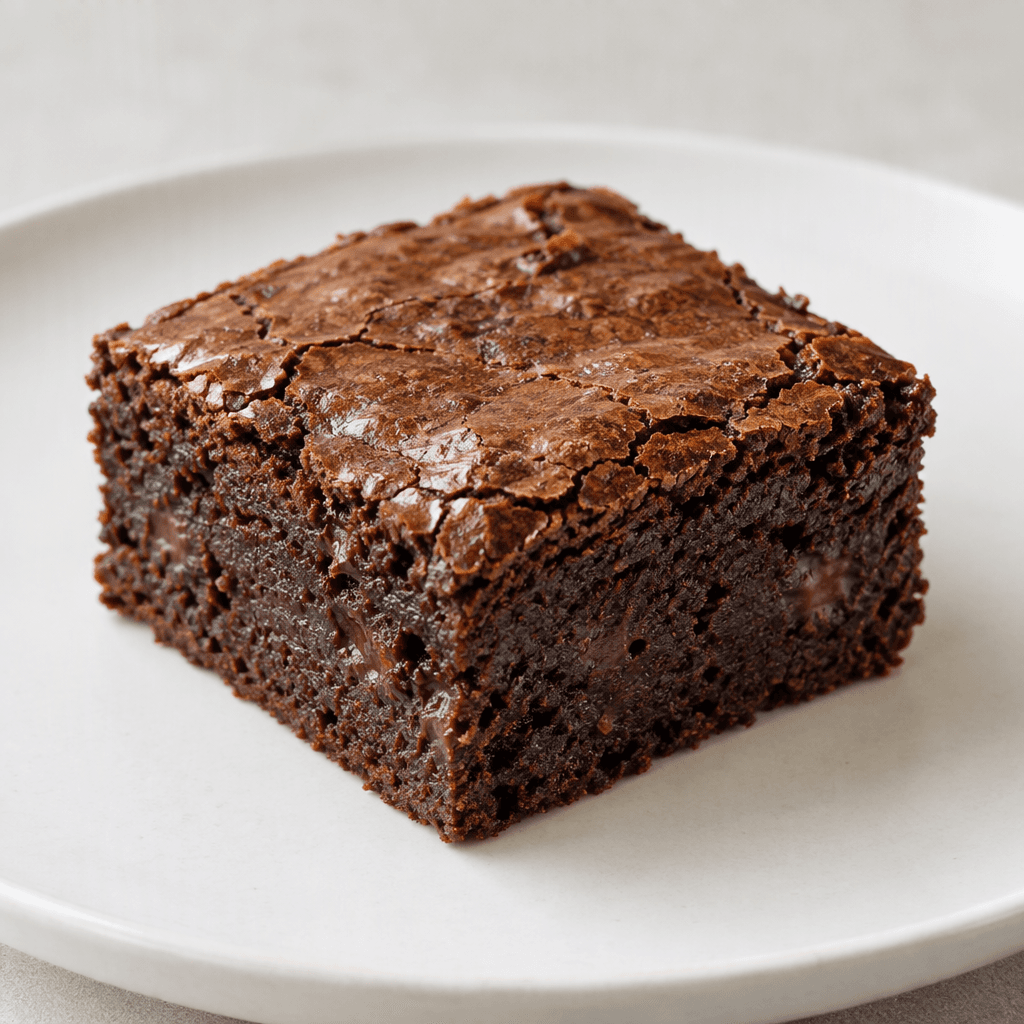
Brownie (Classic) Calories
Rich chocolate, classic American dessert
In season: Winter · Autumn
CALORIES · 100 G
GI
POTASSIUM · 100 G
FIBER · 100 G
Quick answer
1 piece (medium) of Brownie (Classic) (60 g) has 252 calories. That works out to 420 calories per 100 g. It contains 33 g of carbs, 3 g of protein, 12 g of fat and 1.5 g of fiber. Its 0.1 mg of Copper covers 12% of the Daily Value. Its glycemic index is 65 (high), so it raises blood sugar quickly.
Brownie (Classic) Nutrition Facts
Selected: 1 piece (medium) · 60 g
252
KCAL / 60G
Carbs
33g
· 12% DV
Protein
3g
· 6% DV
Fat
12g
· 15% DV
Fiber
1.5g
· 5% DV
DV is the share of the daily value covered, on a 2,000 kcal reference diet.
Calories come from: Carbs 52% · Protein 5% · Fat 43%
Brownie (Classic) nutrition facts table · 1 piece (medium) (60 g)
| Nutrient | Amount | % DV |
|---|---|---|
| Calories | 252 kcal | |
| Total fat | 12 g | 15% |
| Saturated fat | 4.8 g | 24% |
| Trans fat | 0.12 g | |
| Sodium | 108 mg | 5% |
| Total carbohydrate | 33 g | 12% |
| Fiber | 1.5 g | 5% |
| Protein | 3 g | 6% |
Calories: Calories measure energy. Average daily need is 2,000 kcal. Excess calories are stored as fat, too few cause weight loss.
Carbs: Your body's primary energy source. The brain runs exclusively on carbs. Daily need: 275g.
Protein: Essential for muscle repair and cell growth. Daily need: 50g. Keeps you full and boosts metabolism.
Fat: Needed for hormone production and vitamin absorption. Daily need: 78g. Limit saturated fats, choose unsaturated.
Fiber: Critical for digestive health and satiety. Daily need: 28g. Stabilizes blood sugar, lowers cholesterol.

Log this food in EatBetter
100,000+ people use it
- Get your daily calorie target
- Snap your meal, log it in seconds
- See every vitamin and mineral

📸 Scan the code to get the app free.

How Many Calories in 1 Medium Brownie (Classic)?
| Serving | Amount | Calories |
|---|---|---|
| 1 piece (medium) | 60 g | 252 kcal |
| 1 piece (mini) | 30 g | 126 kcal |
| 1 piece (small) | 40 g | 168 kcal |
| 1 slice (thin) | 45 g | 189 kcal |
| 1 slice (thick) | 70 g | 294 kcal |
| 1 serving (jumbo) | 80 g | 336 kcal |
| 1 piece (large) | 90 g | 378 kcal |
| 100 g | 100 g | 420 kcal |
| 2 piece (double) | 120 g | 504 kcal |
Calculated from 420 calories per 100 g.
Frequently Asked Questions About Brownie (Classic)
What ingredients are in a classic brownie?
A classic brownie is typically made with chocolate or cocoa, butter, sugar, eggs and flour. Some recipes add vanilla or nuts, but its characteristic dense, chocolate-rich texture comes from the balance of fat, sugar and flour.
How is a classic brownie different from chocolate cake?
A classic brownie is denser and fudgier than chocolate cake, which is usually lighter and more aerated. Brownie batter generally has less flour and less leavening, so the finished dessert stays compact rather than rising into a fluffy crumb.
How do you make classic brownies fudgy?
For fudgy classic brownies, use melted chocolate and butter, avoid adding too much flour, and mix only until the ingredients come together. Take the pan out while the center is still slightly soft; it will continue to set as it cools.
Why do classic brownies get a shiny, crackly top?
The shiny, crackly top on classic brownies forms when dissolved sugar and egg proteins create a thin crust during baking. Beating the eggs and sugar well and using fine sugar can help produce that familiar surface.
How can you tell when a classic brownie is done baking?
A classic brownie is ready when the edges look set but the middle still feels slightly soft. A toothpick inserted near the center should come out with moist crumbs, not wet batter; a completely clean toothpick can mean it has overbaked.
How should you store classic brownies?
Let classic brownies cool completely, then keep them in an airtight container in a cool, dry place. Refrigeration can make their texture firmer, so room-temperature storage is preferable if you plan to eat them soon.
Can you freeze classic brownies?
Yes, classic brownies freeze well. Cool them fully, wrap individual pieces tightly so they are protected from air, and freeze them in a sealed container. Thaw the pieces while still wrapped to limit condensation on the surface.
How do you reheat a classic brownie without drying it out?
Warm a classic brownie briefly in the microwave, checking often so it does not become tough. A low oven also works; covering the piece loosely helps retain moisture. Add ice cream after heating rather than warming it with the brownie.
Where did the classic brownie originate?
The classic brownie originated in the United States and became popular as a chocolate dessert served in squares. Early brownie recipes varied, and both fudgy and more cake-like versions remain common today.
What goes well with a classic brownie?
Vanilla ice cream is a popular match for a classic brownie because its cool, creamy taste contrasts with the rich chocolate. Fresh berries, whipped cream or a cup of coffee also make good accompaniments.
Brownie (Classic) Vitamins & Minerals
Vitamins
Biotin
2.4µg · 8% DV
B2
0.07mg · 5% DV
B1
0.05mg · 4% DV
B12
0.09µg · 4% DV
Minerals
Copper
0.11mg · 12% DV
Selenium
4.2µg · 8% DV
Iron
1.2mg · 7% DV
Manganese
0.15mg · 7% DV
Sodium
108mg · 5% DV
Potassium ⭐
72mg · 2% DV
Brownie (Classic) Glycemic Index
GLYCEMIC INDEX
GLYCEMIC LOAD
Accounts for portion size — a more realistic measure than GI alone.
How to Burn Off Brownie (Classic)
To burn the 252 calories in 1 piece (medium) (60 g):
🚶
Walking (5 km/h)
🏃
Running (8 km/h)
🚴
Cycling
🏊
Swimming
Times are calculated with the MET equation for a 70 kg adult. Actual burn varies with your weight, age and pace.
What is Brownie (Classic)?
A classic brownie is a rich American bake made with chocolate or cocoa, flour, eggs, sugar and butter. It is usually denser and moister than cake, with a fudgy centre and a more set edge; recipes vary from deeply chocolatey to slightly cakier.
In the United States it is commonly cut into squares and served as a snack or dessert, sometimes warm with ice cream. Elsewhere, it pairs easily with coffee or tea. Brownies are energy-dense, with 420 calories per 100 g, so a modest square can be satisfying; fresh berries or sliced fruit make a bright contrast.
How Nutritious Is Brownie (Classic)?
Nutrient density
Low
How many vitamins, minerals and how much fiber this food carries per calorie. A high score means a lot of nutrition for few calories.
Satiety score
Low
An EatBetter score computed from fiber, protein and calorie density. A high score means staying full longer on the same calories.
Both scores are calculated per 100 g and do not change with the selected portion. The satiety score is EatBetter's own calculation, not a clinical measure.
Is Brownie (Classic) Processed?
NOVA 3
Processed
1. Unprocessed
2. Minimally Processed
3. Processed
4. Ultra-Processed
NOVA classifies foods into 4 groups by industrial processing. NOVA 1 (unprocessed) is the healthiest.
Does Brownie (Classic) Contain Allergens?
Contains these allergens:
Which Diets Is Brownie (Classic) Good For?
Vegan
— Not suitable
Vegetarian
— Not suitable
Gluten-Free
— Not suitable
Dairy-Free
— Not suitable
Mediterranean
— Not suitable
Paleo
— Not suitable
Whole30
— Not suitable
DASH
— Not suitable
Keto
— Not suitable
Low FODMAP
— Not suitable
Brownie (Classic) Fat Profile
SATURATED
4.8g
MONOUNSATURATED
4.2g
POLYUNSATURATED
0.9g
Omega 6:3 ratio 24:1
Above the ideal 4:1 (24:1).
Compare Brownie (Classic)
Foods Similar to Brownie (Classic)
Have another question about Brownie (Classic)?
Ask the AI nutrition coach — calories, portions, alternatives and more, answered in seconds in the app.

Scan calories with your camera
Instant AI nutrition analysis

Nutrition data compiled from USDA FoodData Central and scientific sources.