

Ready & Packaged Foods
All →Vegetables & Legumes
All →Desserts & Confectionery
All →Meat & Protein
All →Grains & Bakery
All →Beverages
All →Milk & Dairy
All →

Brown Sugar Calories
Contains natural molasses, slightly more minerals than white sugar
In season: Spring · Summer · Autumn · Winter
CALORIES
GI
POTASSIUM
FIBER
Quick answer
1 tablespoon (medium) of Brown Sugar (12 g) has 46 calories. That works out to 380 calories per 100 g. It contains 11.8 g of carbs, 0 g of protein, 0 g of fat and 0 g of fiber. Its glycemic index is 65 (high), so it raises blood sugar quickly.
What is Brown Sugar?
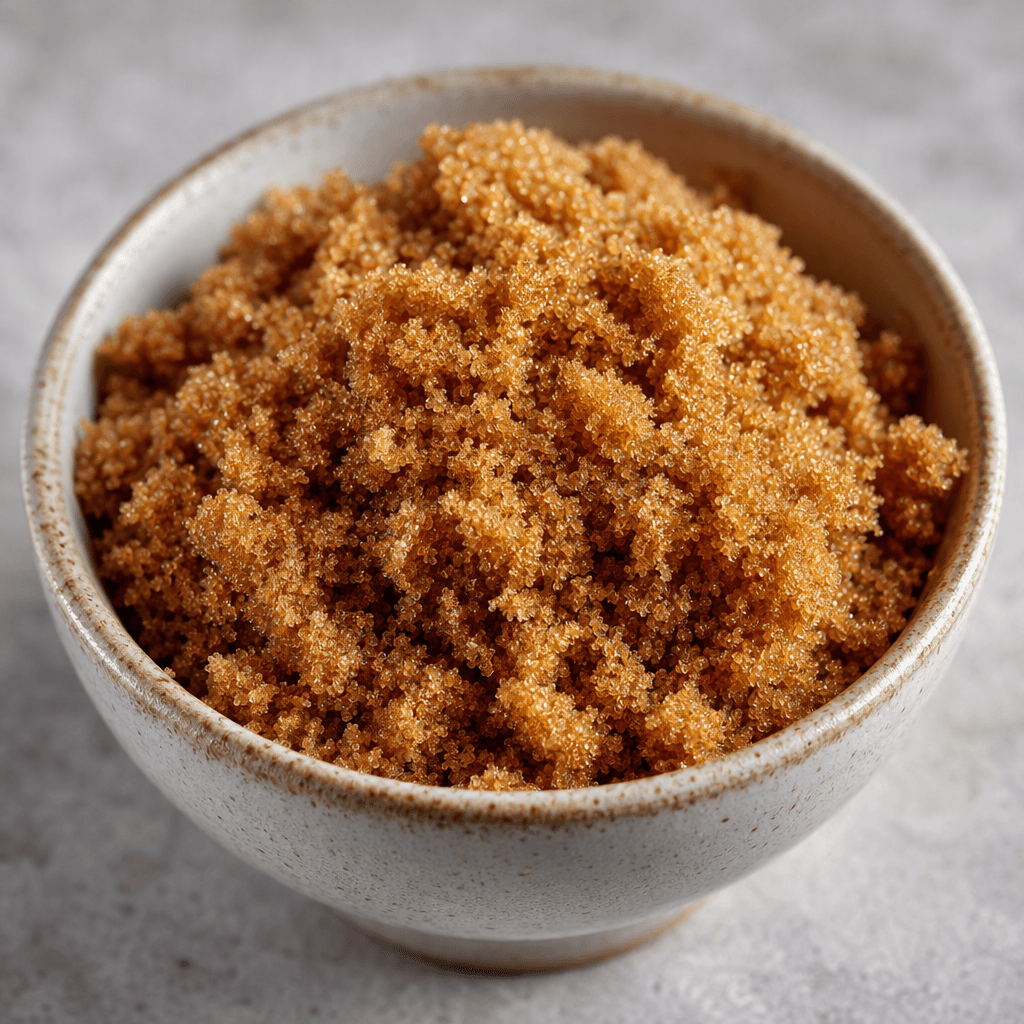
Brown sugar consists of sugar crystals with molasses, which gives them their warm colour, gentle moisture and caramel-like flavour. It is commonly used in baking, from cookies and cakes to sauces, and can also sweeten coffee, tea or porridge. Some varieties retain molasses from sugar processing, while others are made by adding it back to refined sugar.
The soft, slightly clumpy crystals bring a deeper taste than white sugar and help keep baked goods moist. Nutritionally, it is still mostly carbohydrate—98 g per 100 g—with only a little more of some minerals than white sugar. Use it in oatmeal or baking, or stir a small amount into a hot drink; reducing the amount is an easy way to make a recipe less sweet.
Brown Sugar Nutrition Facts
Selected: 100 g
380
KCAL / 100G
Carbs
98g
· 36% DV
Protein
0g
· 0% DV
Fat
0g
· 0% DV
Fiber
0g
· 0% DV
DV is the share of the daily value covered, on a 2,000 kcal reference diet.
Calories come from: Carbs 100% · Protein 0% · Fat 0%

Log this food in EatBetter
100,000+ people use it
- Get your daily calorie target
- Snap your meal, log it in seconds
- See every vitamin and mineral

📸 Scan the code to get the app free.

Brown Sugar Vitamins & Minerals
Vitamins
B1
0.01mg · 1% DV
B2
0.01mg · 1% DV
B3
0.1mg · 1% DV
B6
0.01mg · 1% DV
Minerals
Iron
2mg · 11% DV
Potassium ⭐
346mg · 10% DV
Calcium
85mg · 9% DV
Copper
0mg · 0% DV
How Nutritious Is Brown Sugar?
Nutrient density
Low
How many vitamins, minerals and how much fiber this food carries per calorie. A high score means a lot of nutrition for few calories.
Satiety score
Low
An EatBetter score computed from fiber, protein and calorie density. A high score means staying full longer on the same calories.
Both scores are calculated per 100 g and do not change with the selected portion. The satiety score is EatBetter's own calculation, not a clinical measure.
Brown Sugar Glycemic Index
GLYCEMIC INDEX
GLYCEMIC LOAD
Accounts for portion size — a more realistic measure than GI alone.
How to Burn Off Brown Sugar
To burn the 380 calories in 100 g:
🚶
Walking (5 km/h)
🏃
Running (8 km/h)
🚴
Cycling
🏊
Swimming
Times are calculated with the MET equation for a 70 kg adult. Actual burn varies with your weight, age and pace.
Is Brown Sugar Processed?
NOVA 3
Processed
1. Unprocessed
2. Minimally Processed
3. Processed
4. Ultra-Processed
NOVA classifies foods into 4 groups by industrial processing. NOVA 1 (unprocessed) is the healthiest.
Does Brown Sugar Contain Allergens?
No known major allergens
Which Diets Is Brown Sugar Good For?
Vegan
✓ Suitable
Vegetarian
✓ Suitable
Gluten-Free
✓ Suitable
Dairy-Free
— Not suitable
Mediterranean
✓ Suitable
Paleo
— Not suitable
Whole30
— Not suitable
DASH
— Not suitable
Keto
— Not suitable
Low FODMAP
— Not suitable
Brown Sugar Fat Profile
SATURATED
0g
MONOUNSATURATED
0g
POLYUNSATURATED
0g
Compare Brown Sugar
Foods Similar to Brown Sugar
Frequently Asked Questions About Brown Sugar
What is brown sugar made of?
Brown sugar is sugar crystals containing molasses, which gives it its brown color, moist texture, and caramel-like flavor. Some products retain molasses from processing; others are made by adding molasses to refined white sugar.
Is brown sugar healthier than white sugar?
No, brown sugar is not meaningfully healthier than white sugar. Its molasses contributes small amounts of minerals, but not enough to make it a significant source; both are added sugars.
Can you use brown sugar instead of white sugar in baking?
Yes, brown sugar can replace white sugar in many baking recipes. Its molasses adds moisture and a deeper flavor, so cookies may turn out softer and baked goods may be darker than intended.
Why does brown sugar get hard?
Brown sugar hardens when it loses moisture to the air. The molasses that keeps it soft can dry out if the sugar is left exposed, so storing it in an airtight container helps prevent hard lumps.
How do you soften hardened brown sugar?
To soften hardened brown sugar quickly, cover it with a damp paper towel and microwave it briefly. Use it right away, since it can harden again as it cools; heat only the amount you need.
Does brown sugar go bad?
Brown sugar can usually be kept for a long time if stored airtight in a cool, dry place. It may harden or lose quality, but a hard lump alone does not mean it has spoiled.
What is the difference between light and dark brown sugar?
Dark brown sugar contains more molasses than light brown sugar, so it has a stronger flavor, darker color, and often a slightly moister texture. They can often be swapped, though the flavor of the recipe will change.
Can brown sugar make cookies chewy?
Yes, brown sugar often helps make cookies chewier and softer because its molasses adds moisture. It also gives them a deeper, caramel-like taste; replacing all the sugar in a recipe may change how the cookies spread.
Does brown sugar dissolve in coffee?
Yes, brown sugar dissolves in hot coffee, just as it does in other hot liquids. Its molasses gives the coffee a mild caramel note, so the flavor will differ from coffee sweetened with white sugar.
Can brown sugar be used to make caramel?
Yes, brown sugar can be heated to make caramel-style sauces and toppings. Its molasses gives the result a darker, more pronounced flavor, so watch it closely while heating to keep it from burning.
Have another question about Brown Sugar?
Ask the AI nutrition coach — calories, portions, alternatives and more, answered in seconds in the app.

Scan calories with your camera
Instant AI nutrition analysis

Nutrition data compiled from USDA FoodData Central and scientific sources.