

Ready & Packaged Foods
All →Vegetables & Legumes
All →Desserts & Confectionery
All →Meat & Protein
All →Grains & Bakery
All →Beverages
All →Milk & Dairy
All →

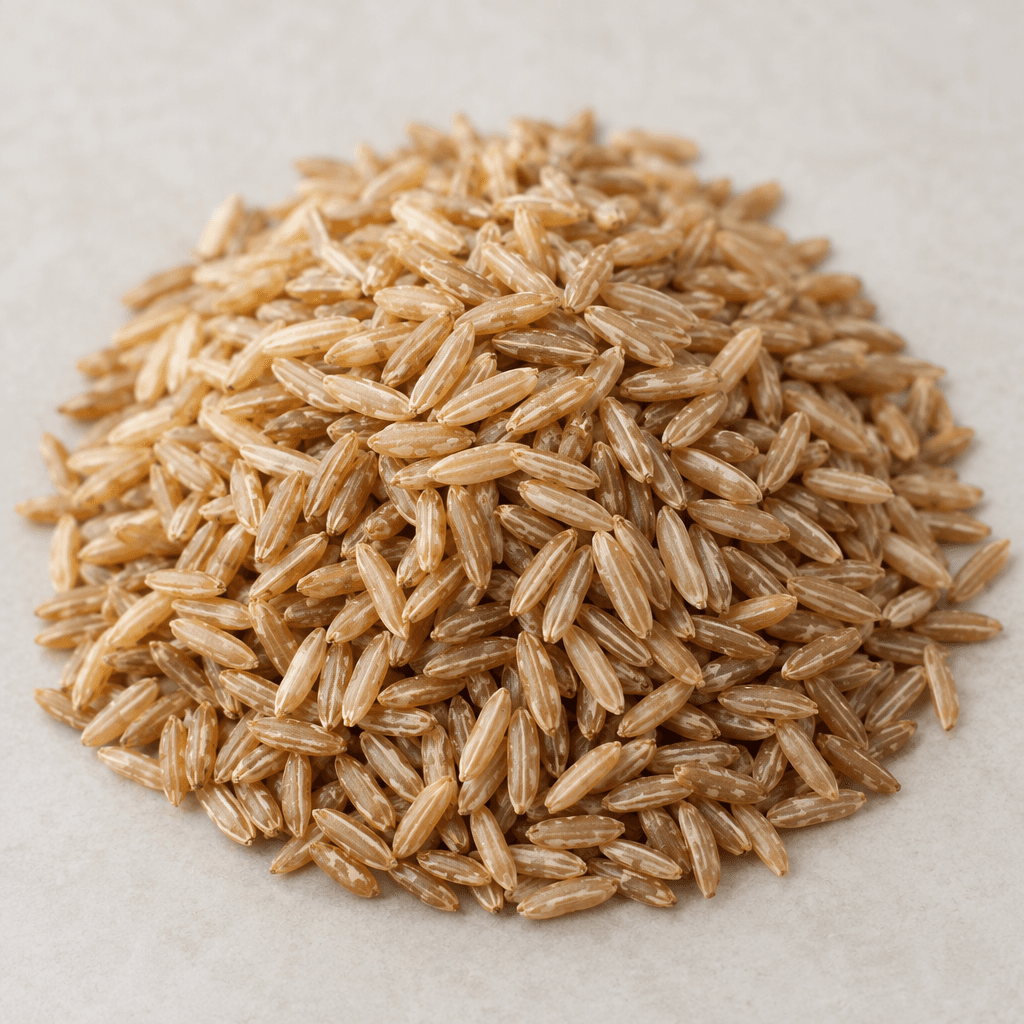
Brown rice (raw) Calories
Source of fiber and magnesium, complex carbohydrate, low glycemic index
In season: Spring · Summer · Autumn · Winter
CALORIES
GI
POTASSIUM
FIBER
Quick answer
1 cup (medium) of Brown rice (raw) (185 g) has 675 calories. That works out to 365 calories per 100 g. It contains 142.8 g of carbs, 13.9 g of protein, 5 g of fat and 6.3 g of fiber. Its 6.9 mg of Manganese covers 301% of the Daily Value. Its glycemic index is 50 (medium), so it raises blood sugar at a moderate pace.
What is Brown rice (raw)?
Raw brown rice is the whole grain with its inedible outer hull removed but its bran and germ left intact. It is sold dry and must be cooked before eating. Once cooked, it has a mild, nutty flavour and a firmer, chewier texture than white rice. It works well as a side for vegetables, beans, fish or meat, and can be used in grain bowls and salads. In many kitchens, it takes the place of white rice in familiar rice dishes.
Brown rice is mainly a source of complex carbohydrate, with fibre from the bran. The grains usually need more cooking time and water than white rice; rinsing and soaking them first can help them cook evenly. Pair it with plenty of vegetables for a balanced, lighter meal.
Brown rice (raw) Nutrition Facts
Selected: 100 g
365
KCAL / 100G
Carbs
77.2g
· 28% DV
Protein
7.5g
· 15% DV
Fat
2.7g
· 3% DV
Fiber
3.4g
· 12% DV
DV is the share of the daily value covered, on a 2,000 kcal reference diet.
Calories come from: Carbs 85% · Protein 8% · Fat 7%
Brown rice (raw) Vitamins & Minerals
Vitamins
B1
0.4mg · 33% DV
B3
5.09mg · 32% DV
B5
1.49mg · 30% DV
B6
0.51mg · 30% DV
Minerals
Manganese
4mg · 174% DV
Phosphorus
333mg · 48% DV
Selenium
23.4µg · 43% DV
Magnesium
143mg · 34% DV
How Nutritious Is Brown rice (raw)?
Nutrient density
Medium
How many vitamins, minerals and how much fiber this food carries per calorie. A high score means a lot of nutrition for few calories.
Satiety score
Low
An EatBetter score computed from fiber, protein and calorie density. A high score means staying full longer on the same calories.
Both scores are calculated per 100 g and do not change with the selected portion. The satiety score is EatBetter's own calculation, not a clinical measure.
Brown rice (raw) Glycemic Index
GLYCEMIC INDEX
GLYCEMIC LOAD
Accounts for portion size — a more realistic measure than GI alone.
How to Burn Off Brown rice (raw)
To burn the 365 calories in 100 g:
🚶
Walking (5 km/h)
🏃
Running (8 km/h)
🚴
Cycling
🏊
Swimming
Times are calculated with the MET equation for a 70 kg adult. Actual burn varies with your weight, age and pace.
Is Brown rice (raw) Processed?
NOVA 2
Minimally Processed
1. Unprocessed
2. Minimally Processed
3. Processed
4. Ultra-Processed
NOVA classifies foods into 4 groups by industrial processing. NOVA 1 (unprocessed) is the healthiest.
Does Brown rice (raw) Contain Allergens?
No known major allergens
Which Diets Is Brown rice (raw) Good For?
Vegan
✓ Suitable
Vegetarian
✓ Suitable
Gluten-Free
✓ Suitable
Dairy-Free
— Not suitable
Mediterranean
✓ Suitable
Paleo
✓ Suitable
Whole30
— Not suitable
DASH
— Not suitable
Keto
— Not suitable
Low FODMAP
— Not suitable
Brown rice (raw) Fat Profile
SATURATED
0.6g
MONOUNSATURATED
1g
POLYUNSATURATED
1g
Omega 6:3 ratio 33.3:1
Above the ideal 4:1 (33.3:1).
Compare Brown rice (raw)
Foods Similar to Brown rice (raw)
Frequently Asked Questions About Brown rice (raw)
How do you cook brown rice?
Rinse brown rice, then simmer it in water until the grains are tender and the liquid is absorbed. A common starting point is about two parts water to one part rice; let it rest covered for a few minutes before fluffing.
Does brown rice take longer to cook than white rice?
Yes, brown rice usually takes longer because its bran layer remains around the grain. It often needs roughly 35–45 minutes on the stovetop, while white rice cooks faster; check the package because varieties and methods differ.
Should you soak brown rice before cooking?
No, soaking brown rice is optional, not essential. Soaking it for a few hours can shorten cooking time and help the grains soften more evenly; drain and use fresh water for cooking.
Why is my brown rice still hard after cooking?
Brown rice usually stays hard because it needs more water or more cooking time. Add a little hot water, cover the pot, and keep it at a gentle simmer until the grains are tender.
Should you rinse brown rice before cooking it?
Yes, rinse brown rice under cool running water before cooking. This removes dust and some loose surface starch; swish the grains gently in a fine-mesh strainer until the water runs clearer.
Does brown rice contain arsenic, and can cooking reduce it?
Yes, rice can absorb arsenic from soil and water, and brown rice may contain more than white rice because arsenic can collect in the bran. Cooking it in plenty of water and draining the excess can reduce arsenic, though some nutrients are lost too.
How should you store uncooked brown rice?
Keep uncooked brown rice in an airtight container in a cool, dark place. Its bran contains oils that can turn rancid, so it does not keep as long as white rice; refrigeration or freezing helps extend storage.
Can you freeze cooked brown rice?
Yes, cooked brown rice freezes well. Cool it promptly, portion it into airtight freezer-safe containers, and thaw or reheat only what you need; add a splash of water when reheating to restore moisture.
Is brown rice better than white rice for blood sugar?
Brown rice may lead to a gentler blood-sugar rise than white rice because its bran provides fiber, but it still contains substantial carbohydrate. Pairing a moderate portion with vegetables and protein can help make a meal more balanced.
Can you sprout brown rice?
Some whole, unpolished brown rice can sprout, but ordinary grocery-store rice may not germinate reliably. Use rice specifically sold as suitable for sprouting, keep it clean and moist, and cook the sprouts thoroughly before eating.
Have another question about Brown rice (raw)?
Ask the AI nutrition coach — calories, portions, alternatives and more, answered in seconds in the app.

Scan calories with your camera
Instant AI nutrition analysis

Nutrition data compiled from USDA FoodData Central and scientific sources.