

Ready & Packaged Foods
All →Vegetables & Legumes
All →Desserts & Confectionery
All →Meat & Protein
All →Grains & Bakery
All →Beverages
All →Milk & Dairy
All →

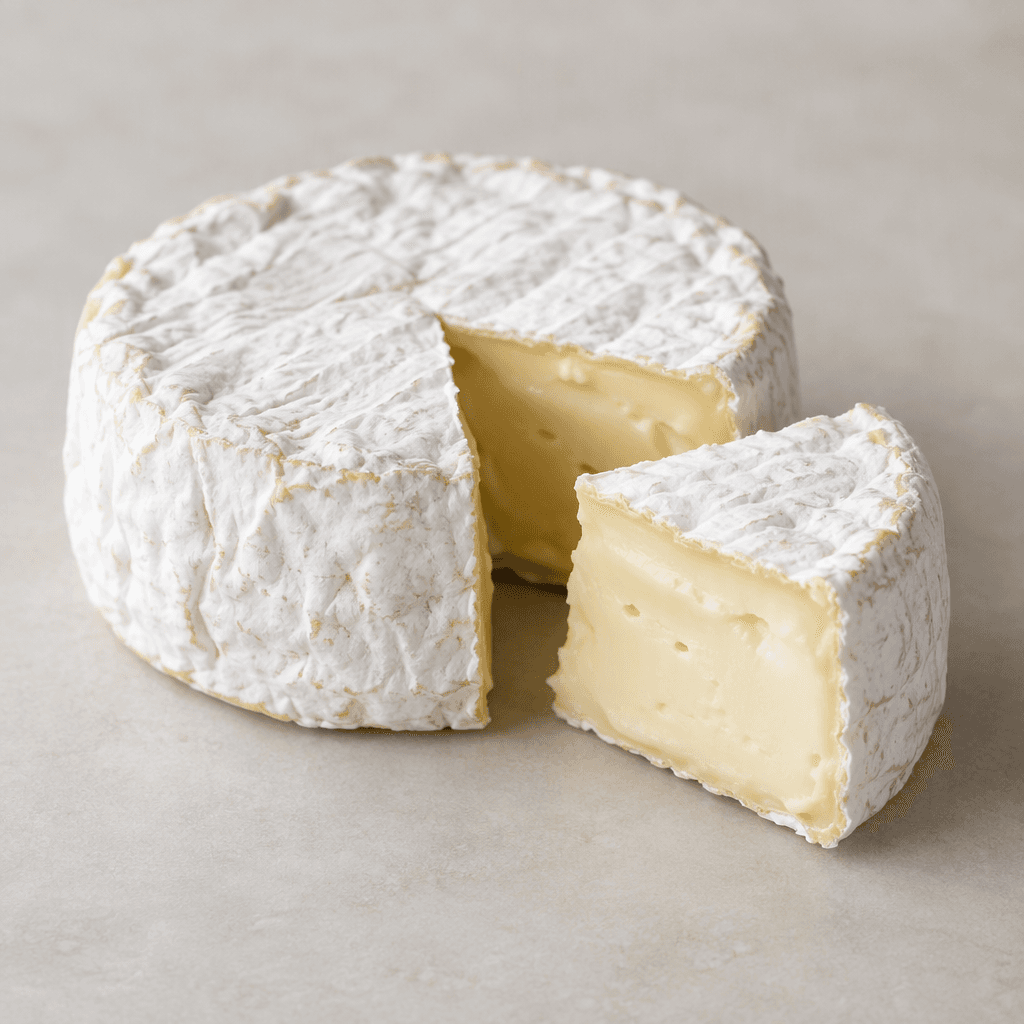
Brie Cheese Calories
Soft, creamy French cheese. Rich in calcium and B12.
In season: Spring · Summer · Autumn · Winter
CALORIES
GI
POTASSIUM
FIBER
Quick answer
1 slice (medium) of Brie Cheese (30 g) has 100 calories. That works out to 334 calories per 100 g. It contains 0.2 g of carbs, 6.2 g of protein, 8.3 g of fat and 0 g of fiber. Its 0.7 µg of B12 covers 30% of the Daily Value. Its glycemic index is 0 (low), so it raises blood sugar slowly.
What is Brie Cheese?
Brie cheese is a soft French cheese associated with the Brie region. It has a pale, creamy interior and a thin, white bloomy rind; as it ripens, the centre becomes softer and more yielding.
It is commonly served at room temperature on a cheese board, with crusty bread, crackers or fruit, and can also be baked until gooey. Its mild, buttery flavour suits both sweet accompaniments such as pears and savoury ones like nuts. Brie cheese provides protein but is also rich in fat and energy, so a modest slice is often enough. Pair it with fresh fruit or a crisp salad for a lighter plate.
Brie Cheese Nutrition Facts
Selected: 100 g
334
KCAL / 100G
Carbs
0.5g
· 0% DV
Protein
20.8g
· 42% DV
Fat
27.7g
· 36% DV
Fiber
0g
· 0% DV
DV is the share of the daily value covered, on a 2,000 kcal reference diet.
Calories come from: Carbs 1% · Protein 25% · Fat 74%

Log this food in EatBetter
100,000+ people use it
- Get your daily calorie target
- Snap your meal, log it in seconds
- See every vitamin and mineral

📸 Scan the code to get the app free.

Brie Cheese Vitamins & Minerals
Vitamins
B12
2.4µg · 100% DV
Biotin
16µg · 53% DV
B2
0.45mg · 35% DV
Vitamin A
170µg · 19% DV
Minerals
Phosphorus
320mg · 46% DV
Sodium
629mg · 27% DV
Zinc
3mg · 27% DV
Selenium
14µg · 25% DV
Potassium ⭐
152mg · 4% DV
How Nutritious Is Brie Cheese?
Nutrient density
Medium
How many vitamins, minerals and how much fiber this food carries per calorie. A high score means a lot of nutrition for few calories.
Satiety score
Medium
An EatBetter score computed from fiber, protein and calorie density. A high score means staying full longer on the same calories.
Both scores are calculated per 100 g and do not change with the selected portion. The satiety score is EatBetter's own calculation, not a clinical measure.
Brie Cheese Glycemic Index
GLYCEMIC INDEX
GLYCEMIC LOAD
Accounts for portion size — a more realistic measure than GI alone.
How to Burn Off Brie Cheese
To burn the 334 calories in 100 g:
🚶
Walking (5 km/h)
🏃
Running (8 km/h)
🚴
Cycling
🏊
Swimming
Times are calculated with the MET equation for a 70 kg adult. Actual burn varies with your weight, age and pace.
Is Brie Cheese Processed?
NOVA 3
Processed
1. Unprocessed
2. Minimally Processed
3. Processed
4. Ultra-Processed
NOVA classifies foods into 4 groups by industrial processing. NOVA 1 (unprocessed) is the healthiest.
Does Brie Cheese Contain Allergens?
Contains these allergens:
Which Diets Is Brie Cheese Good For?
Vegan
— Not suitable
Vegetarian
✓ Suitable
Gluten-Free
— Not suitable
Dairy-Free
— Not suitable
Mediterranean
✓ Suitable
Paleo
— Not suitable
Whole30
— Not suitable
DASH
— Not suitable
Keto
✓ Suitable
Low FODMAP
— Not suitable
Brie Cheese Fat Profile
SATURATED
17.8g
MONOUNSATURATED
7.5g
POLYUNSATURATED
1.1g
Omega 6:3 ratio 6.3:1
Above the ideal 4:1 (6.3:1).
Compare Brie Cheese
Foods Similar to Brie Cheese
Frequently Asked Questions About Brie Cheese
Can you freeze Brie cheese?
Yes, Brie cheese can be frozen, but freezing may make its creamy texture crumbly after thawing. Wrap it tightly and thaw it in the refrigerator; use thawed Brie in cooked dishes, where the texture change is less noticeable.
Does Brie cheese melt well?
Yes, Brie cheese melts into a soft, creamy texture when heated. Remove the rind if you want a smoother sauce, or leave it on when baking a whole wheel; it helps the cheese hold its shape as it warms.
What goes well with Brie cheese?
Brie cheese pairs well with crisp apples or pears, grapes, crusty bread, crackers, and fruit preserves. For a savoury board, add nuts or cured meat; the mild, creamy cheese works with both sweet and salty flavours.
How do you cut Brie cheese?
Cut Brie cheese into wedges from the centre toward the rind so each piece gets some of the creamy interior and the white rind. For a round wheel, avoid cutting off just the pointed tip, which leaves the remaining pieces mostly rind.
How long should Brie cheese sit out before serving?
Let Brie cheese sit out briefly before serving so it softens and its aroma becomes easier to taste. Keep it refrigerated until shortly before the meal, and return leftovers to the refrigerator rather than leaving the cheese out for an extended time.
Can you eat Brie cheese rind?
Yes, Brie cheese rind is edible. The soft white bloom is part of the cheese’s ripening process and has a mild earthy flavour; you can cut it away if you prefer the taste or texture of the interior alone.
How do you know if Brie cheese has gone bad?
Brie cheese may be spoiled if it develops an unpleasant ammonia-like smell, unusual coloured spots, or a sticky surface. Its normal rind is white and velvety; when the appearance or smell seems wrong, discard it rather than tasting it.
Is Brie cheese safe to eat during pregnancy?
Cold Brie cheese is generally avoided during pregnancy because soft mould-ripened cheeses can carry Listeria. It can be eaten if cooked until steaming hot throughout; ask your healthcare professional for advice specific to your pregnancy.
What is the difference between Brie cheese and Camembert?
Brie cheese and Camembert are both soft French cheeses with bloomy white rinds, but Brie is often milder and made in larger wheels, while Camembert can have a stronger flavour. The exact difference varies with the producer and ripening.
Can you bake Brie cheese in its wooden box?
Only bake Brie cheese in its wooden box if the box is designed to be oven-safe and has no plastic, staples, or other non-oven-safe parts. Otherwise, place the cheese in a small ovenproof dish and heat it until soft.
Have another question about Brie Cheese?
Ask the AI nutrition coach — calories, portions, alternatives and more, answered in seconds in the app.

Scan calories with your camera
Instant AI nutrition analysis

Nutrition data compiled from USDA FoodData Central and scientific sources.