

Ready & Packaged Foods
All →Vegetables & Legumes
All →Desserts & Confectionery
All →Meat & Protein
All →Grains & Bakery
All →Beverages
All →Milk & Dairy
All →

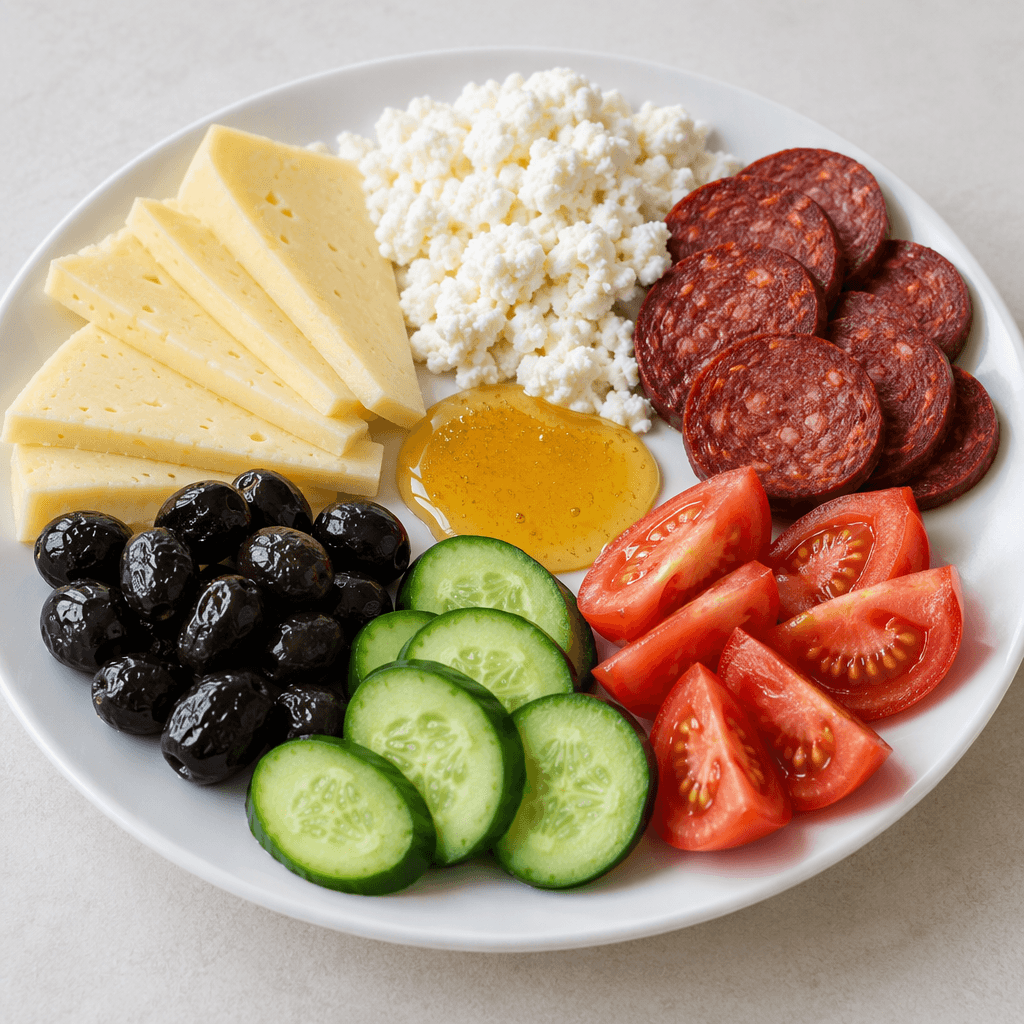
Breakfast plate Calories
Egg, cheese, olives, tomato, cucumber, bread, sometimes honey or jam
In season: Spring · Summer · Autumn · Winter
CALORIES
GI
POTASSIUM
FIBER
Quick answer
1 serving (medium) of Breakfast plate (250 g) has 425 calories. That works out to 170 calories per 100 g. It contains 42.5 g of carbs, 21.3 g of protein, 18.8 g of fat and 5.3 g of fiber. Its 1.8 µg of B12 covers 73% of the Daily Value. Its glycemic index is 50 (medium), so it raises blood sugar at a moderate pace.
What is Breakfast plate?
A Breakfast plate brings together familiar parts of a Turkish morning spread. It may include cheeses such as kaşar and lor, olives, sliced tomato and cucumber, and sucuk; eggs, honey or jam are common additions, with bread alongside. The exact mix varies between households and regions.
The appeal is in the contrast: salty and savoury bites alongside crisp vegetables and a little sweetness. In Turkey, it is typically shared over a leisurely breakfast with bread and strong tea. Cheese and eggs contribute protein, while bread and sweet toppings add carbohydrates; the vegetables bring freshness and fibre. For a lighter plate, add more vegetables and keep the sucuk and honey portions modest.
Breakfast plate Nutrition Facts
Selected: 100 g
170
KCAL / 100G
Carbs
17g
· 6% DV
Protein
8.5g
· 17% DV
Fat
7.5g
· 10% DV
Fiber
2.1g
· 8% DV
DV is the share of the daily value covered, on a 2,000 kcal reference diet.
Calories come from: Carbs 40% · Protein 20% · Fat 40%
Breakfast plate Vitamins & Minerals
Vitamins
B12
0.7µg · 29% DV
Biotin
6.5µg · 22% DV
Vitamin A
180µg · 20% DV
B2
0.22mg · 17% DV
Minerals
Phosphorus
110mg · 16% DV
Sodium
350mg · 15% DV
Selenium
8.5µg · 15% DV
Calcium
120mg · 12% DV
How Nutritious Is Breakfast plate?
Nutrient density
High
How many vitamins, minerals and how much fiber this food carries per calorie. A high score means a lot of nutrition for few calories.
Satiety score
Medium
An EatBetter score computed from fiber, protein and calorie density. A high score means staying full longer on the same calories.
Both scores are calculated per 100 g and do not change with the selected portion. The satiety score is EatBetter's own calculation, not a clinical measure.
Breakfast plate Glycemic Index
GLYCEMIC INDEX
GLYCEMIC LOAD
Accounts for portion size — a more realistic measure than GI alone.
How to Burn Off Breakfast plate
To burn the 170 calories in 100 g:
🚶
Walking (5 km/h)
🏃
Running (8 km/h)
🚴
Cycling
🏊
Swimming
Times are calculated with the MET equation for a 70 kg adult. Actual burn varies with your weight, age and pace.
Is Breakfast plate Processed?
NOVA 3
Processed
1. Unprocessed
2. Minimally Processed
3. Processed
4. Ultra-Processed
NOVA classifies foods into 4 groups by industrial processing. NOVA 1 (unprocessed) is the healthiest.
Does Breakfast plate Contain Allergens?
Contains these allergens:
Which Diets Is Breakfast plate Good For?
Vegan
— Not suitable
Vegetarian
— Not suitable
Gluten-Free
— Not suitable
Dairy-Free
— Not suitable
Mediterranean
✓ Suitable
Paleo
— Not suitable
Whole30
— Not suitable
DASH
— Not suitable
Keto
— Not suitable
Low FODMAP
— Not suitable
Breakfast plate Fat Profile
SATURATED
2.6g
MONOUNSATURATED
2.8g
POLYUNSATURATED
1.1g
Omega 6:3 ratio 8.8:1
Above the ideal 4:1 (8.8:1).
Compare Breakfast plate
Foods Similar to Breakfast plate
Frequently Asked Questions About Breakfast plate
What goes on a Turkish breakfast plate?
A Turkish breakfast plate commonly includes cheese, olives, tomatoes, cucumbers and bread. Depending on the household, it may also feature eggs, sucuk, honey or jam. The ingredients are usually arranged in separate portions so people can choose what they want.
How do you make a Turkish breakfast plate at home?
To make a Turkish breakfast plate, arrange sliced cheese, olives and fresh vegetables on a plate, with bread on the side. Add honey or jam if you like, and serve cooked eggs or sucuk separately while they are still warm.
Is a Turkish breakfast plate the same as a Turkish breakfast spread?
No. A Turkish breakfast plate is a single serving assembled on one plate, while a Turkish breakfast spread usually places several dishes and ingredients on the table for sharing. A plate can still include the familiar mix of cheese, olives, vegetables and bread.
What is the difference between kaşar and lor on a Turkish breakfast plate?
Kaşar is a mild Turkish semi-hard cheese, while lor is a soft, crumbly fresh cheese. A Turkish breakfast plate may include both: serve kaşar in slices and lor in a small mound so their different textures are easy to enjoy.
Should sucuk be cooked before it goes on a breakfast plate?
Yes, sucuk is normally cooked before it is served on a breakfast plate. Fry the slices until heated through, then serve them warm alongside the cooler cheese and vegetables rather than placing raw slices on the plate.
What bread goes best with a Turkish breakfast plate?
Fresh Turkish bread, such as a loaf of pide or simit, pairs well with a Turkish breakfast plate. Bread is useful for eating the cheeses and olives, or for spreading honey; serve it separately so it does not become soggy from the vegetables.
Is tea traditionally served with a Turkish breakfast plate?
Yes, Turkish tea is the traditional drink served with a Turkish breakfast plate. It is usually offered in small glasses, and coffee, milk or juice can be served instead if that suits the meal better.
Can you prepare a Turkish breakfast plate the night before?
You can prepare some parts of a Turkish breakfast plate ahead, such as portioning cheese and olives into covered containers in the refrigerator. Cut tomatoes and cucumbers shortly before serving, and keep bread and cooked eggs or sucuk separate.
How can you make a Turkish breakfast plate lighter?
A lighter Turkish breakfast plate can emphasize tomatoes, cucumbers and a moderate amount of cheese, with less sucuk, bread and honey. Keep the ingredients separate and let everyone choose portions rather than automatically filling the plate with every item.
Can a Turkish breakfast plate be served for brunch?
Yes, a Turkish breakfast plate works well for brunch because its mix of savory and sweet foods can suit a leisurely late-morning meal. Add freshly brewed tea and warm bread, and offer cooked eggs or sucuk separately for anyone who wants a heartier plate.
Have another question about Breakfast plate?
Ask the AI nutrition coach — calories, portions, alternatives and more, answered in seconds in the app.

Scan calories with your camera
Instant AI nutrition analysis

Nutrition data compiled from USDA FoodData Central and scientific sources.