

Ready & Packaged Foods
All →Vegetables & Legumes
All →Desserts & Confectionery
All →Meat & Protein
All →Grains & Bakery
All →Beverages
All →Milk & Dairy
All →

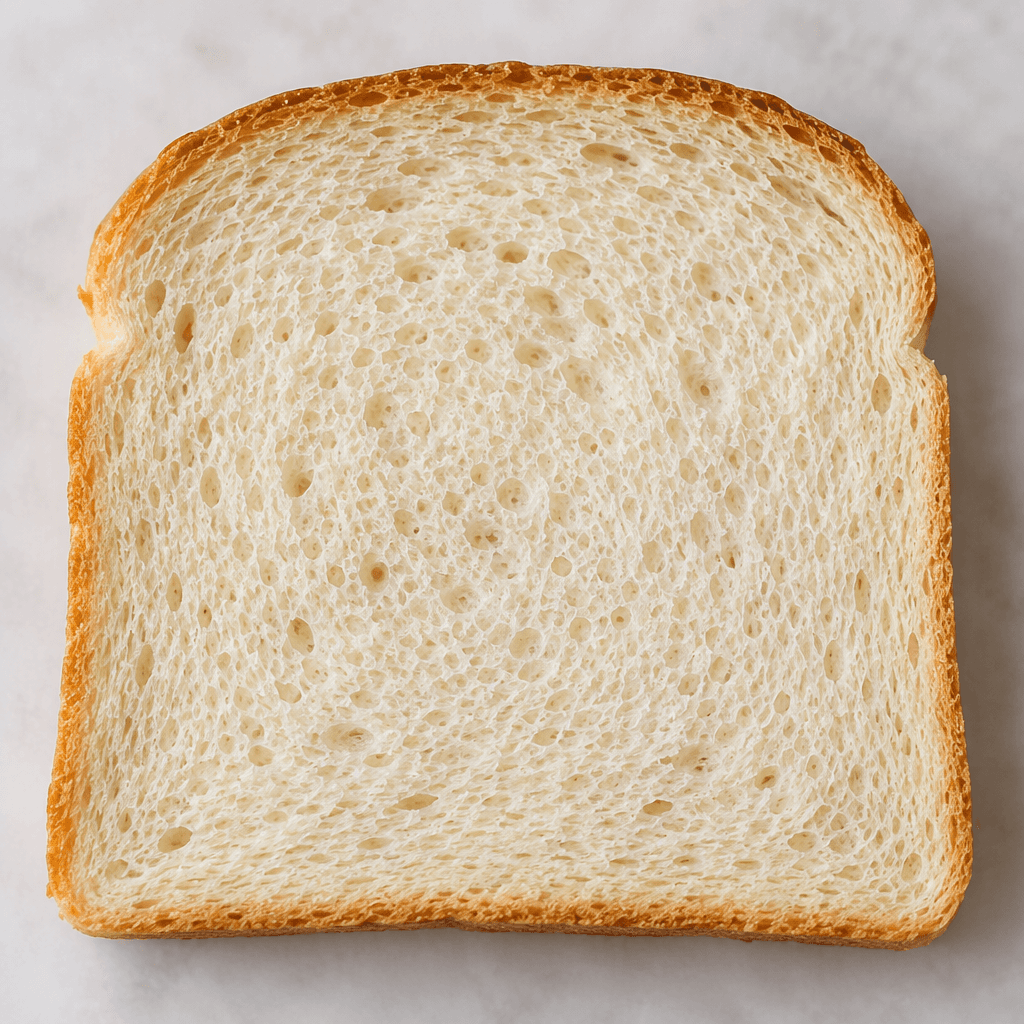
Bread (thin slice) Calories
Thin slice of bread, lower calories and carbs, quick energy source.
CALORIES
GI
POTASSIUM
FIBER
Quick answer
1 slice (thin) of Bread (thin slice) (25 g) has 63 calories. That works out to 250 calories per 100 g. It contains 12 g of carbs, 2.1 g of protein, 0.6 g of fat and 0.7 g of fiber. Its 3.3 µg of Selenium covers 6% of the Daily Value. Its glycemic index is 75 (high), so it raises blood sugar quickly.
What is Bread (thin slice)?
Bread (thin slice) is a slim-cut piece of baked bread, typically made from flour, water and yeast. It has a soft interior and a lightly browned crust. Depending on the loaf, it may be eaten fresh or toasted, used for sandwiches, or served alongside soup and meals. In Turkey, bread is a familiar part of breakfast, often paired with cheese, olives or eggs.
It is mainly a source of carbohydrates, with some protein and fibre and relatively little fat. A thin slice makes it easier to keep portions modest, though toppings and spreads affect the meal’s overall nutrition. Pair it with eggs, hummus or vegetables for a more filling snack or breakfast.
Bread (thin slice) Nutrition Facts
Selected: 100 g
250
KCAL / 100G
Carbs
48g
· 17% DV
Protein
8.5g
· 17% DV
Fat
2.5g
· 3% DV
Fiber
2.7g
· 10% DV
DV is the share of the daily value covered, on a 2,000 kcal reference diet.
Calories come from: Carbs 77% · Protein 14% · Fat 9%
Bread (thin slice) Vitamins & Minerals
Vitamins
B1
0.23mg · 19% DV
B3
2.5mg · 16% DV
B2
0.12mg · 9% DV
Folate
35µg · 9% DV
Minerals
Selenium
13µg · 24% DV
Iron
3mg · 17% DV
Sodium
400mg · 17% DV
Calcium
110mg · 11% DV
How Nutritious Is Bread (thin slice)?
Nutrient density
Low
How many vitamins, minerals and how much fiber this food carries per calorie. A high score means a lot of nutrition for few calories.
Satiety score
Medium
An EatBetter score computed from fiber, protein and calorie density. A high score means staying full longer on the same calories.
Both scores are calculated per 100 g and do not change with the selected portion. The satiety score is EatBetter's own calculation, not a clinical measure.
Bread (thin slice) Glycemic Index
GLYCEMIC INDEX
GLYCEMIC LOAD
Accounts for portion size — a more realistic measure than GI alone.
How to Burn Off Bread (thin slice)
To burn the 250 calories in 100 g:
🚶
Walking (5 km/h)
🏃
Running (8 km/h)
🚴
Cycling
🏊
Swimming
Times are calculated with the MET equation for a 70 kg adult. Actual burn varies with your weight, age and pace.
Is Bread (thin slice) Processed?
NOVA 3
Processed
1. Unprocessed
2. Minimally Processed
3. Processed
4. Ultra-Processed
NOVA classifies foods into 4 groups by industrial processing. NOVA 1 (unprocessed) is the healthiest.
Does Bread (thin slice) Contain Allergens?
Contains these allergens:
Which Diets Is Bread (thin slice) Good For?
Vegan
✓ Suitable
Vegetarian
✓ Suitable
Gluten-Free
— Not suitable
Dairy-Free
— Not suitable
Mediterranean
✓ Suitable
Paleo
— Not suitable
Whole30
— Not suitable
DASH
— Not suitable
Keto
— Not suitable
Low FODMAP
— Not suitable
Bread (thin slice) Fat Profile
SATURATED
0.5g
MONOUNSATURATED
0.4g
POLYUNSATURATED
0.6g
Omega 6:3 ratio 16.7:1
Above the ideal 4:1 (16.7:1).
Compare Bread (thin slice)
Foods Similar to Bread (thin slice)
Frequently Asked Questions About Bread (thin slice)
Does thin-slice bread cause weight gain?
No, thin-slice bread does not cause weight gain by itself; weight changes reflect eating patterns over time. Toppings and fillings can add substantially to a sandwich, so consider the whole meal rather than the bread slice alone.
How should thin-slice bread be stored?
Keep thin-slice bread in a sealed bag in a cool, dry place. Leaving it exposed to air makes it dry out, while a damp or warm spot encourages mold. Close the package after each use.
Can thin-slice bread be frozen?
Yes, thin-slice bread freezes well. Separate slices with small pieces of parchment or freeze them in a way that lets you remove just what you need. Toast slices straight from frozen or let them thaw at room temperature.
Can you eat thin-slice bread if you cut off the mold?
No, discard moldy thin-slice bread rather than cutting away the visible spot. Mold can spread through the porous bread beyond what you can see, so remove the moldy slice and discard other slices stored in the same package.
Does toasting thin-slice bread change its nutrition?
Toasting thin-slice bread removes some moisture and makes it crisp, but it does not remove its protein or carbohydrates. Toasting can also make a slice easier to overeat, so stop when it is lightly browned rather than burnt.
Why does thin-slice bread go stale so quickly?
Thin-slice bread has more surface exposed to air relative to its thickness, so it can lose moisture and dry out quickly. Keep it sealed between servings; freezing what you will not use soon also helps preserve its texture.
How can you keep thin-slice bread from getting soggy in a sandwich?
Keep wet fillings such as tomato or pickles away from the bread until serving, or place a layer of cheese or lettuce between the filling and the slice. Toasting thin-slice bread first can also help it hold up better.
Is thin-slice bread a good choice before a workout?
Yes, thin-slice bread can provide carbohydrates before exercise, which the body uses for energy. Choose a simple topping if you are eating close to your workout, since heavy, fatty fillings may feel uncomfortable during activity.
Is thin-slice bread healthy?
It can fit into a balanced diet, but the type matters: whole-grain bread provides more fiber than bread made mainly with refined flour. Pair a slice with protein-rich food or vegetables for a more substantial meal.
Can you use thin-slice bread to make French toast?
Yes, thin-slice bread works for French toast, but it can become soft quickly after soaking. Dip each slice briefly in the egg mixture, then cook it in a lightly greased pan until both sides are set and browned.
Have another question about Bread (thin slice)?
Ask the AI nutrition coach — calories, portions, alternatives and more, answered in seconds in the app.

Scan calories with your camera
Instant AI nutrition analysis

Nutrition data compiled from USDA FoodData Central and scientific sources.