

Ready & Packaged Foods
All →Vegetables & Legumes
All →Desserts & Confectionery
All →Meat & Protein
All →Grains & Bakery
All →Beverages
All →Milk & Dairy
All →

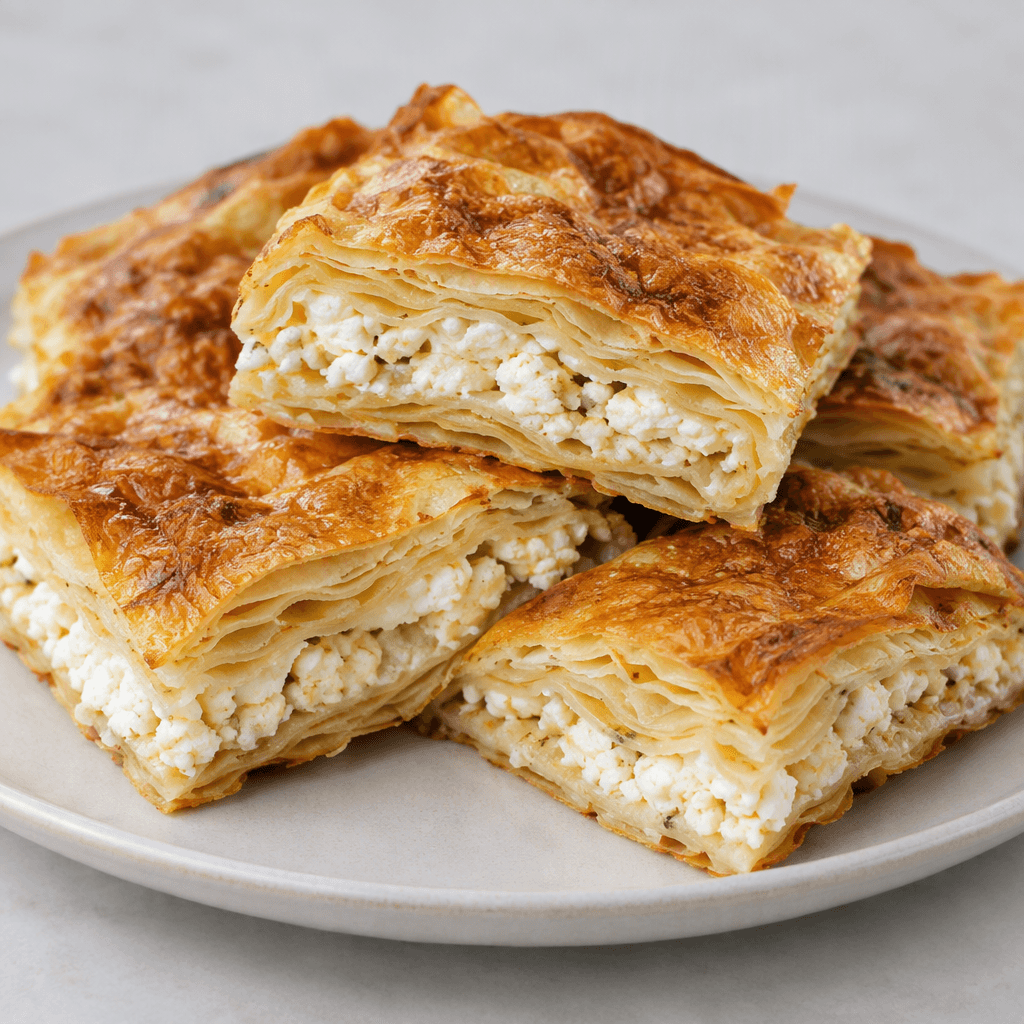
Borek with Cottage Cheese Calories
Traditional Turkish pastry filled with cottage cheese. Source of protein and calcium.
In season: Spring · Summer · Autumn · Winter
CALORIES
GI
POTASSIUM
FIBER
Quick answer
1 piece (medium) of Borek with Cottage Cheese (80 g) has 176 calories. That works out to 220 calories per 100 g. It contains 18.4 g of carbs, 6.8 g of protein, 8 g of fat and 1 g of fiber. Its 88 mg of Phosphorus covers 13% of the Daily Value. Its glycemic index is 65 (medium), so it raises blood sugar at a moderate pace.
What is Borek with Cottage Cheese?
Lorlu börek is a Turkish pastry made by layering thin sheets of dough with lor, a fresh whey cheese. Though the English page name says “Borek with Cottage Cheese,” lor is not quite the same as cottage cheese: it is usually mild, soft and crumbly. The pastry bakes to a golden, crisp finish around its tender filling.
In Turkey, it is served warm or at room temperature, often for breakfast, alongside tea, or as part of a light meal. It provides some protein, while the pastry contributes much of its carbohydrate and energy. For a fresher, lighter plate, pair a piece with tomatoes, cucumber and herbs; it also works well as a savoury snack.
Borek with Cottage Cheese Nutrition Facts
Selected: 100 g
220
KCAL / 100G
Carbs
23g
· 8% DV
Protein
8.5g
· 17% DV
Fat
10g
· 13% DV
Fiber
1.2g
· 4% DV
DV is the share of the daily value covered, on a 2,000 kcal reference diet.
Calories come from: Carbs 43% · Protein 16% · Fat 41%
Borek with Cottage Cheese Vitamins & Minerals
Vitamins
B12
0.35µg · 15% DV
B2
0.18mg · 14% DV
Vitamin A
110µg · 12% DV
B5
0.45mg · 9% DV
Minerals
Phosphorus
110mg · 16% DV
Sodium
350mg · 15% DV
Calcium
140mg · 14% DV
Selenium
7µg · 13% DV
How Nutritious Is Borek with Cottage Cheese?
Nutrient density
Medium
How many vitamins, minerals and how much fiber this food carries per calorie. A high score means a lot of nutrition for few calories.
Satiety score
Medium
An EatBetter score computed from fiber, protein and calorie density. A high score means staying full longer on the same calories.
Both scores are calculated per 100 g and do not change with the selected portion. The satiety score is EatBetter's own calculation, not a clinical measure.
Borek with Cottage Cheese Glycemic Index
GLYCEMIC INDEX
GLYCEMIC LOAD
Accounts for portion size — a more realistic measure than GI alone.
How to Burn Off Borek with Cottage Cheese
To burn the 220 calories in 100 g:
🚶
Walking (5 km/h)
🏃
Running (8 km/h)
🚴
Cycling
🏊
Swimming
Times are calculated with the MET equation for a 70 kg adult. Actual burn varies with your weight, age and pace.
Is Borek with Cottage Cheese Processed?
NOVA 3
Processed
1. Unprocessed
2. Minimally Processed
3. Processed
4. Ultra-Processed
NOVA classifies foods into 4 groups by industrial processing. NOVA 1 (unprocessed) is the healthiest.
Does Borek with Cottage Cheese Contain Allergens?
Contains these allergens:
Which Diets Is Borek with Cottage Cheese Good For?
Vegan
— Not suitable
Vegetarian
✓ Suitable
Gluten-Free
— Not suitable
Dairy-Free
— Not suitable
Mediterranean
✓ Suitable
Paleo
— Not suitable
Whole30
— Not suitable
DASH
— Not suitable
Keto
— Not suitable
Low FODMAP
— Not suitable
Borek with Cottage Cheese Fat Profile
SATURATED
4.2g
MONOUNSATURATED
3.1g
POLYUNSATURATED
1.1g
Omega 6:3 ratio 6.4:1
Above the ideal 4:1 (6.4:1).
Compare Borek with Cottage Cheese
Foods Similar to Borek with Cottage Cheese
Frequently Asked Questions About Borek with Cottage Cheese
What is lorlu börek?
Lorlu börek is a Turkish layered pastry filled with lor, a mild fresh curd cheese. It is folded or layered with thin pastry sheets and baked until golden; recipes vary by region and household.
How do you make lorlu börek?
To make lorlu börek, mix lor with an egg and optional herbs, place the filling between pastry sheets, and fold or layer them in a greased pan. Brush the top with oil or a milk-based wash, then bake until golden.
Why does lorlu börek filling leak out?
Lorlu börek filling can leak if the pastry is overfilled, the edges are not sealed, or the lor is very wet. Drain excess moisture, leave a clear border around the filling, and pinch or fold the edges closed before baking.
Can you assemble lorlu börek the night before?
Yes, you can assemble lorlu börek ahead and refrigerate it covered until you are ready to bake. Keep it chilled rather than leaving it at room temperature, and add any finishing wash just before baking if the pastry tends to soften.
What pastry sheets work best for lorlu börek?
Thin Turkish yufka is the usual choice for lorlu börek, while filo can work as a substitute. Filo is thinner and dries out quickly, so cover unused sheets with a clean damp towel and brush each layer lightly with fat.
How do you reheat lorlu börek without making it soggy?
Reheat lorlu börek in an oven or toaster oven rather than covering it in the microwave. The dry heat helps crisp the pastry again; warm individual pieces until the center is hot, and avoid stacking them while they reheat.
Can you freeze lorlu börek before baking?
Yes, lorlu börek can be frozen unbaked. Arrange the assembled pieces in a single layer until firm, then transfer them to a freezer-safe container; bake from frozen or thaw in the refrigerator, allowing extra baking time if needed.
What is the difference between lor and cottage cheese in lorlu börek?
Lor is a mild Turkish curd cheese, usually drier and less creamy than many cottage cheeses. If using cottage cheese in lorlu börek, drain it first so its extra moisture does not make the pastry soggy.
What do you serve with lorlu börek?
Lorlu börek pairs well with a crisp salad, tomatoes, olives, or plain yogurt. In Turkey it is also commonly served with tea, especially at breakfast or as a snack; choose lighter sides to balance the rich pastry.
Can you add spinach to lorlu börek?
Yes, spinach can be added to lorlu börek alongside the lor. Cook or wilt the spinach first, then squeeze out excess liquid before mixing it into the filling; this helps keep the pastry layers from becoming wet.
Have another question about Borek with Cottage Cheese?
Ask the AI nutrition coach — calories, portions, alternatives and more, answered in seconds in the app.

Scan calories with your camera
Instant AI nutrition analysis

Nutrition data compiled from USDA FoodData Central and scientific sources.