

Ready & Packaged Foods
All →Vegetables & Legumes
All →Desserts & Confectionery
All →Meat & Protein
All →Grains & Bakery
All →Beverages
All →Milk & Dairy
All →

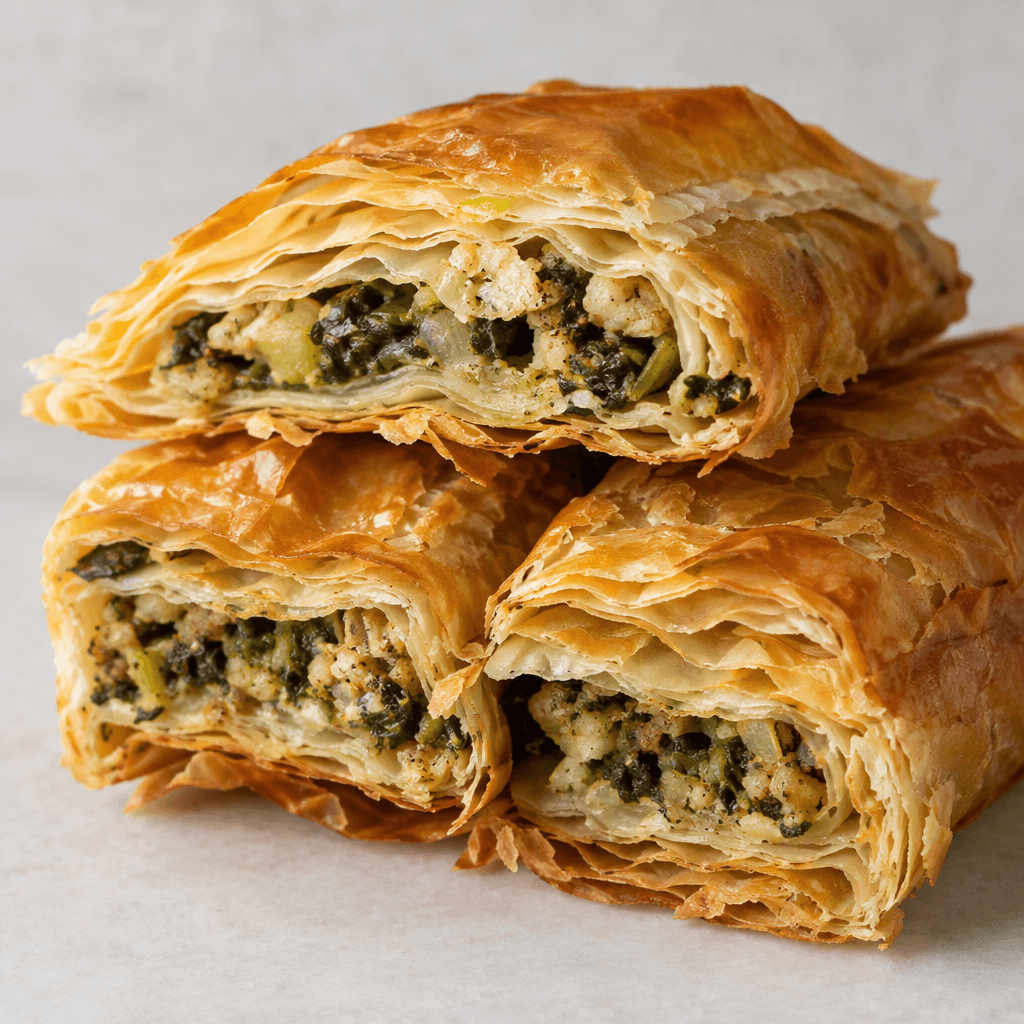
Borek Calories
Traditional Turkish pastry made with thin dough, filled with cheese, minced meat, or spinach
In season: Spring · Summer · Autumn · Winter
CALORIES
GI
POTASSIUM
FIBER
Quick answer
1 piece (medium) of Borek (80 g) has 216 calories. That works out to 270 calories per 100 g. It contains 22.4 g of carbs, 6 g of protein, 10.4 g of fat and 1.3 g of fiber. Its 344 mg of Sodium covers 15% of the Daily Value. Its glycemic index is 60 (medium), so it raises blood sugar at a moderate pace.
What is Borek?
Borek is a Turkish pastry made from thin sheets of dough layered or rolled around a savoury filling, commonly cheese, minced meat or spinach. It comes in many shapes, from coils to neat tray-baked slices, and is part of a broad pastry tradition shared across Turkey and neighbouring regions.
Fresh from the oven, it is crisp and flaky outside, with a soft, savoury centre. In Turkey, people eat it at breakfast, with tea as a snack, or as part of a meal; it is also familiar in communities around the world. Borek is filling and mainly provides carbohydrates and fat, with some protein from the filling. Pair it with a fresh salad for a lighter, more balanced plate.
Borek Nutrition Facts
Selected: 100 g
270
KCAL / 100G
Carbs
28g
· 10% DV
Protein
7.5g
· 15% DV
Fat
13g
· 17% DV
Fiber
1.6g
· 6% DV
DV is the share of the daily value covered, on a 2,000 kcal reference diet.
Calories come from: Carbs 43% · Protein 12% · Fat 45%
Borek Vitamins & Minerals
Vitamins
B1
0.13mg · 11% DV
B12
0.25µg · 10% DV
Vitamin A
80µg · 9% DV
B2
0.12mg · 9% DV
Minerals
Sodium
430mg · 19% DV
Selenium
9µg · 16% DV
Phosphorus
90mg · 13% DV
Calcium
110mg · 11% DV
How Nutritious Is Borek?
Nutrient density
Low
How many vitamins, minerals and how much fiber this food carries per calorie. A high score means a lot of nutrition for few calories.
Satiety score
Low
An EatBetter score computed from fiber, protein and calorie density. A high score means staying full longer on the same calories.
Both scores are calculated per 100 g and do not change with the selected portion. The satiety score is EatBetter's own calculation, not a clinical measure.
Borek Glycemic Index
GLYCEMIC INDEX
GLYCEMIC LOAD
Accounts for portion size — a more realistic measure than GI alone.
How to Burn Off Borek
To burn the 270 calories in 100 g:
🚶
Walking (5 km/h)
🏃
Running (8 km/h)
🚴
Cycling
🏊
Swimming
Times are calculated with the MET equation for a 70 kg adult. Actual burn varies with your weight, age and pace.
Is Borek Processed?
NOVA 3
Processed
1. Unprocessed
2. Minimally Processed
3. Processed
4. Ultra-Processed
NOVA classifies foods into 4 groups by industrial processing. NOVA 1 (unprocessed) is the healthiest.
Does Borek Contain Allergens?
Contains these allergens:
Which Diets Is Borek Good For?
Vegan
— Not suitable
Vegetarian
✓ Suitable
Gluten-Free
— Not suitable
Dairy-Free
— Not suitable
Mediterranean
✓ Suitable
Paleo
— Not suitable
Whole30
— Not suitable
DASH
— Not suitable
Keto
— Not suitable
Low FODMAP
— Not suitable
Borek Fat Profile
SATURATED
4.1g
MONOUNSATURATED
4.7g
POLYUNSATURATED
2.4g
Omega 6:3 ratio 55:1
Above the ideal 4:1 (55:1).
Compare Borek
Foods Similar to Borek
Frequently Asked Questions About Borek
What is borek?
Borek is a layered or rolled pastry made with thin dough, commonly filled with cheese, minced meat, or spinach. It is popular across Turkey and neighboring regions, and can be baked, pan-fried, or cooked in other traditional ways.
What is borek made of?
Borek is usually made with thin yufka or phyllo-style dough and a savory filling such as cheese, minced meat, or spinach. Depending on the recipe, the layers may be brushed with oil, butter, milk, or a yogurt-based mixture.
How do you make borek crispy?
For crisp borek, use a well-drained filling, brush the dough layers lightly rather than soaking them, and bake in a preheated oven. Let the pastry stand uncovered after baking so trapped steam does not soften the flaky layers.
What are the different types of borek?
Borek comes in many shapes and styles. Su böreği uses briefly boiled dough layers, kol böreği is rolled into long coils, and sigara böreği is a small cigar-shaped roll; fillings and cooking methods vary by region.
What is the difference between borek and baklava?
Borek is generally a savory pastry filled with ingredients such as cheese, meat, or vegetables, while baklava is a sweet layered pastry filled with nuts and soaked in syrup. Both use thin dough, but their fillings and finishes are quite different.
Where did borek originate?
Borek is associated with Turkish and wider Central Asian culinary traditions and spread across regions during the Ottoman era. Many countries now have their own versions, with distinct fillings, shapes, and names.
Can you freeze borek?
Yes, borek can be frozen before or after baking. Wrap portions airtight to protect them from freezer odors; bake unbaked pieces from frozen, or thaw cooked borek in the refrigerator before reheating it in an oven.
How long does leftover borek keep?
Cooked borek keeps in the refrigerator for a few days when cooled and stored in a covered container. Refrigerate it promptly rather than leaving it out for hours, especially when the filling contains cheese, meat, or egg.
How do you reheat borek without making it soggy?
Reheat borek in an oven or a dry skillet to bring back some crispness. A microwave is convenient but tends to soften the pastry; avoid covering the borek while reheating, since trapped steam makes the layers less flaky.
What do you serve with borek?
Serve borek with plain yogurt, a fresh salad, or a glass of ayran for a balanced savory meal. In Turkey, cheese or spinach borek is also commonly enjoyed at breakfast or with tea.
Have another question about Borek?
Ask the AI nutrition coach — calories, portions, alternatives and more, answered in seconds in the app.

Scan calories with your camera
Instant AI nutrition analysis

Nutrition data compiled from USDA FoodData Central and scientific sources.