

Ready & Packaged Foods
All →Vegetables & Legumes
All →Desserts & Confectionery
All →Meat & Protein
All →Grains & Bakery
All →Beverages
All →Milk & Dairy
All →

Blueberry Calories
Rich in antioxidants, low calorie, source of fiber
In season: Spring · Summer
CALORIES
GI
POTASSIUM
FIBER
Quick answer
1 cup (medium) of Blueberry (148 g) has 84 calories. That works out to 57 calories per 100 g. It contains 21.5 g of carbs, 1 g of protein, 0.4 g of fat and 3.6 g of fiber. Its 28.6 µg of Vitamin K covers 24% of the Daily Value. Its glycemic index is 53 (low), so it raises blood sugar slowly.
What is Blueberry?
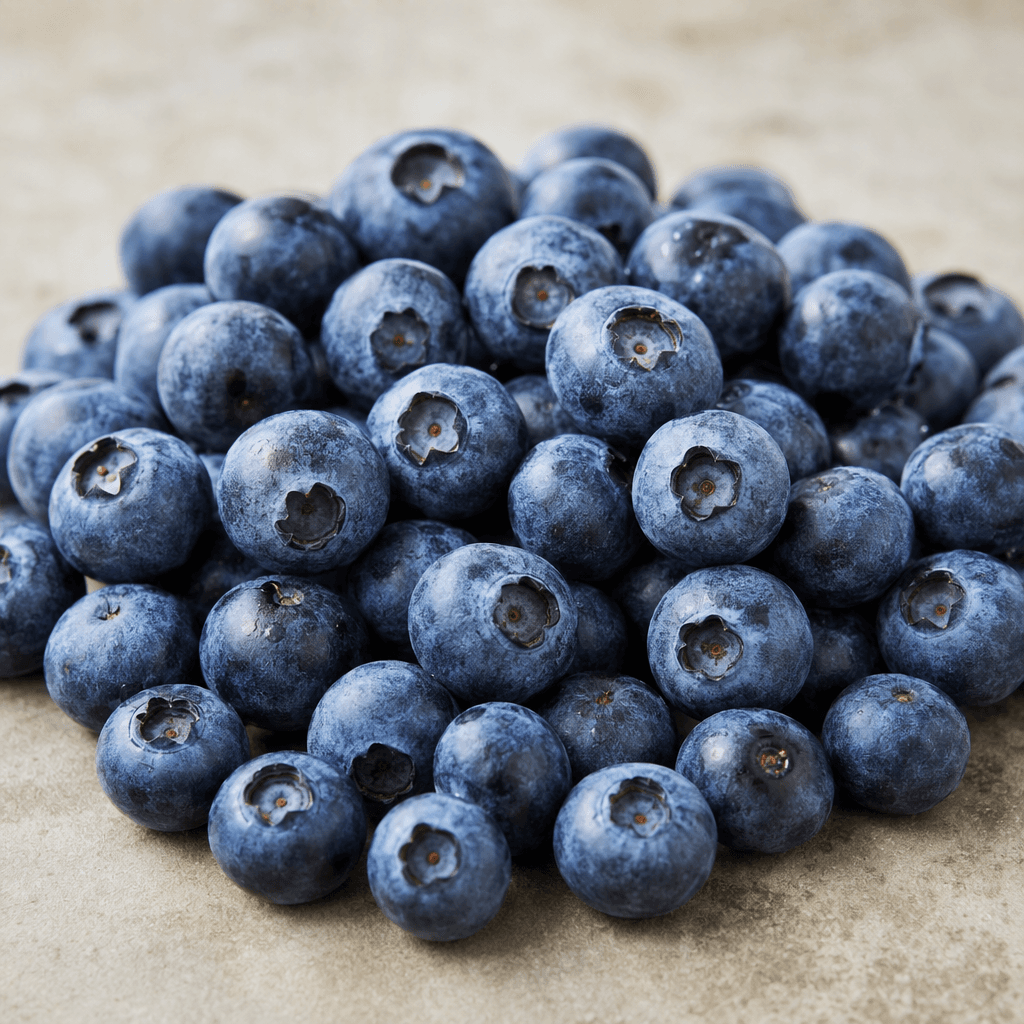
Blueberries are small, round fruits that grow on shrubs in the heath family. The cultivated berries commonly sold today are especially associated with North America, where they have long been eaten fresh and used in cooking. Their taut, deep blue-purple skin often has a pale, powdery bloom; this is natural, not a sign of spoilage.
They taste sweet with a gentle tang and have juicy flesh that softens easily when cooked. Enjoy them by the handful, stirred into porridge or yoghurt, or baked into muffins and pies; they are also popular in smoothies and preserves. Blueberries provide fibre, with 2.4 g per 100 g, while remaining relatively light. Add them to breakfast or use them to bring fruit sweetness to desserts with less added sugar.
Blueberry Nutrition Facts
Selected: 100 g
57
KCAL / 100G
Carbs
14.5g
· 5% DV
Protein
0.7g
· 1% DV
Fat
0.3g
· 0% DV
Fiber
2.4g
· 9% DV
DV is the share of the daily value covered, on a 2,000 kcal reference diet.
Calories come from: Carbs 91% · Protein 4% · Fat 5%

Log this food in EatBetter
100,000+ people use it
- Get your daily calorie target
- Snap your meal, log it in seconds
- See every vitamin and mineral

📸 Scan the code to get the app free.

Blueberry Vitamins & Minerals
Vitamins
Vitamin K
19.3µg · 16% DV
Vitamin C
9.7mg · 11% DV
Vitamin E
0.57mg · 4% DV
B2
0.04mg · 3% DV
Minerals
Potassium ⭐
77mg · 2% DV
Phosphorus
12mg · 2% DV
Manganese
0mg · 0% DV
Copper
0mg · 0% DV
How Nutritious Is Blueberry?
Nutrient density
High
How many vitamins, minerals and how much fiber this food carries per calorie. A high score means a lot of nutrition for few calories.
Satiety score
Medium
An EatBetter score computed from fiber, protein and calorie density. A high score means staying full longer on the same calories.
Both scores are calculated per 100 g and do not change with the selected portion. The satiety score is EatBetter's own calculation, not a clinical measure.
Blueberry Glycemic Index
GLYCEMIC INDEX
GLYCEMIC LOAD
Accounts for portion size — a more realistic measure than GI alone.
How to Burn Off Blueberry
To burn the 57 calories in 100 g:
🚶
Walking (5 km/h)
🏃
Running (8 km/h)
🚴
Cycling
🏊
Swimming
Times are calculated with the MET equation for a 70 kg adult. Actual burn varies with your weight, age and pace.
Is Blueberry Processed?
NOVA 1
Unprocessed
1. Unprocessed
2. Minimally Processed
3. Processed
4. Ultra-Processed
NOVA classifies foods into 4 groups by industrial processing. NOVA 1 (unprocessed) is the healthiest.
Does Blueberry Contain Allergens?
No known major allergens
Which Diets Is Blueberry Good For?
Vegan
✓ Suitable
Vegetarian
✓ Suitable
Gluten-Free
✓ Suitable
Dairy-Free
— Not suitable
Mediterranean
✓ Suitable
Paleo
✓ Suitable
Whole30
— Not suitable
DASH
— Not suitable
Keto
— Not suitable
Low FODMAP
— Not suitable
Blueberry Fat Profile
SATURATED
0.02g
MONOUNSATURATED
0.04g
POLYUNSATURATED
0.09g
Omega 6:3 ratio 2.7:1
Below the ideal 4:1 — a good omega balance.
Compare Blueberry
Foods Similar to Blueberry
Frequently Asked Questions About Blueberry
Are blueberries good for you?
Yes, blueberries are a nutritious fruit that provides fibre and antioxidant compounds. Add fresh or frozen berries to oatmeal, yogurt or salads, or eat them on their own as a snack.
How should you store blueberries?
Keep blueberries unwashed in the refrigerator and remove any crushed or moldy berries first. Moisture encourages spoilage, so rinse them shortly before eating rather than storing them wet.
Can you freeze blueberries?
Yes, blueberries freeze well. Rinse and dry them thoroughly, freeze them in a single layer on a tray, then transfer them to a sealed freezer container; you can add them straight to smoothies or baking.
Do you need to wash blueberries before eating them?
Yes, rinse blueberries gently under cool running water just before eating. Their pale, powdery bloom is a natural protective coating, so there is no need to scrub the skins.
How can you tell when blueberries are ripe?
Ripe blueberries are plump, firm and deep blue to purple, often with a light, natural bloom. Green or reddish berries are usually unripe and will not become reliably sweet after picking.
Are fresh or frozen blueberries better?
Both fresh and frozen blueberries are good choices. Frozen berries are convenient for smoothies and baking, while fresh ones keep their shape better in snacks and salads; choose unsweetened frozen fruit when available.
Can people with diabetes eat blueberries?
Yes, people with diabetes can include blueberries while accounting for the portion and the meal’s total carbohydrates. Blood glucose responses vary, so anyone adjusting food around diabetes medication should ask their clinician or dietitian for personal guidance.
Can you eat blueberries every day?
Yes, most people can enjoy blueberries regularly as part of a varied diet. Add them to breakfast or have them as a snack, and vary your fruit choices rather than relying on blueberries alone.
Should blueberries be refrigerated?
Yes, refrigerate fresh blueberries to slow spoilage. Keep them dry in a breathable container, and avoid sealing damp berries in a way that traps condensation; wash them only when you are ready to eat.
What is the difference between wild and cultivated blueberries?
Wild blueberries are generally smaller and often have a more concentrated, tart flavor, while cultivated blueberries tend to be larger and milder. The exact taste and size vary by variety and growing conditions.
Have another question about Blueberry?
Ask the AI nutrition coach — calories, portions, alternatives and more, answered in seconds in the app.

Scan calories with your camera
Instant AI nutrition analysis

Nutrition data compiled from USDA FoodData Central and scientific sources.