

Ready & Packaged Foods
All →Vegetables & Legumes
All →Desserts & Confectionery
All →Meat & Protein
All →Grains & Bakery
All →Beverages
All →Milk & Dairy
All →

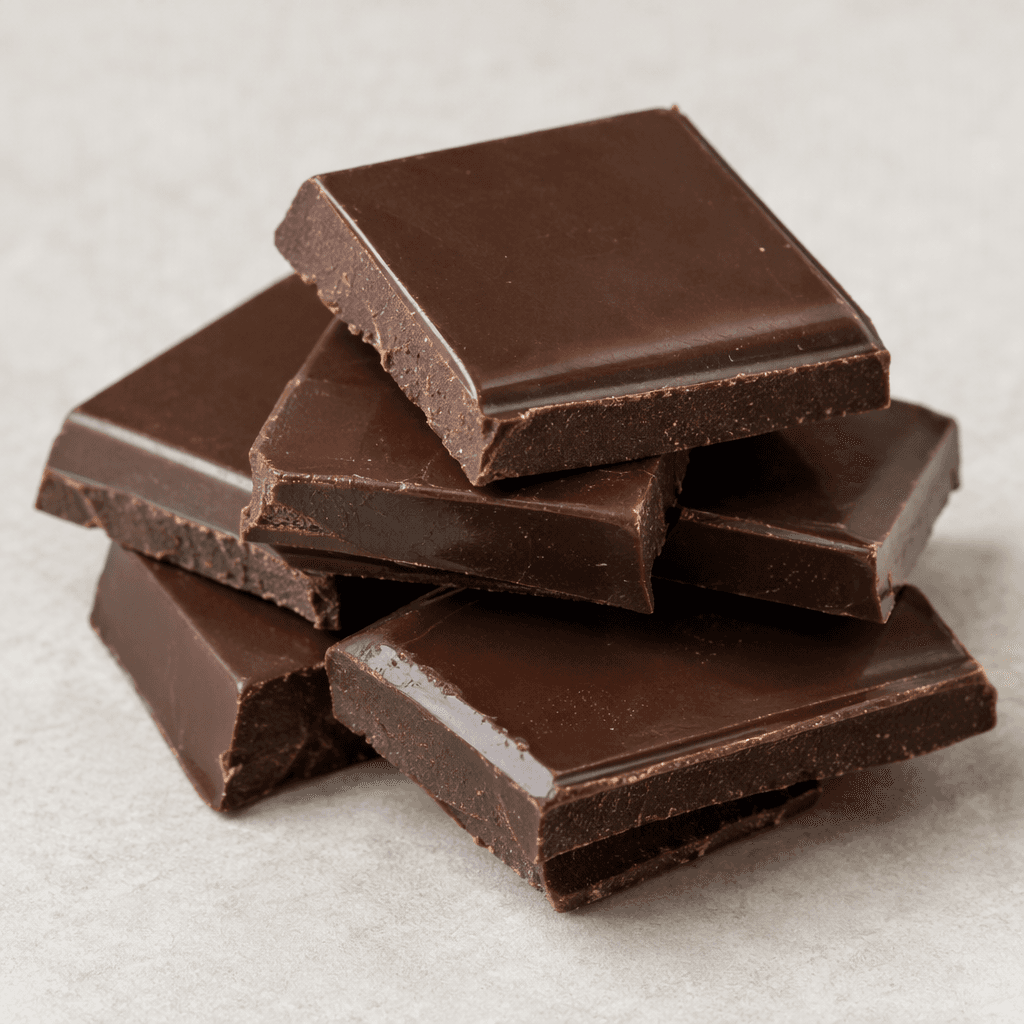
Dark chocolate (60% cocoa) Calories
Rich cocoa, antioxidants, lower sugar
In season: Winter · Autumn · Spring · Summer
CALORIES
GI
POTASSIUM
FIBER
Quick answer
1 piece (medium) of Dark chocolate (60% cocoa) (20 g) has 104 calories. That works out to 520 calories per 100 g. It contains 9.2 g of carbs, 1.4 g of protein, 7.2 g of fat and 1.7 g of fiber. Its 0.4 mg of Copper covers 40% of the Daily Value. Its glycemic index is 23 (low), so it raises blood sugar slowly.
What is Dark chocolate (60% cocoa)?
Dark chocolate (60% cocoa) is made with cocoa solids and cocoa butter, with sugar added; the percentage indicates the share of cocoa ingredients, not that the bar is sugar-free. It has a deeper cocoa flavour and is usually less sweet than milk chocolate, while remaining a familiar everyday treat.
Enjoy it in a small square with coffee or tea, or chop it into baking, where it works well in cakes, cookies and ganache. The pieces snap cleanly, then melt to a smooth texture, with a pleasantly bitter edge balanced by sweetness. It is energy-dense, though it also provides 8.5 g of fibre per 100 g. For a lighter snack, have one piece with fruit, or grate a little over yoghurt.
Dark chocolate (60% cocoa) Nutrition Facts
Selected: 100 g
520
KCAL / 100G
Carbs
46g
· 17% DV
Protein
7.2g
· 14% DV
Fat
36g
· 46% DV
Fiber
8.5g
· 30% DV
DV is the share of the daily value covered, on a 2,000 kcal reference diet.
Calories come from: Carbs 34% · Protein 5% · Fat 61%
Dark chocolate (60% cocoa) Vitamins & Minerals
Vitamins
B2
0.25mg · 19% DV
B1
0.08mg · 7% DV
B3
1.1mg · 7% DV
Biotin
2µg · 7% DV
Minerals
Copper
2mg · 222% DV
Iron
8mg · 44% DV
Manganese
1mg · 43% DV
Magnesium
170mg · 40% DV
How Nutritious Is Dark chocolate (60% cocoa)?
Nutrient density
Medium
How many vitamins, minerals and how much fiber this food carries per calorie. A high score means a lot of nutrition for few calories.
Satiety score
Medium
An EatBetter score computed from fiber, protein and calorie density. A high score means staying full longer on the same calories.
Both scores are calculated per 100 g and do not change with the selected portion. The satiety score is EatBetter's own calculation, not a clinical measure.
Dark chocolate (60% cocoa) Glycemic Index
GLYCEMIC INDEX
GLYCEMIC LOAD
Accounts for portion size — a more realistic measure than GI alone.
How to Burn Off Dark chocolate (60% cocoa)
To burn the 520 calories in 100 g:
🚶
Walking (5 km/h)
🏃
Running (8 km/h)
🚴
Cycling
🏊
Swimming
Times are calculated with the MET equation for a 70 kg adult. Actual burn varies with your weight, age and pace.
Is Dark chocolate (60% cocoa) Processed?
NOVA 3
Processed
1. Unprocessed
2. Minimally Processed
3. Processed
4. Ultra-Processed
NOVA classifies foods into 4 groups by industrial processing. NOVA 1 (unprocessed) is the healthiest.
Does Dark chocolate (60% cocoa) Contain Allergens?
Contains these allergens:
Which Diets Is Dark chocolate (60% cocoa) Good For?
Vegan
— Not suitable
Vegetarian
✓ Suitable
Gluten-Free
— Not suitable
Dairy-Free
— Not suitable
Mediterranean
— Not suitable
Paleo
— Not suitable
Whole30
— Not suitable
DASH
— Not suitable
Keto
— Not suitable
Low FODMAP
— Not suitable
Dark chocolate (60% cocoa) Fat Profile
SATURATED
21.5g
MONOUNSATURATED
11.5g
POLYUNSATURATED
1.7g
Omega 6:3 ratio 18.3:1
Above the ideal 4:1 (18.3:1).
Compare Dark chocolate (60% cocoa)
Foods Similar to Dark chocolate (60% cocoa)
Frequently Asked Questions About Dark chocolate (60% cocoa)
Is dark chocolate (60% cocoa) good for you?
Dark chocolate (60% cocoa) contains cocoa compounds, but it also provides sugar and energy. A modest serving can fit into a balanced diet; its antioxidant content does not make it a treatment or a food to eat without limit.
Does dark chocolate (60% cocoa) contain caffeine?
Yes, dark chocolate (60% cocoa) contains caffeine and theobromine, though the amount varies by product. It generally has less caffeine than coffee, but people sensitive to stimulants may find that eating it late affects their sleep.
Can dogs eat dark chocolate (60% cocoa)?
No. Dark chocolate (60% cocoa) can poison dogs because it contains theobromine and caffeine, and higher-cocoa chocolate is especially concerning. If your dog eats any, contact a veterinarian promptly rather than waiting for symptoms.
Why does dark chocolate (60% cocoa) turn white?
A pale coating on dark chocolate (60% cocoa) is usually fat bloom or sugar bloom, caused by temperature changes or moisture. It is generally a quality issue rather than a sign of spoilage, but discard chocolate with mold or an off smell.
How should you store dark chocolate (60% cocoa)?
Store dark chocolate (60% cocoa) tightly wrapped in a cool, dry place away from sunlight and strong odors. Refrigeration can expose it to moisture and cause surface changes, so it is usually unnecessary unless your room is very warm.
Can you use dark chocolate (60% cocoa) instead of milk chocolate in baking?
Yes, dark chocolate (60% cocoa) can replace milk chocolate in many recipes, but the result will taste less sweet and more cocoa-forward. Adjust the recipe’s added sugar to taste, and melt the chocolate gently to avoid scorching.
Does dark chocolate (60% cocoa) keep you awake?
It can. Dark chocolate (60% cocoa) contains caffeine and theobromine, which may make it harder for some people to fall asleep when eaten near bedtime. If you notice this effect, have it earlier in the day.
What does 60% mean on dark chocolate (60% cocoa)?
The 60% on dark chocolate (60% cocoa) refers to the proportion of cocoa ingredients in the product. The remaining ingredients commonly include sugar and, depending on the recipe, cocoa butter or other ingredients; the percentage alone does not tell you the exact sweetness.
Why does dark chocolate (60% cocoa) seize when you melt it?
Dark chocolate (60% cocoa) often seizes when even a little water or steam gets into the melting chocolate. Use a completely dry bowl and utensils, keep steam away, and melt it slowly over low heat or in short microwave bursts.
Can people with diabetes eat dark chocolate (60% cocoa)?
Some people with diabetes can include dark chocolate (60% cocoa), but it still contains carbohydrates and sugar and can affect blood glucose. Account for the portion in your meal plan; ask your clinician or dietitian for advice tailored to your treatment.
Have another question about Dark chocolate (60% cocoa)?
Ask the AI nutrition coach — calories, portions, alternatives and more, answered in seconds in the app.

Scan calories with your camera
Instant AI nutrition analysis

Nutrition data compiled from USDA FoodData Central and scientific sources.