

Ready & Packaged Foods
All →Vegetables & Legumes
All →Desserts & Confectionery
All →Meat & Protein
All →Grains & Bakery
All →Beverages
All →Milk & Dairy
All →

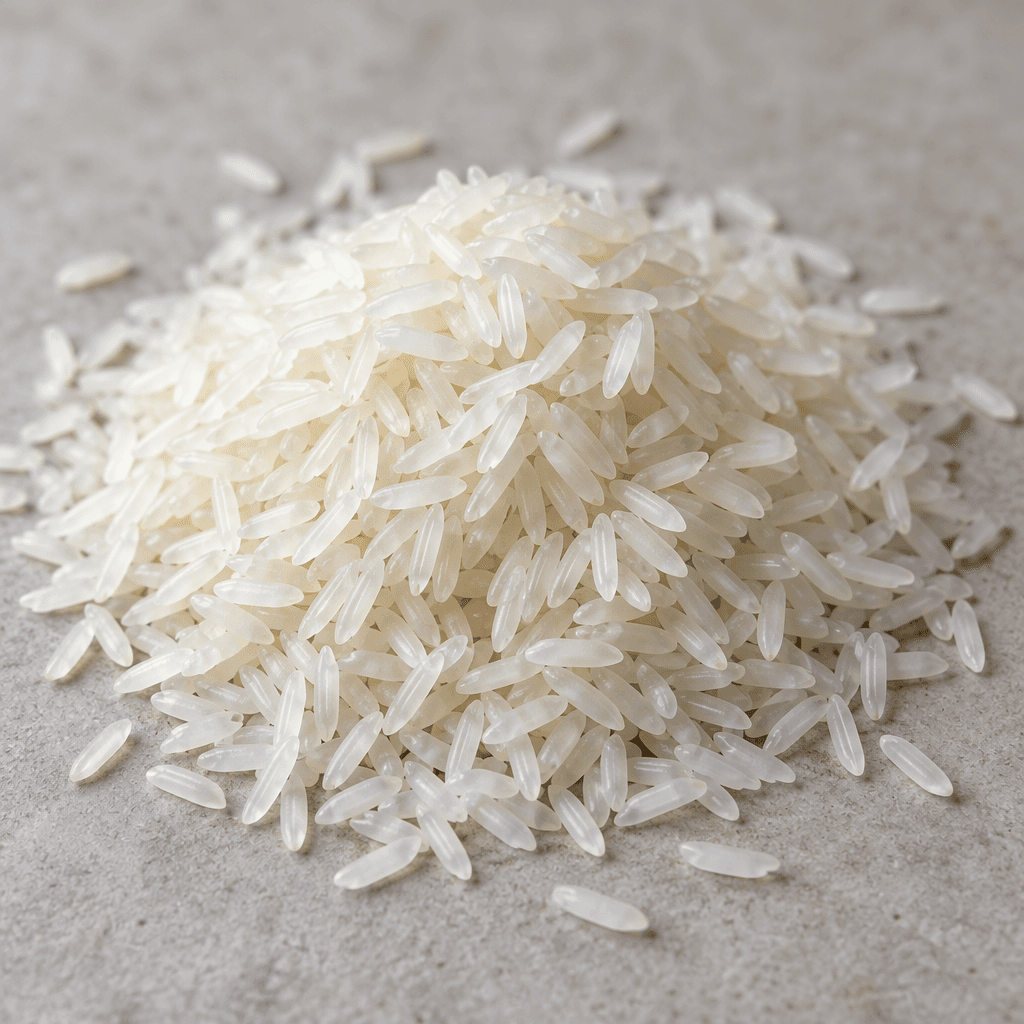
White rice, raw Calories
Staple refined grain high in carbohydrates; low in fiber
CALORIES
GI
POTASSIUM
FIBER
Quick answer
1 cup (medium) of White rice, raw (185 g) has 675 calories. That works out to 365 calories per 100 g. It contains 148 g of carbs, 13.1 g of protein, 1.3 g of fat and 2.4 g of fiber. Its 2 mg of Manganese covers 88% of the Daily Value. Its glycemic index is 73 (high), so it raises blood sugar quickly.
What is White rice, raw?
Raw white rice consists of grains that have had their outer husk and bran removed. Dry and firm before cooking, the grains soften and may turn fluffy and separate or stick together, depending on the variety and method. Across many cuisines, it is steamed, simmered or cooked as pilaf, then served alongside vegetables, beans, meat, fish or saucy dishes; it is also used in rice pudding and other desserts.
It is mainly a source of carbohydrate and contains little fibre compared with brown rice. Pairing a portion with vegetables and beans or another protein makes for a more balanced meal. For a lighter pilaf, use a modest amount of added fat and serve it with plenty of vegetables.
White rice, raw Nutrition Facts
Selected: 100 g
365
KCAL / 100G
Carbs
80g
· 29% DV
Protein
7.1g
· 14% DV
Fat
0.7g
· 1% DV
Fiber
1.3g
· 5% DV
DV is the share of the daily value covered, on a 2,000 kcal reference diet.
Calories come from: Carbs 90% · Protein 8% · Fat 2%
White rice, raw Vitamins & Minerals
Vitamins
B5
1mg · 20% DV
B3
1.6mg · 10% DV
B6
0.16mg · 9% DV
Biotin
2µg · 7% DV
Minerals
Manganese
1mg · 43% DV
Selenium
15.1µg · 27% DV
Phosphorus
115mg · 16% DV
Zinc
1mg · 9% DV
How Nutritious Is White rice, raw?
Nutrient density
Low
How many vitamins, minerals and how much fiber this food carries per calorie. A high score means a lot of nutrition for few calories.
Satiety score
Low
An EatBetter score computed from fiber, protein and calorie density. A high score means staying full longer on the same calories.
Both scores are calculated per 100 g and do not change with the selected portion. The satiety score is EatBetter's own calculation, not a clinical measure.
White rice, raw Glycemic Index
GLYCEMIC INDEX
GLYCEMIC LOAD
Accounts for portion size — a more realistic measure than GI alone.
How to Burn Off White rice, raw
To burn the 365 calories in 100 g:
🚶
Walking (5 km/h)
🏃
Running (8 km/h)
🚴
Cycling
🏊
Swimming
Times are calculated with the MET equation for a 70 kg adult. Actual burn varies with your weight, age and pace.
Is White rice, raw Processed?
NOVA 2
Minimally Processed
1. Unprocessed
2. Minimally Processed
3. Processed
4. Ultra-Processed
NOVA classifies foods into 4 groups by industrial processing. NOVA 1 (unprocessed) is the healthiest.
Does White rice, raw Contain Allergens?
No known major allergens
Which Diets Is White rice, raw Good For?
Vegan
✓ Suitable
Vegetarian
✓ Suitable
Gluten-Free
✓ Suitable
Dairy-Free
— Not suitable
Mediterranean
✓ Suitable
Paleo
— Not suitable
Whole30
— Not suitable
DASH
— Not suitable
Keto
— Not suitable
Low FODMAP
— Not suitable
White rice, raw Fat Profile
SATURATED
0.18g
MONOUNSATURATED
0.21g
POLYUNSATURATED
0.19g
Omega 6:3 ratio 18:1
Above the ideal 4:1 (18:1).
Compare White rice, raw
Foods Similar to White rice, raw
Frequently Asked Questions About White rice, raw
How do you cook white rice from raw so it comes out fluffy?
Rinse the raw white rice, drain it well, then cook it covered with the appropriate amount of water until tender. Let it rest off the heat before fluffing gently with a fork; stirring during cooking can make the grains sticky.
Should you rinse raw white rice before cooking it?
Yes, rinsing raw white rice removes loose surface starch and can help keep cooked grains from sticking together. Swish it gently in water and drain; rinsing is especially useful when you want separate grains rather than a creamy texture.
What is the water-to-rice ratio for raw white rice?
There is no single water ratio for all raw white rice: grain shape, cooking method, and soaking all affect how much it needs. Start with the package directions, and use less cooking water if the rice has already absorbed water while soaking.
Does rinsing raw white rice remove arsenic?
No, rinsing raw white rice does not remove all its arsenic, though it may wash away some. Cooking rice in excess water and draining it can reduce arsenic further, but that method may also wash away some nutrients.
How should you store raw white rice?
Store raw white rice in a tightly sealed container in a cool, dry, dark place. Keep it away from moisture, heat, and strong-smelling foods; a sealed container also helps protect the grains from pantry pests.
Does uncooked white rice go bad?
Yes, uncooked white rice can become unsuitable to eat if it gets damp, develops mold, or is infested with insects. Discard rice with an unusual musty or rancid smell; properly sealed, dry rice generally keeps much longer than cooked rice.
Is it safe to eat raw white rice?
It is not recommended to eat raw white rice. The hard grains are difficult to digest, and uncooked rice may carry microorganisms that can cause illness; cook it thoroughly before eating.
Should you soak raw white rice before cooking?
No, soaking raw white rice is not essential. It can help the grains cook more evenly and reduce cooking time, but drain the rice well and account for the water it has absorbed when adding cooking liquid.
Why are there bugs in my raw white rice?
Bugs in raw white rice may come from eggs already present in the grains or from pests reaching an open container. If you find insects, discard the rice, wash and dry the container, and store replacement rice sealed.
Can you freeze raw white rice?
Yes, raw white rice can be frozen in a well-sealed, moisture-proof container, although freezing is usually unnecessary if you store it somewhere cool and dry. Keep the container closed while the rice warms to room temperature to avoid condensation.
Have another question about White rice, raw?
Ask the AI nutrition coach — calories, portions, alternatives and more, answered in seconds in the app.

Scan calories with your camera
Instant AI nutrition analysis

Nutrition data compiled from USDA FoodData Central and scientific sources.