

Ready & Packaged Foods
All →Vegetables & Legumes
All →Desserts & Confectionery
All →Meat & Protein
All →Grains & Bakery
All →Beverages
All →Milk & Dairy
All →

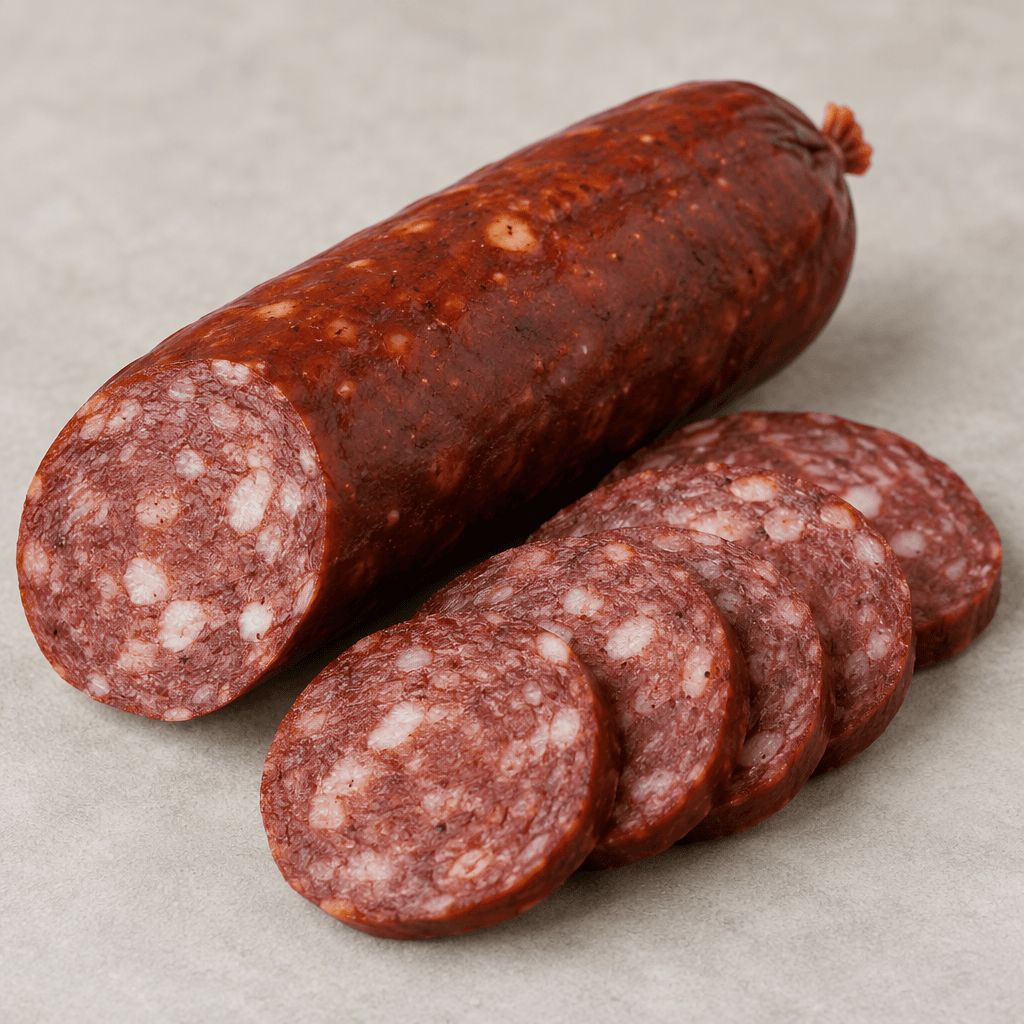
Beef sucuk Calories
Spiced beef sausage, source of protein and iron
In season: Spring · Summer · Autumn · Winter
CALORIES
GI
POTASSIUM
FIBER
Quick answer
2 slice (medium) of Beef sucuk (40 g) has 164 calories. That works out to 410 calories per 100 g. It contains 1 g of carbs, 7.8 g of protein, 14.4 g of fat and 0 g of fiber. Its 0.8 µg of B12 covers 35% of the Daily Value. Its glycemic index is 0 (low), so it raises blood sugar slowly.
What is Beef sucuk?
Beef sucuk is a Turkish-style sausage made from seasoned beef, commonly flavoured with garlic, cumin and other spices. It has a firm texture and a deep, savoury taste, with flecks of fat visible in each slice. Traditionally, sucuk is cured and air-dried before it is sold.
In Turkey, it is often fried for breakfast with eggs, tucked into bread or added to dishes such as pide. Elsewhere, it works well in a breakfast sandwich or as a boldly flavoured addition to a cooked meal. It provides protein, but is also high in fat: 100 g contains 36 g of fat. A few thin slices can bring plenty of flavour; cook them with eggs, tomatoes or peppers for a more balanced plate.
Beef sucuk Nutrition Facts
Selected: 100 g
410
KCAL / 100G
Carbs
2.5g
· 1% DV
Protein
19.5g
· 39% DV
Fat
36g
· 46% DV
Fiber
0g
· 0% DV
DV is the share of the daily value covered, on a 2,000 kcal reference diet.
Calories come from: Carbs 2% · Protein 19% · Fat 79%
Beef sucuk Vitamins & Minerals
Vitamins
B12
2.1µg · 88% DV
B3
4.2mg · 26% DV
B6
0.34mg · 20% DV
B2
0.18mg · 14% DV
Minerals
Sodium
1200mg · 52% DV
Zinc
4mg · 36% DV
Selenium
13µg · 24% DV
Phosphorus
170mg · 24% DV
How Nutritious Is Beef sucuk?
Nutrient density
Medium
How many vitamins, minerals and how much fiber this food carries per calorie. A high score means a lot of nutrition for few calories.
Satiety score
Low
An EatBetter score computed from fiber, protein and calorie density. A high score means staying full longer on the same calories.
Both scores are calculated per 100 g and do not change with the selected portion. The satiety score is EatBetter's own calculation, not a clinical measure.
Beef sucuk Glycemic Index
GLYCEMIC INDEX
GLYCEMIC LOAD
Accounts for portion size — a more realistic measure than GI alone.
How to Burn Off Beef sucuk
To burn the 410 calories in 100 g:
🚶
Walking (5 km/h)
🏃
Running (8 km/h)
🚴
Cycling
🏊
Swimming
Times are calculated with the MET equation for a 70 kg adult. Actual burn varies with your weight, age and pace.
Is Beef sucuk Processed?
NOVA 3
Processed
1. Unprocessed
2. Minimally Processed
3. Processed
4. Ultra-Processed
NOVA classifies foods into 4 groups by industrial processing. NOVA 1 (unprocessed) is the healthiest.
Does Beef sucuk Contain Allergens?
No known major allergens
Which Diets Is Beef sucuk Good For?
Vegan
— Not suitable
Vegetarian
— Not suitable
Gluten-Free
✓ Suitable
Dairy-Free
— Not suitable
Mediterranean
✓ Suitable
Paleo
✓ Suitable
Whole30
— Not suitable
DASH
— Not suitable
Keto
✓ Suitable
Low FODMAP
— Not suitable
Beef sucuk Fat Profile
SATURATED
15.5g
MONOUNSATURATED
16.2g
POLYUNSATURATED
2.1g
Omega 6:3 ratio 2.8:1
Below the ideal 4:1 — a good omega balance.
Compare Beef sucuk
Foods Similar to Beef sucuk
Frequently Asked Questions About Beef sucuk
What is beef sucuk?
Beef sucuk is a Turkish-style, strongly seasoned beef sausage, traditionally fermented and dried. It is typically sliced and cooked in a pan, though production methods vary, so follow the package directions for the specific product.
How do you cook beef sucuk without burning it?
Cook beef sucuk over medium-low heat and turn the slices as they brown. Its fat renders as it heats, so a dry pan is usually enough; high heat can darken the outside before the middle warms through.
Does beef sucuk need to be cooked before eating?
Beef sucuk should be cooked unless its package clearly says it is ready to eat. Products differ in how they are fermented, dried, and handled, so cooking it thoroughly is the safer choice when the instructions are unclear.
Why does beef sucuk split or curl in the pan?
Beef sucuk can split or curl when its casing tightens as the sausage heats, especially over high heat. Use moderate heat and make a few shallow cuts in the casing if needed; avoid cutting deeply into the slices.
What spices are used in beef sucuk?
Beef sucuk is commonly seasoned with garlic, cumin, and red pepper, but recipes vary by producer and region. The spice blend gives it its characteristic savory, aromatic flavor and can make some versions noticeably hotter than others.
Can you grill beef sucuk?
Yes, you can grill beef sucuk, but use moderate heat because its fat can drip and cause flare-ups. Grill slices or pieces briefly, turning them as they brown, and keep them away from direct flames if the grill is very hot.
Is beef sucuk the same as Turkish sausage?
Beef sucuk is one type of Turkish sausage, distinguished by its beef base and characteristic garlic-and-spice seasoning. “Turkish sausage” is broader and can refer to other sausage styles with different meats, seasonings, and preparation methods.
How can you use beef sucuk besides serving it with eggs?
Beef sucuk works well in toasted sandwiches, pide, flatbreads, and bean dishes. Add it in small pieces while cooking so its rendered fat and spices season the rest of the dish without overwhelming it.
Can beef sucuk be frozen?
Yes, beef sucuk can be frozen. Wrap it tightly or seal it in a freezer-safe bag, ideally in portions you can use at once, then thaw it in the refrigerator rather than leaving it at room temperature.
Is beef sucuk healthy to eat regularly?
Beef sucuk is a processed meat, so it is better as an occasional food than a regular staple. Frequent processed-meat consumption is linked with higher health risks; balance it with meals built around vegetables, legumes, and other less-processed foods.
Have another question about Beef sucuk?
Ask the AI nutrition coach — calories, portions, alternatives and more, answered in seconds in the app.

Scan calories with your camera
Instant AI nutrition analysis

Nutrition data compiled from USDA FoodData Central and scientific sources.