

Ready & Packaged Foods
All →Vegetables & Legumes
All →Desserts & Confectionery
All →Meat & Protein
All →Grains & Bakery
All →Beverages
All →Milk & Dairy
All →

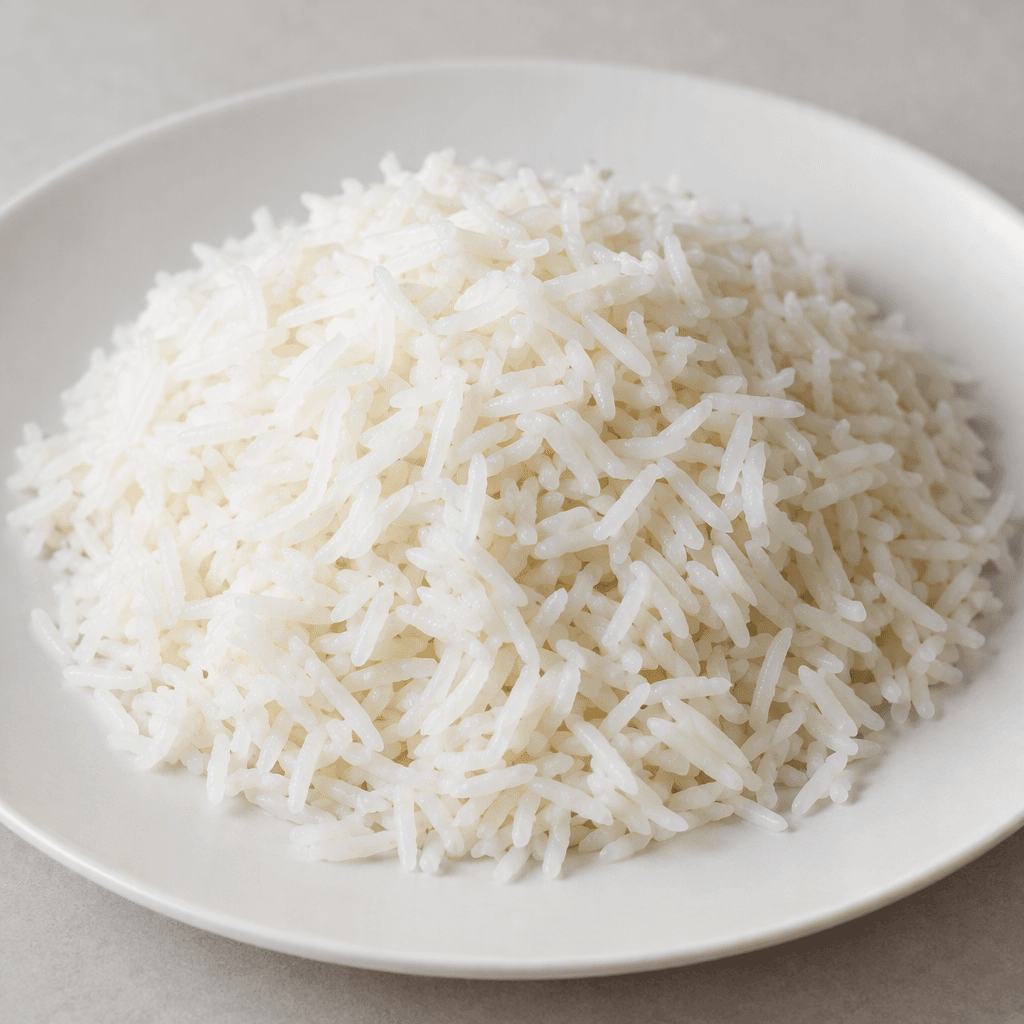
Basmati Rice (Cooked) Calories
Long-grain aromatic rice. Low fat, moderate carbs.
In season: Spring · Summer · Autumn · Winter
CALORIES
GI
POTASSIUM
FIBER
Quick answer
1 cup (medium) of Basmati Rice (Cooked) (200 g) has 242 calories. That works out to 121 calories per 100 g. It contains 51.2 g of carbs, 5.4 g of protein, 0.6 g of fat and 0.8 g of fiber. Its 0.7 mg of Manganese covers 31% of the Daily Value. Its glycemic index is 58 (medium), so it raises blood sugar at a moderate pace.
What is Basmati Rice (Cooked)?
Cooked basmati rice is made from the long, slender, aromatic rice traditionally grown in the Indian subcontinent. When cooked, the grains lengthen and tend to stay separate and fluffy, with a subtle fragrance and a light, mildly nutty flavour.
Across South Asia it is served with curries, dals, grilled meats and vegetables; elsewhere, it works just as well alongside stews, roasted dishes or a simple bowl of beans. Plain cooked basmati rice is low in fat and provides mostly carbohydrates, with little fibre. Pair it with vegetables and a protein-rich dish for a more rounded meal, or season it with herbs and spices rather than adding much oil.
Basmati Rice (Cooked) Nutrition Facts
Selected: 100 g
121
KCAL / 100G
Carbs
25.6g
· 9% DV
Protein
2.7g
· 5% DV
Fat
0.3g
· 0% DV
Fiber
0.4g
· 1% DV
DV is the share of the daily value covered, on a 2,000 kcal reference diet.
Calories come from: Carbs 88% · Protein 9% · Fat 3%
Basmati Rice (Cooked) Vitamins & Minerals
Vitamins
B3
1.5mg · 9% DV
B6
0.09mg · 5% DV
B5
0.13mg · 3% DV
B1
0.02mg · 2% DV
Minerals
Selenium
3µg · 5% DV
Phosphorus
32mg · 5% DV
Magnesium
8mg · 2% DV
Calcium
5mg · 1% DV
How Nutritious Is Basmati Rice (Cooked)?
Nutrient density
Medium
How many vitamins, minerals and how much fiber this food carries per calorie. A high score means a lot of nutrition for few calories.
Satiety score
Low
An EatBetter score computed from fiber, protein and calorie density. A high score means staying full longer on the same calories.
Both scores are calculated per 100 g and do not change with the selected portion. The satiety score is EatBetter's own calculation, not a clinical measure.
Basmati Rice (Cooked) Glycemic Index
GLYCEMIC INDEX
GLYCEMIC LOAD
Accounts for portion size — a more realistic measure than GI alone.
How to Burn Off Basmati Rice (Cooked)
To burn the 121 calories in 100 g:
🚶
Walking (5 km/h)
🏃
Running (8 km/h)
🚴
Cycling
🏊
Swimming
Times are calculated with the MET equation for a 70 kg adult. Actual burn varies with your weight, age and pace.
Is Basmati Rice (Cooked) Processed?
NOVA 2
Minimally Processed
1. Unprocessed
2. Minimally Processed
3. Processed
4. Ultra-Processed
NOVA classifies foods into 4 groups by industrial processing. NOVA 1 (unprocessed) is the healthiest.
Does Basmati Rice (Cooked) Contain Allergens?
No known major allergens
Which Diets Is Basmati Rice (Cooked) Good For?
Vegan
✓ Suitable
Vegetarian
✓ Suitable
Gluten-Free
✓ Suitable
Dairy-Free
— Not suitable
Mediterranean
✓ Suitable
Paleo
✓ Suitable
Whole30
— Not suitable
DASH
— Not suitable
Keto
— Not suitable
Low FODMAP
— Not suitable
Basmati Rice (Cooked) Fat Profile
SATURATED
0.08g
MONOUNSATURATED
0.09g
POLYUNSATURATED
0.09g
Omega 6:3 ratio 9:1
Above the ideal 4:1 (9:1).
Compare Basmati Rice (Cooked)
Foods Similar to Basmati Rice (Cooked)
Frequently Asked Questions About Basmati Rice (Cooked)
How long does cooked basmati rice last in the fridge?
Cooked basmati rice keeps for 3–4 days in the refrigerator when stored in a sealed container. Cool it promptly after cooking rather than leaving it at room temperature for an extended period.
Can you reheat cooked basmati rice?
Yes, you can reheat cooked basmati rice. Reheat only the portion you plan to eat, stirring until it is steaming hot throughout, and avoid repeatedly cooling and reheating the same batch.
Can you freeze cooked basmati rice?
Yes, cooked basmati rice freezes well. Cool it promptly, divide it into meal-size portions, and store them in airtight freezer-safe containers; reheat the rice thoroughly before serving.
How do you keep cooked basmati rice fluffy instead of clumpy?
To keep cooked basmati rice fluffy, rinse the uncooked grains to remove excess surface starch, use the cooking liquid sparingly, and avoid stirring while it cooks. Let it rest covered, then gently loosen the grains with a fork.
What is the difference between basmati rice and jasmine rice?
Basmati rice has long, slender grains and a distinct aroma, while jasmine rice is typically softer and more clingy when cooked, with a floral scent. Their textures differ, so they are not always interchangeable in a dish.
Can you make fried rice with cooked basmati rice?
Yes, cooked basmati rice works in fried rice, especially when chilled so the grains are firmer and less likely to clump in the pan. Break up any compacted grains before stir-frying them with vegetables, egg, or other ingredients.
Can cooked basmati rice be eaten cold?
Yes, cooked basmati rice can be eaten cold in salads or grain bowls. Refrigerate it promptly after cooking and keep it chilled until serving; rice left out at room temperature for too long should be discarded.
Is basmati rice good for weight loss?
Basmati rice can fit into a weight-loss meal, but it does not cause weight loss on its own. Pair a moderate serving with vegetables and a protein source to make the meal more filling.
Can people with diabetes eat basmati rice?
Yes, people with diabetes can include basmati rice, but its carbohydrates can raise blood glucose. Keeping the portion moderate and eating it with vegetables and protein may help; follow your own glucose response and care plan.
What goes well with cooked basmati rice?
Cooked basmati rice pairs especially well with richly seasoned curries, lentil dishes, grilled chicken, and saucy vegetables. Its fragrant, separate grains soak up sauces without becoming as sticky as some shorter-grain rice.
Have another question about Basmati Rice (Cooked)?
Ask the AI nutrition coach — calories, portions, alternatives and more, answered in seconds in the app.

Scan calories with your camera
Instant AI nutrition analysis

Nutrition data compiled from USDA FoodData Central and scientific sources.