

Ready & Packaged Foods
All →Vegetables & Legumes
All →Desserts & Confectionery
All →Meat & Protein
All →Grains & Bakery
All →Beverages
All →Milk & Dairy
All →

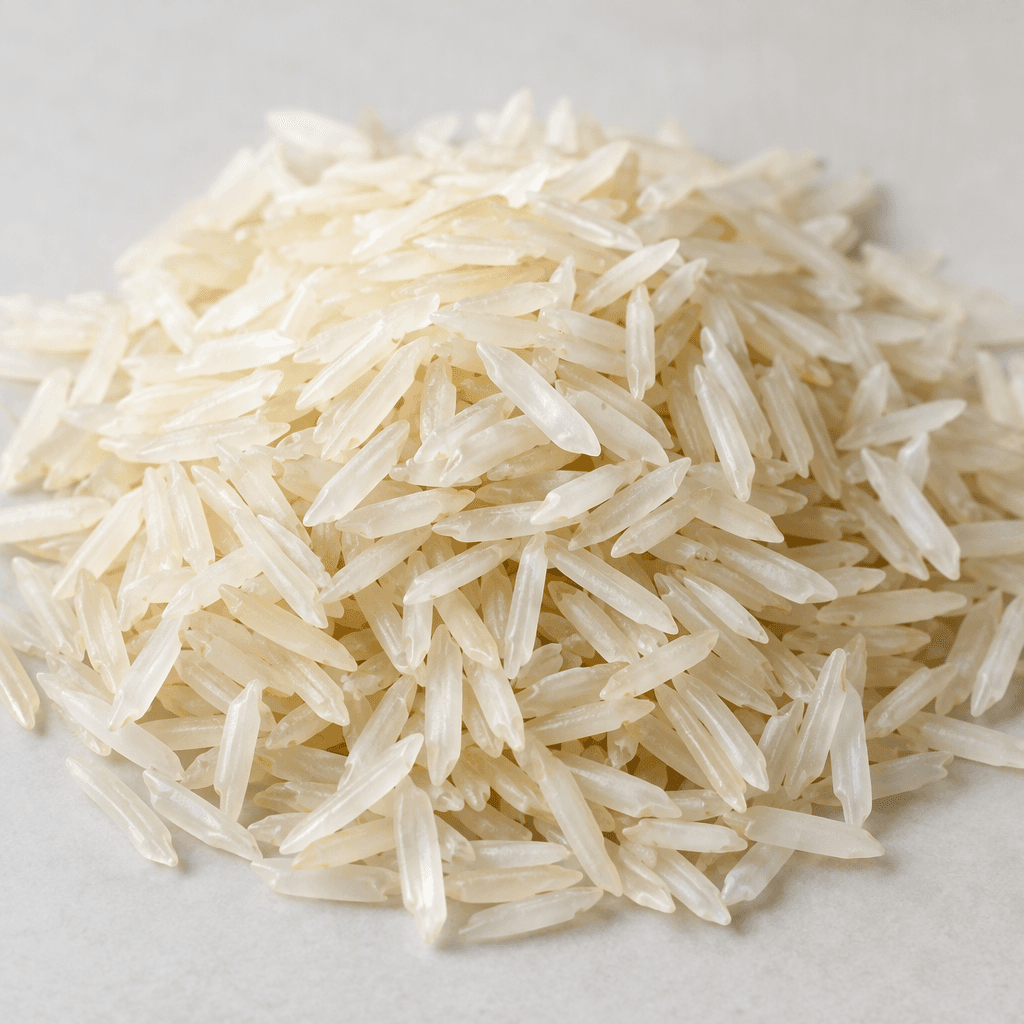
Basmati Rice Calories
Long-grain, aromatic rice. Low fat, moderate carbs.
In season: Spring · Summer · Autumn · Winter
CALORIES
GI
POTASSIUM
FIBER
Quick answer
1 cup (medium) of Basmati Rice (185 g) has 648 calories. That works out to 350 calories per 100 g. It contains 142.6 g of carbs, 15.2 g of protein, 1.1 g of fat and 1.9 g of fiber. Its 2 mg of Manganese covers 88% of the Daily Value. Its glycemic index is 58 (medium), so it raises blood sugar at a moderate pace.
What is Basmati Rice?
Basmati Rice is a fragrant, slender long-grain rice traditionally grown in the Indian subcontinent, particularly India and Pakistan. Its grains lengthen as they cook and tend to stay separate, with a delicate, nutty aroma that is noticeable even in a simple bowl of rice.
Across South Asia it is served with curries, dals and spiced meats; elsewhere, it also works well as a side for roasted vegetables, fish or stews. Rinsing the grains before cooking helps produce a lighter, more distinct texture. Basmati Rice is mostly a source of carbohydrate and is naturally low in fat, so the amount of oil or butter added makes a practical difference to the finished dish. Its aroma means it needs little embellishment.
Basmati Rice Nutrition Facts
Selected: 100 g
350
KCAL / 100G
Carbs
77.1g
· 28% DV
Protein
8.2g
· 16% DV
Fat
0.6g
· 1% DV
Fiber
1g
· 4% DV
DV is the share of the daily value covered, on a 2,000 kcal reference diet.
Calories come from: Carbs 89% · Protein 9% · Fat 2%

Log this food in EatBetter
100,000+ people use it
- Get your daily calorie target
- Snap your meal, log it in seconds
- See every vitamin and mineral

📸 Scan the code to get the app free.

Basmati Rice Vitamins & Minerals
Vitamins
B3
1.6mg · 10% DV
B5
0.5mg · 10% DV
B6
0.16mg · 9% DV
B1
0.07mg · 6% DV
Minerals
Manganese
1mg · 43% DV
Selenium
15µg · 27% DV
Phosphorus
115mg · 16% DV
Potassium ⭐
115mg · 3% DV
Copper
0mg · 0% DV
How Nutritious Is Basmati Rice?
Nutrient density
Medium
How many vitamins, minerals and how much fiber this food carries per calorie. A high score means a lot of nutrition for few calories.
Satiety score
Low
An EatBetter score computed from fiber, protein and calorie density. A high score means staying full longer on the same calories.
Both scores are calculated per 100 g and do not change with the selected portion. The satiety score is EatBetter's own calculation, not a clinical measure.
Basmati Rice Glycemic Index
GLYCEMIC INDEX
GLYCEMIC LOAD
Accounts for portion size — a more realistic measure than GI alone.
How to Burn Off Basmati Rice
To burn the 350 calories in 100 g:
🚶
Walking (5 km/h)
🏃
Running (8 km/h)
🚴
Cycling
🏊
Swimming
Times are calculated with the MET equation for a 70 kg adult. Actual burn varies with your weight, age and pace.
Is Basmati Rice Processed?
NOVA 2
Minimally Processed
1. Unprocessed
2. Minimally Processed
3. Processed
4. Ultra-Processed
NOVA classifies foods into 4 groups by industrial processing. NOVA 1 (unprocessed) is the healthiest.
Does Basmati Rice Contain Allergens?
No known major allergens
Which Diets Is Basmati Rice Good For?
Vegan
✓ Suitable
Vegetarian
✓ Suitable
Gluten-Free
✓ Suitable
Dairy-Free
— Not suitable
Mediterranean
✓ Suitable
Paleo
— Not suitable
Whole30
— Not suitable
DASH
— Not suitable
Keto
— Not suitable
Low FODMAP
— Not suitable
Basmati Rice Fat Profile
SATURATED
0.2g
MONOUNSATURATED
0.16g
POLYUNSATURATED
0.18g
Omega 6:3 ratio 18:1
Above the ideal 4:1 (18:1).
Compare Basmati Rice
Foods Similar to Basmati Rice
Frequently Asked Questions About Basmati Rice
How do you cook Basmati Rice so the grains stay separate?
Rinse Basmati Rice, drain it well, and cook it covered without stirring. Once the water is absorbed, let the rice rest off the heat, then gently fluff it with a fork to separate the long grains.
Should you rinse Basmati Rice before cooking?
Yes, rinse Basmati Rice before cooking. A few changes of water remove some surface starch, helping the cooked grains stay more distinct rather than clumping together.
Do you need to soak Basmati Rice before cooking?
Soaking Basmati Rice is helpful but not essential. It lets the long grains absorb water before cooking, which can help them cook evenly and remain intact; drain the soaking water before adding fresh water to cook.
What is the water-to-rice ratio for Basmati Rice?
The right water-to-rice ratio for Basmati Rice varies with the cooking method, the rice itself, and whether it has been soaked. Use the package directions as your starting point, since too much water can make the grains soft and clumped.
Why does Basmati Rice sometimes turn mushy?
Basmati Rice usually turns mushy from excess water, overcooking, or stirring while it cooks. Measure the cooking liquid carefully, keep the lid on, and let the rice rest before fluffing it.
What is the difference between Basmati Rice and jasmine rice?
Basmati Rice has long, aromatic grains that tend to remain separate when cooked, while jasmine rice is softer and slightly sticky. Basmati is commonly used in South Asian dishes; jasmine rice is associated with Southeast Asian cooking.
Why does Basmati Rice smell so fragrant?
Basmati Rice has a distinctive natural aroma that becomes more noticeable during cooking. Its fragrance is one of the variety’s defining qualities, so strong added seasoning is not needed to make it aromatic.
Can you use Basmati Rice for biryani?
Yes, Basmati Rice is a classic choice for biryani because its long grains hold their shape and its aroma complements the spices. Partially cook the rice before layering it with the other ingredients so it can finish cooking without becoming mushy.
How should you store uncooked Basmati Rice?
Store uncooked Basmati Rice in an airtight container in a cool, dry place away from sunlight and strong-smelling foods. Keeping moisture out helps protect its texture and aroma.
Can you freeze cooked Basmati Rice?
Yes, cooked Basmati Rice can be frozen. Cool it promptly, divide it into airtight portions, and reheat it until steaming hot throughout; avoid leaving cooked rice at room temperature for an extended period.
Have another question about Basmati Rice?
Ask the AI nutrition coach — calories, portions, alternatives and more, answered in seconds in the app.

Scan calories with your camera
Instant AI nutrition analysis

Nutrition data compiled from USDA FoodData Central and scientific sources.