

Ready & Packaged Foods
All →Vegetables & Legumes
All →Desserts & Confectionery
All →Meat & Protein
All →Grains & Bakery
All →Beverages
All →Milk & Dairy
All →

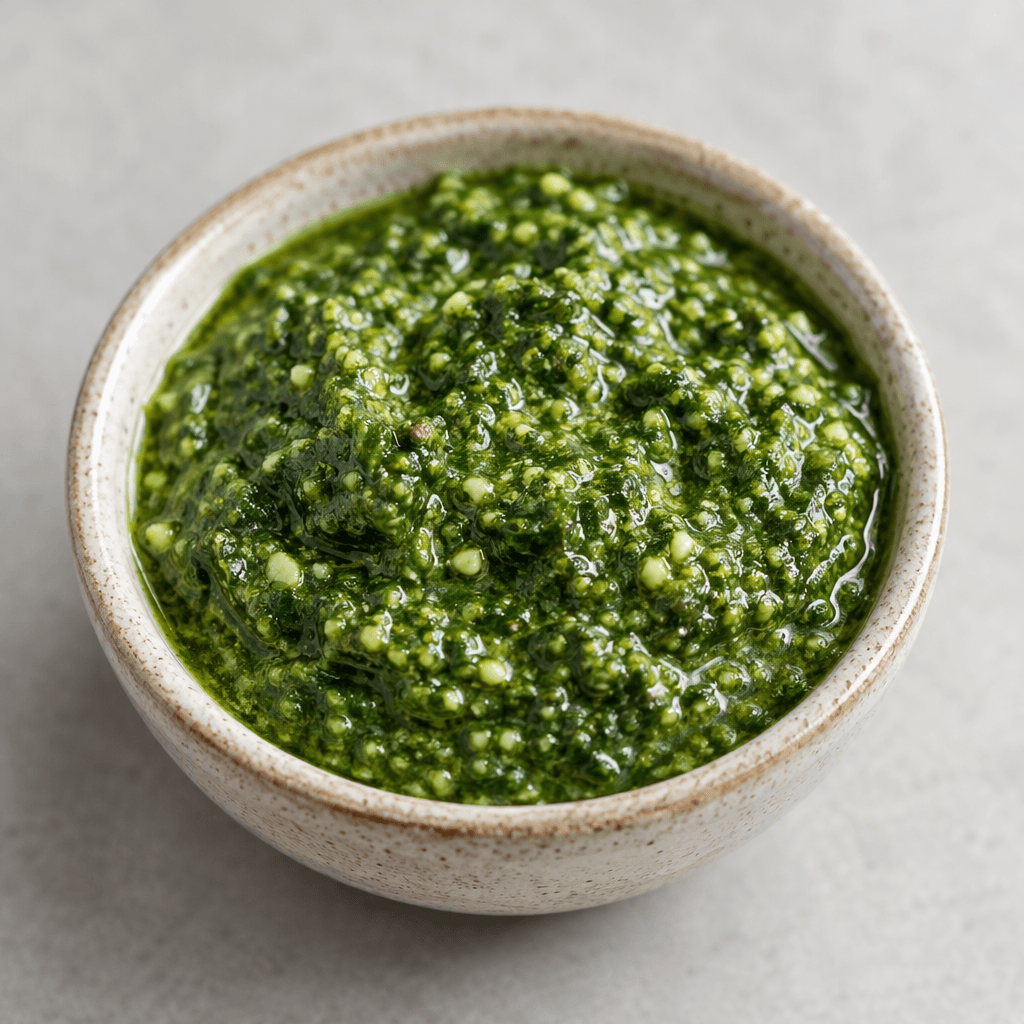
Basil Pesto Calories
Classic Italian sauce made with fresh basil, olive oil, pine nuts, and parmesan.
In season: Summer
CALORIES
GI
POTASSIUM
FIBER
Quick answer
1 tablespoon (medium) of Basil Pesto (16 g) has 69 calories. That works out to 430 calories per 100 g. It contains 1 g of carbs, 0.8 g of protein, 6.9 g of fat and 0.3 g of fiber. Its 19.2 µg of Vitamin K covers 16% of the Daily Value. Its glycemic index is 15 (low), so it raises blood sugar slowly.
What is Basil Pesto?
Basil pesto is a thick Italian sauce traditionally made with fresh basil, olive oil, pine nuts and Parmesan. Its vivid green colour and flecks of leaves and nuts give it a rich, slightly textured consistency.
In Italy, it is famously tossed with pasta, often with potatoes and green beans; it also works well spread on bread or stirred into soups. Elsewhere, try a little in a sandwich, over roasted vegetables or with pasta for a quick boost of flavour. It is concentrated and energy-dense, with 43 g of fat per 100 g. Use a modest spoonful and loosen it with a splash of pasta water to coat a dish without adding too much.
Basil Pesto Nutrition Facts
Selected: 100 g
430
KCAL / 100G
Carbs
6g
· 2% DV
Protein
5g
· 10% DV
Fat
43g
· 55% DV
Fiber
2g
· 7% DV
DV is the share of the daily value covered, on a 2,000 kcal reference diet.
Calories come from: Carbs 6% · Protein 5% · Fat 89%
Basil Pesto Vitamins & Minerals
Vitamins
Vitamin K
120µg · 100% DV
Vitamin A
350µg · 39% DV
B12
0.5µg · 21% DV
Vitamin E
2.5mg · 17% DV
Minerals
Sodium
1100mg · 48% DV
Manganese
1mg · 43% DV
Calcium
180mg · 18% DV
Phosphorus
90mg · 13% DV
How Nutritious Is Basil Pesto?
Nutrient density
Medium
How many vitamins, minerals and how much fiber this food carries per calorie. A high score means a lot of nutrition for few calories.
Satiety score
Low
An EatBetter score computed from fiber, protein and calorie density. A high score means staying full longer on the same calories.
Both scores are calculated per 100 g and do not change with the selected portion. The satiety score is EatBetter's own calculation, not a clinical measure.
Basil Pesto Glycemic Index
GLYCEMIC INDEX
GLYCEMIC LOAD
Accounts for portion size — a more realistic measure than GI alone.
How to Burn Off Basil Pesto
To burn the 430 calories in 100 g:
🚶
Walking (5 km/h)
🏃
Running (8 km/h)
🚴
Cycling
🏊
Swimming
Times are calculated with the MET equation for a 70 kg adult. Actual burn varies with your weight, age and pace.
Is Basil Pesto Processed?
NOVA 3
Processed
1. Unprocessed
2. Minimally Processed
3. Processed
4. Ultra-Processed
NOVA classifies foods into 4 groups by industrial processing. NOVA 1 (unprocessed) is the healthiest.
Does Basil Pesto Contain Allergens?
Contains these allergens:
Which Diets Is Basil Pesto Good For?
Vegan
— Not suitable
Vegetarian
✓ Suitable
Gluten-Free
— Not suitable
Dairy-Free
— Not suitable
Mediterranean
✓ Suitable
Paleo
— Not suitable
Whole30
— Not suitable
DASH
— Not suitable
Keto
— Not suitable
Low FODMAP
— Not suitable
Basil Pesto Fat Profile
SATURATED
7.5g
MONOUNSATURATED
28g
POLYUNSATURATED
4g
Omega 6:3 ratio 8.3:1
Above the ideal 4:1 (8.3:1).
Compare Basil Pesto
Foods Similar to Basil Pesto
Frequently Asked Questions About Basil Pesto
What is basil pesto made of?
Classic basil pesto is made with fresh basil, olive oil, pine nuts, garlic, and hard Italian cheese such as Parmesan. Some recipes also include pecorino, while packaged versions may use different ingredients.
How do you use basil pesto?
Basil pesto works as a pasta sauce, sandwich spread, pizza topping, or dressing mixed into vegetables. For pasta, stir it in after draining rather than simmering it for a long time, which can dull the basil’s fresh flavor.
How long does basil pesto last after opening?
Opened basil pesto should be kept covered in the refrigerator and used according to the package directions. Use a clean spoon each time, and discard it if you notice mold, an unusual smell, or other signs of spoilage.
Can you freeze basil pesto?
Yes, basil pesto freezes well. Freeze it in small airtight portions so you can thaw only what you need; an ice-cube tray is handy for this. Thaw a portion in the refrigerator and avoid repeatedly thawing and refreezing it.
Why does basil pesto turn brown?
Basil pesto turns brown when cut basil reacts with oxygen. To slow the change, refrigerate it in a sealed container soon after opening and cover the surface with a thin layer of olive oil.
Can you heat basil pesto?
Yes, but prolonged heating can mute basil pesto’s fresh herbal flavor. Stir it into hot pasta off the heat, or add it near the end of cooking rather than boiling it in a pan.
What can I use instead of pine nuts in basil pesto?
Walnuts or sunflower seeds can replace pine nuts in basil pesto. They change the flavor and texture, and walnuts are still tree nuts, so choose a seed-based alternative if avoiding tree nuts.
Can basil pesto be used as pizza sauce?
Yes, basil pesto can be used as pizza sauce. Spread a thin layer over the dough because its concentrated flavor and oil can overwhelm the other toppings if you use too much.
Does basil pesto need to be cooked?
No, basil pesto does not need to be cooked; it is ready to eat as a sauce or spread. Adding it after cooking helps preserve its aromatic basil flavor, especially in pasta dishes.
What does basil pesto taste like?
Basil pesto tastes fresh and herbal, with savory notes from the cheese and garlic and a rich, nutty flavor from the oil and pine nuts. The balance varies with the recipe and the amount used.
Have another question about Basil Pesto?
Ask the AI nutrition coach — calories, portions, alternatives and more, answered in seconds in the app.

Scan calories with your camera
Instant AI nutrition analysis

Nutrition data compiled from USDA FoodData Central and scientific sources.