

Ready & Packaged Foods
All →Vegetables & Legumes
All →Desserts & Confectionery
All →Meat & Protein
All →Grains & Bakery
All →Beverages
All →Milk & Dairy
All →

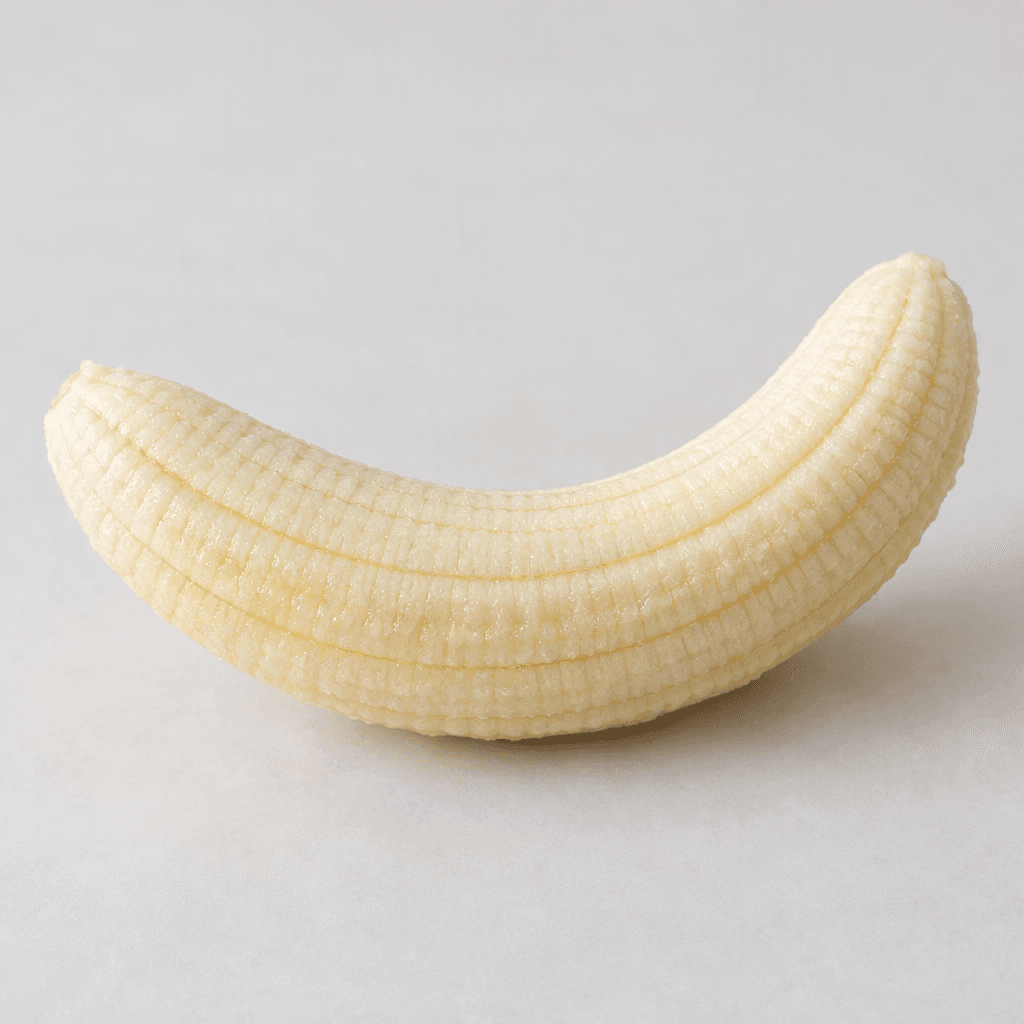
Banana (peeled) Calories
Rich in potassium and fiber, natural energy source
In season: Spring · Summer · Autumn · Winter
CALORIES
GI
POTASSIUM
FIBER
Quick answer
1 piece (medium) of Banana (peeled) (120 g) has 107 calories. That works out to 89 calories per 100 g. It contains 27.4 g of carbs, 1.3 g of protein, 0.4 g of fat and 3.1 g of fiber. Its 0.4 mg of B6 covers 26% of the Daily Value. Its glycemic index is 51 (medium), so it raises blood sugar at a moderate pace.
What is Banana (peeled)?
A peeled banana is the soft, sweet fruit of a tropical plant grown widely in warm regions. Its pale flesh is creamy and easy to mash, becoming sweeter as it ripens. It is commonly eaten fresh as a portable snack, sliced over cereal or porridge, blended into smoothies, or used in baking. In many places, it is also served with yogurt or nut butter for a more filling bite.
Bananas provide carbohydrate for readily available energy, along with fiber and potassium; a medium one weighs about 120 g. Their natural sweetness can help flavor breakfast bowls and desserts, so you can often use less added sugar in recipes.
Banana (peeled) Nutrition Facts
Selected: 100 g
89
KCAL / 100G
Carbs
22.8g
· 8% DV
Protein
1.1g
· 2% DV
Fat
0.3g
· 0% DV
Fiber
2.6g
· 9% DV
DV is the share of the daily value covered, on a 2,000 kcal reference diet.
Calories come from: Carbs 93% · Protein 4% · Fat 3%
Banana (peeled) Vitamins & Minerals
Vitamins
B6
0.37mg · 22% DV
Vitamin C
8.7mg · 10% DV
B5
0.33mg · 7% DV
B2
0.07mg · 5% DV
Minerals
Potassium ⭐
358mg · 11% DV
Magnesium
27mg · 6% DV
Phosphorus
22mg · 3% DV
Selenium
1µg · 2% DV
How Nutritious Is Banana (peeled)?
Nutrient density
High
How many vitamins, minerals and how much fiber this food carries per calorie. A high score means a lot of nutrition for few calories.
Satiety score
Medium
An EatBetter score computed from fiber, protein and calorie density. A high score means staying full longer on the same calories.
Both scores are calculated per 100 g and do not change with the selected portion. The satiety score is EatBetter's own calculation, not a clinical measure.
Banana (peeled) Glycemic Index
GLYCEMIC INDEX
GLYCEMIC LOAD
Accounts for portion size — a more realistic measure than GI alone.
How to Burn Off Banana (peeled)
To burn the 89 calories in 100 g:
🚶
Walking (5 km/h)
🏃
Running (8 km/h)
🚴
Cycling
🏊
Swimming
Times are calculated with the MET equation for a 70 kg adult. Actual burn varies with your weight, age and pace.
Is Banana (peeled) Processed?
NOVA 1
Unprocessed
1. Unprocessed
2. Minimally Processed
3. Processed
4. Ultra-Processed
NOVA classifies foods into 4 groups by industrial processing. NOVA 1 (unprocessed) is the healthiest.
Does Banana (peeled) Contain Allergens?
No known major allergens
Which Diets Is Banana (peeled) Good For?
Vegan
✓ Suitable
Vegetarian
✓ Suitable
Gluten-Free
✓ Suitable
Dairy-Free
— Not suitable
Mediterranean
✓ Suitable
Paleo
✓ Suitable
Whole30
— Not suitable
DASH
— Not suitable
Keto
— Not suitable
Low FODMAP
— Not suitable
Banana (peeled) Fat Profile
SATURATED
0.11g
MONOUNSATURATED
0.03g
POLYUNSATURATED
0.07g
Omega 6:3 ratio 2.3:1
Below the ideal 4:1 — a good omega balance.
Compare Banana (peeled)
Foods Similar to Banana (peeled)
Frequently Asked Questions About Banana (peeled)
Does a peeled banana help with constipation?
A ripe peeled banana can contribute fiber, but it is not a reliable constipation remedy. Less-ripe bananas contain more resistant starch, which may worsen constipation for some people. Drink fluids and include other fiber-rich foods too.
How do you keep a peeled banana from turning brown?
Coat the exposed surface of a peeled banana with a little lemon juice and store it in an airtight container in the refrigerator. Browning is caused by contact with air; it changes appearance more than safety.
Can you freeze a peeled banana?
Yes. Slice a peeled banana, freeze the pieces in a single layer, then transfer them to a sealed freezer container. The thawed fruit will be soft, so it works especially well in smoothies, baking, and porridge.
Do peeled bananas need to be refrigerated?
Yes, refrigerate a peeled banana if you are not eating it right away. Keep it covered in an airtight container to slow browning and limit exposure to other foods. Use it promptly for the best texture.
Can people with diabetes eat peeled bananas?
Yes, people with diabetes can eat peeled bananas, but the carbohydrates can raise blood glucose. Pairing one with a source of protein or fat may help make a snack more filling. For an individual meal plan, ask your diabetes care team.
Does a peeled banana make you gain weight?
No single peeled banana causes weight gain. It can be a filling snack, but regularly eating more energy than your body uses can lead to weight gain. Choose it instead of, rather than in addition to, a less filling snack.
Can you eat a peeled banana at night?
Yes, eating a peeled banana at night is generally fine. It does not have a special effect that causes weight gain or disrupts sleep for everyone. If eating close to bedtime makes you uncomfortable, have it earlier.
Why does a peeled banana taste bitter?
A peeled banana may taste bitter if it is underripe, bruised, or beginning to spoil. Choose fruit with a sweet smell and creamy flesh; discard it if it has an off odor, mold, or an unusually slimy texture.
Are brown spots on a peeled banana safe to eat?
Yes, small brown spots on a peeled banana are usually harmless and often reflect oxidation or bruising. Do not eat it if the spots come with mold, a sour or fermented smell, or a distinctly slimy texture.
Is a peeled banana good before a workout?
Yes, a peeled banana is a convenient pre-workout snack because its carbohydrates provide readily available energy. Eat it early enough to feel comfortable during exercise, especially if food close to a workout upsets your stomach.
Have another question about Banana (peeled)?
Ask the AI nutrition coach — calories, portions, alternatives and more, answered in seconds in the app.

Scan calories with your camera
Instant AI nutrition analysis

Nutrition data compiled from USDA FoodData Central and scientific sources.