

Ready & Packaged Foods
All →Vegetables & Legumes
All →Desserts & Confectionery
All →Meat & Protein
All →Grains & Bakery
All →Beverages
All →Milk & Dairy
All →

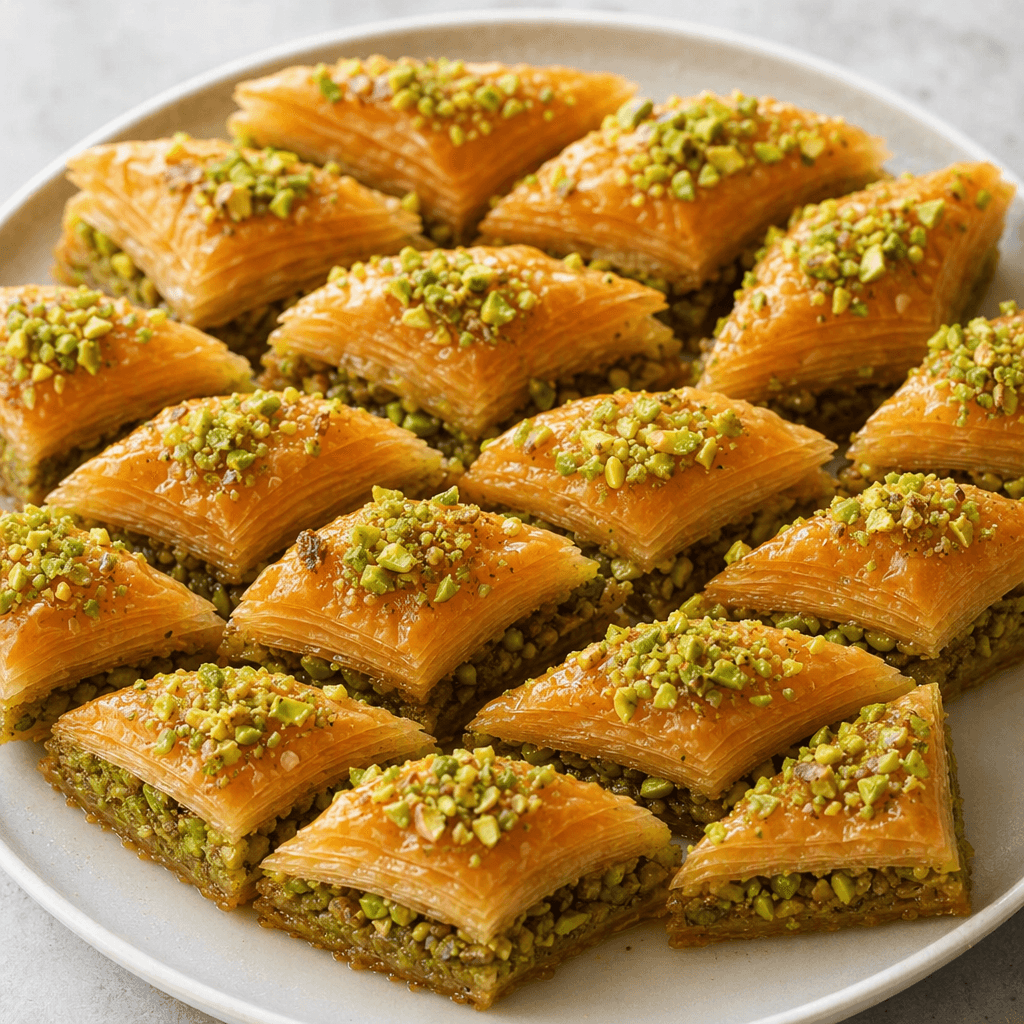
Pistachio Baklava Calories
Traditional Turkish dessert, thin pastry, pistachios, syrup
In season: Spring · Summer · Autumn · Winter
CALORIES
GI
POTASSIUM
FIBER
Quick answer
1 piece (medium) of Pistachio Baklava (40 g) has 164 calories. That works out to 410 calories per 100 g. It contains 22 g of carbs, 2.6 g of protein, 7.2 g of fat and 1 g of fiber. Its 0.1 mg of Copper covers 13% of the Daily Value. Its glycemic index is 65 (high), so it raises blood sugar quickly.
What is Pistachio Baklava?
Pistachio baklava is a traditional sweet made with thin layers of pastry, pistachios, and syrup. Per 100 g, it provides 410 calories, 55 g of carbohydrates, 18 g of fat, and 6.5 g of protein, along with 2.5 g of fiber.
With a glycemic index of 65, this processed dessert is best enjoyed with attention to portion size because of its carbohydrate and energy content. It contains gluten, tree nuts, and dairy. Pistachio baklava fits omnivore, Mediterranean, and flexitarian eating patterns.
Pistachio Baklava Nutrition Facts
Selected: 100 g
410
KCAL / 100G
Carbs
55g
· 20% DV
Protein
6.5g
· 13% DV
Fat
18g
· 23% DV
Fiber
2.5g
· 9% DV
DV is the share of the daily value covered, on a 2,000 kcal reference diet.
Calories come from: Carbs 54% · Protein 6% · Fat 40%
Pistachio Baklava Vitamins & Minerals
Vitamins
Vitamin E
1.6mg · 11% DV
B1
0.09mg · 8% DV
B2
0.11mg · 8% DV
Biotin
2.5µg · 8% DV
Minerals
Phosphorus
70mg · 10% DV
Zinc
1mg · 9% DV
Magnesium
32mg · 8% DV
Selenium
4µg · 7% DV
How Nutritious Is Pistachio Baklava?
Nutrient density
Medium
How many vitamins, minerals and how much fiber this food carries per calorie. A high score means a lot of nutrition for few calories.
Satiety score
Low
An EatBetter score computed from fiber, protein and calorie density. A high score means staying full longer on the same calories.
Both scores are calculated per 100 g and do not change with the selected portion. The satiety score is EatBetter's own calculation, not a clinical measure.
Pistachio Baklava Glycemic Index
GLYCEMIC INDEX
GLYCEMIC LOAD
Accounts for portion size — a more realistic measure than GI alone.
How to Burn Off Pistachio Baklava
To burn the 410 calories in 100 g:
🚶
Walking (5 km/h)
🏃
Running (8 km/h)
🚴
Cycling
🏊
Swimming
Times are calculated with the MET equation for a 70 kg adult. Actual burn varies with your weight, age and pace.
Is Pistachio Baklava Processed?
NOVA 3
Processed
1. Unprocessed
2. Minimally Processed
3. Processed
4. Ultra-Processed
NOVA classifies foods into 4 groups by industrial processing. NOVA 1 (unprocessed) is the healthiest.
Does Pistachio Baklava Contain Allergens?
Contains these allergens:
Which Diets Is Pistachio Baklava Good For?
Vegan
— Not suitable
Vegetarian
— Not suitable
Gluten-Free
— Not suitable
Dairy-Free
— Not suitable
Mediterranean
✓ Suitable
Paleo
— Not suitable
Whole30
— Not suitable
DASH
— Not suitable
Keto
— Not suitable
Low FODMAP
— Not suitable
Pistachio Baklava Fat Profile
SATURATED
5.2g
MONOUNSATURATED
8.1g
POLYUNSATURATED
3.6g
Omega 6:3 ratio 23.3:1
Above the ideal 4:1 (23.3:1).
Compare Pistachio Baklava
Foods Similar to Pistachio Baklava
Frequently Asked Questions About Pistachio Baklava
What is pistachio baklava made of?
Pistachio baklava is made with thin layers of pastry, chopped pistachios, fat, and sweet syrup. Recipes vary: some use clarified butter, and the syrup is commonly made with sugar, water, and lemon.
Where did pistachio baklava originate?
Pistachio baklava is strongly associated with Türkiye, particularly Gaziantep, where pistachios are central to the local style. Its broader history is shared across several regions, so claims that one modern country alone invented it are disputed.
What is the difference between pistachio baklava and Greek baklava?
Pistachio baklava is a specific nut-based version of baklava, while Greek baklava often uses walnuts or a mixture of nuts and may include spices such as cinnamon. Recipes vary in both places, so the names do not guarantee one fixed style.
Why is my pistachio baklava soggy?
Pistachio baklava can turn soggy if it absorbs too much syrup or moisture during storage. Keep it in a dry, airtight container away from steam; refrigeration can also soften its crisp pastry.
How long does pistachio baklava last?
Pistachio baklava keeps best in a cool, dry place in an airtight container. It may lose its crisp texture in a humid kitchen, so refrigerating it is usually not ideal; freeze it if you need to keep it longer.
Can you freeze pistachio baklava?
Yes, pistachio baklava can be frozen. Arrange the pieces in a sealed container with parchment between layers, then thaw them at room temperature. The pastry may be less crisp after thawing than when freshly made.
How do you reheat pistachio baklava without making it soggy?
Warm pistachio baklava briefly in a low oven to help restore some crispness. Avoid the microwave, which can make the pastry soft and chewy, and do not add extra syrup unless the recipe specifically calls for it.
Should pistachio baklava be served warm or cold?
Pistachio baklava is usually served at room temperature. Chilling it can firm up the syrup and mute its aroma, while warming it too much may soften the pastry.
What do you serve with pistachio baklava?
Pistachio baklava is commonly served with unsweetened tea or black coffee, which balance its syrupy sweetness. In Türkiye, small portions are often offered after a meal or alongside tea when guests visit.
Why is pistachio baklava cut before it is baked?
Pistachio baklava is usually scored into portions before baking because its crisp, layered pastry is difficult to cut neatly once cooked. Use a sharp knife and cut through the layers without pressing down hard.
Have another question about Pistachio Baklava?
Ask the AI nutrition coach — calories, portions, alternatives and more, answered in seconds in the app.

Scan calories with your camera
Instant AI nutrition analysis

Nutrition data compiled from USDA FoodData Central and scientific sources.