

Ready & Packaged Foods
All →Vegetables & Legumes
All →Desserts & Confectionery
All →Meat & Protein
All →Grains & Bakery
All →Beverages
All →Milk & Dairy
All →

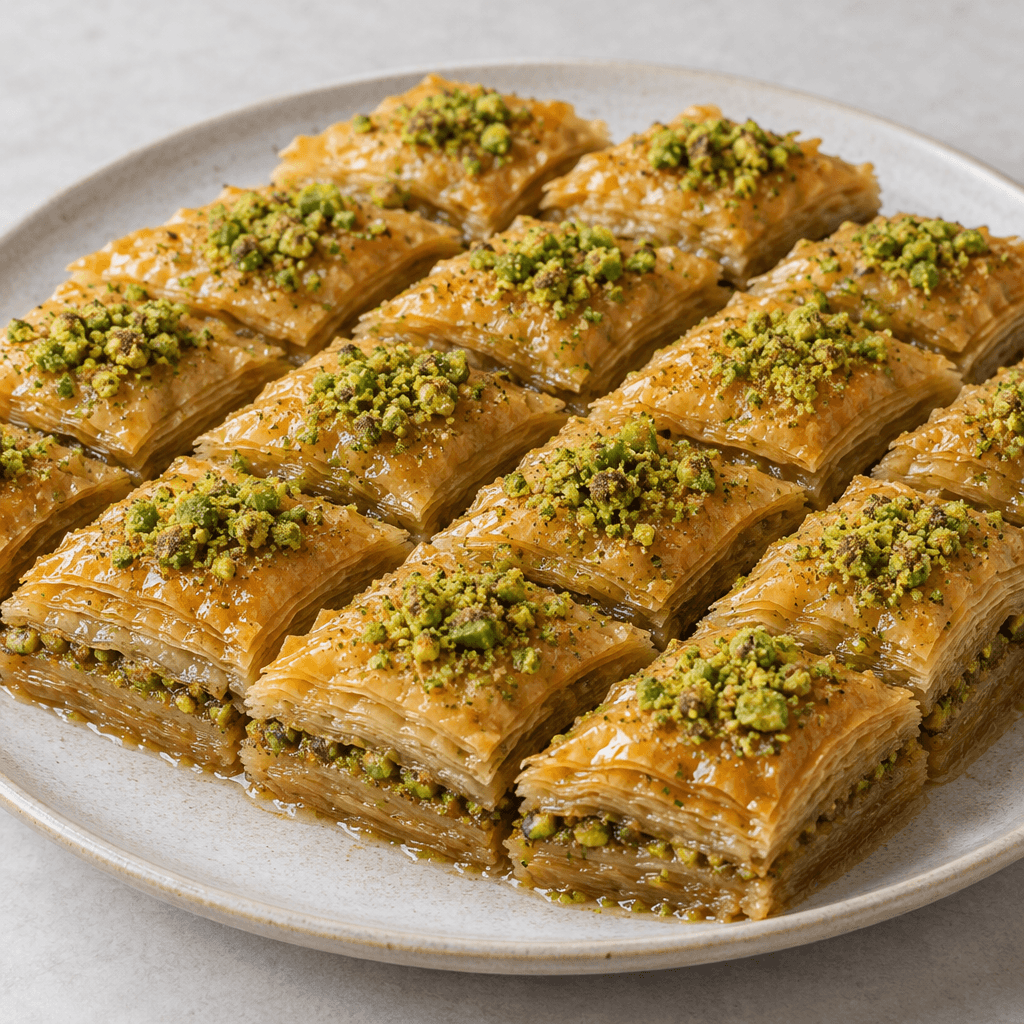
Baklava Calories
Rich pastry, syrup-soaked, nut-filled, high calorie
In season: Spring · Summer · Autumn · Winter
CALORIES
GI
POTASSIUM
FIBER
Quick answer
1 piece (medium) of Baklava (40 g) has 164 calories. That works out to 410 calories per 100 g. It contains 22 g of carbs, 2.2 g of protein, 7.6 g of fat and 1 g of fiber. Its 0.1 mg of Copper covers 11% of the Daily Value. Its glycemic index is 65 (high), so it raises blood sugar quickly.
What is Baklava?
Thin sheets of pastry are layered with pistachios, walnuts or other nuts, baked until crisp, then soaked with syrup to make baklava. It is strongly associated with Turkish and Ottoman cooking, with regional versions found across the eastern Mediterranean and beyond. In Turkey, it is a familiar choice for holidays, celebrations and visits, often brought to the table by the tray.
The pastry is flaky and buttery, with a sweet, glossy syrup and a nutty centre. It is commonly served in small pieces with coffee or tea. Baklava is energy-dense, so a modest piece makes a satisfying dessert; pair it with unsweetened tea or coffee if you want to balance its sweetness.
Baklava Nutrition Facts
Selected: 100 g
410
KCAL / 100G
Carbs
55g
· 20% DV
Protein
5.5g
· 11% DV
Fat
19g
· 24% DV
Fiber
2.5g
· 9% DV
DV is the share of the daily value covered, on a 2,000 kcal reference diet.
Calories come from: Carbs 53% · Protein 5% · Fat 42%
Baklava Vitamins & Minerals
Vitamins
Vitamin E
1.2mg · 8% DV
Biotin
2µg · 7% DV
B1
0.07mg · 6% DV
B2
0.08mg · 6% DV
Minerals
Manganese
1mg · 43% DV
Phosphorus
70mg · 10% DV
Zinc
1mg · 9% DV
Magnesium
30mg · 7% DV
How Nutritious Is Baklava?
Nutrient density
Low
How many vitamins, minerals and how much fiber this food carries per calorie. A high score means a lot of nutrition for few calories.
Satiety score
Low
An EatBetter score computed from fiber, protein and calorie density. A high score means staying full longer on the same calories.
Both scores are calculated per 100 g and do not change with the selected portion. The satiety score is EatBetter's own calculation, not a clinical measure.
Baklava Glycemic Index
GLYCEMIC INDEX
GLYCEMIC LOAD
Accounts for portion size — a more realistic measure than GI alone.
How to Burn Off Baklava
To burn the 410 calories in 100 g:
🚶
Walking (5 km/h)
🏃
Running (8 km/h)
🚴
Cycling
🏊
Swimming
Times are calculated with the MET equation for a 70 kg adult. Actual burn varies with your weight, age and pace.
Is Baklava Processed?
NOVA 3
Processed
1. Unprocessed
2. Minimally Processed
3. Processed
4. Ultra-Processed
NOVA classifies foods into 4 groups by industrial processing. NOVA 1 (unprocessed) is the healthiest.
Does Baklava Contain Allergens?
Contains these allergens:
Which Diets Is Baklava Good For?
Vegan
— Not suitable
Vegetarian
— Not suitable
Gluten-Free
— Not suitable
Dairy-Free
— Not suitable
Mediterranean
✓ Suitable
Paleo
— Not suitable
Whole30
— Not suitable
DASH
— Not suitable
Keto
— Not suitable
Low FODMAP
— Not suitable
Baklava Fat Profile
SATURATED
5.5g
MONOUNSATURATED
9.2g
POLYUNSATURATED
3.1g
Omega 6:3 ratio 35.7:1
Above the ideal 4:1 (35.7:1).
Compare Baklava
Foods Similar to Baklava
Frequently Asked Questions About Baklava
What is baklava made of?
Baklava is made with thin layers of phyllo pastry, butter or another fat, chopped nuts, and syrup. Pistachios and walnuts are common fillings, while regional recipes may use other nuts or flavor the syrup with citrus or spices.
Where did baklava originate?
Baklava developed in the culinary traditions of the Ottoman Empire, and its exact origin is disputed. It is now closely associated with Turkey, especially Gaziantep, while many neighboring regions also have long-standing versions.
What is the difference between Turkish and Greek baklava?
Turkish and Greek baklava share layered pastry, nuts, and syrup, but recipes vary rather than following one strict national formula. Turkish versions often use pistachios and sugar syrup; Greek recipes may use walnuts and honey, depending on the region.
Why does baklava get soggy?
Baklava usually gets soggy when it absorbs too much syrup, is underbaked, or is left exposed to humidity. Let freshly baked layers cook through, add syrup in a controlled amount, and store the finished pastry covered in a cool, dry place.
How should baklava be stored?
Store baklava covered in a cool, dry place to help preserve its crisp layers. Refrigeration can make the pastry firm and less crisp, although baklava made with a perishable filling should be refrigerated for food safety.
Can you freeze baklava?
Yes, baklava can be frozen. Wrap the pieces well or place them in an airtight container to protect them from freezer odors, then thaw at room temperature. The layers may be less crisp after thawing.
Should baklava be served hot or cold?
Baklava is usually served at room temperature, not hot. This lets the syrup settle and makes the pastry easier to handle; if it has been chilled, let it sit out briefly before serving so the layers soften slightly.
What nuts are best for baklava?
Pistachios and walnuts are classic choices for baklava. Pistachios give it a vivid green filling and a distinct, rich flavor, while walnuts bring a deeper, earthier taste; choose unsalted nuts so the syrup remains balanced.
What is the difference between baklava and kataifi?
Baklava is built from sheets of thin phyllo pastry, while kataifi uses shredded, thread-like pastry. Both can contain nuts and syrup, but kataifi has a more tangled, crisp texture instead of baklava’s distinct layers.
What do you serve with baklava?
Serve baklava with unsweetened Turkish coffee or black tea. Their slight bitterness balances the pastry’s sweet syrup, and coffee is often offered alongside baklava after a meal or with guests.
Have another question about Baklava?
Ask the AI nutrition coach — calories, portions, alternatives and more, answered in seconds in the app.

Scan calories with your camera
Instant AI nutrition analysis

Nutrition data compiled from USDA FoodData Central and scientific sources.