

Ready & Packaged Foods
All →Vegetables & Legumes
All →Desserts & Confectionery
All →Meat & Protein
All →Grains & Bakery
All →Beverages
All →Milk & Dairy
All →

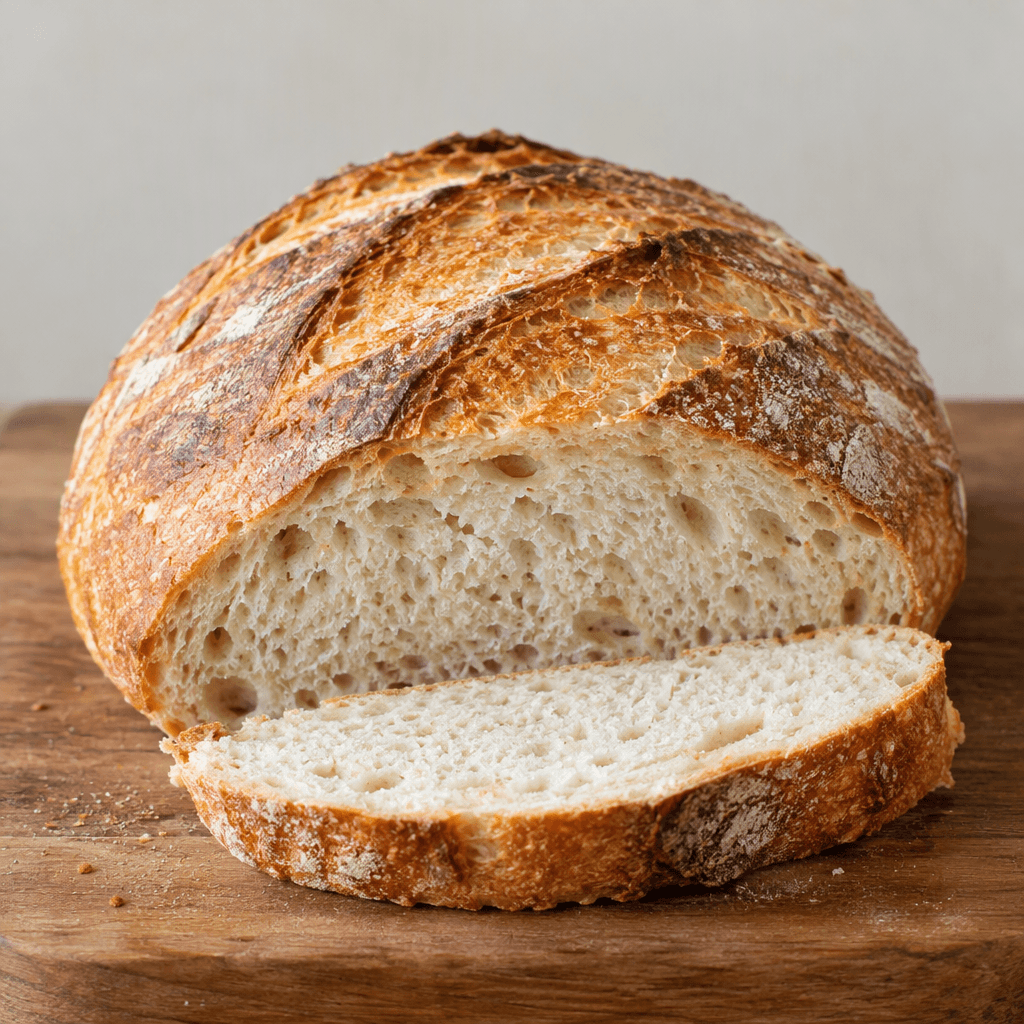
Bakery bread Calories
Traditional bakery bread, usually made from wheat flour.
In season: Spring · Summer · Autumn · Winter
CALORIES
GI
POTASSIUM
FIBER
Quick answer
1 slice (medium) of Bakery bread (35 g) has 93 calories. That works out to 265 calories per 100 g. It contains 17.2 g of carbs, 3 g of protein, 1.1 g of fat and 0.9 g of fiber. Its 0.2 mg of Manganese covers 8% of the Daily Value. Its glycemic index is 70 (high), so it raises blood sugar quickly.
What is Bakery bread?
Bakery bread is a familiar everyday loaf in Turkey, commonly bought from a neighbourhood grocer and supplied by a local bakery. It is usually made with wheat flour, with a golden, lightly crisp crust and a soft, airy crumb. Serve it at breakfast with cheese, olives or eggs, or alongside soup and home-cooked meals; it also makes an easy sandwich or toast. It is mainly a source of carbohydrates, providing 49 g per 100 g. Pairing a slice with eggs, cheese or beans makes for a more filling meal, while day-old slices are useful for toast or dipping into soup.
Bakery bread Nutrition Facts
Selected: 100 g
265
KCAL / 100G
Carbs
49g
· 18% DV
Protein
8.5g
· 17% DV
Fat
3.2g
· 4% DV
Fiber
2.7g
· 10% DV
DV is the share of the daily value covered, on a 2,000 kcal reference diet.
Calories come from: Carbs 76% · Protein 13% · Fat 11%
Bakery bread Vitamins & Minerals
Vitamins
B3
2.2mg · 14% DV
B1
0.15mg · 13% DV
Folate
35µg · 9% DV
B2
0.08mg · 6% DV
Minerals
Manganese
1mg · 43% DV
Selenium
13µg · 24% DV
Sodium
490mg · 21% DV
Phosphorus
80mg · 11% DV
How Nutritious Is Bakery bread?
Nutrient density
Low
How many vitamins, minerals and how much fiber this food carries per calorie. A high score means a lot of nutrition for few calories.
Satiety score
Medium
An EatBetter score computed from fiber, protein and calorie density. A high score means staying full longer on the same calories.
Both scores are calculated per 100 g and do not change with the selected portion. The satiety score is EatBetter's own calculation, not a clinical measure.
Bakery bread Glycemic Index
GLYCEMIC INDEX
GLYCEMIC LOAD
Accounts for portion size — a more realistic measure than GI alone.
How to Burn Off Bakery bread
To burn the 265 calories in 100 g:
🚶
Walking (5 km/h)
🏃
Running (8 km/h)
🚴
Cycling
🏊
Swimming
Times are calculated with the MET equation for a 70 kg adult. Actual burn varies with your weight, age and pace.
Is Bakery bread Processed?
NOVA 3
Processed
1. Unprocessed
2. Minimally Processed
3. Processed
4. Ultra-Processed
NOVA classifies foods into 4 groups by industrial processing. NOVA 1 (unprocessed) is the healthiest.
Does Bakery bread Contain Allergens?
Contains these allergens:
Which Diets Is Bakery bread Good For?
Vegan
— Not suitable
Vegetarian
✓ Suitable
Gluten-Free
— Not suitable
Dairy-Free
— Not suitable
Mediterranean
— Not suitable
Paleo
— Not suitable
Whole30
— Not suitable
DASH
— Not suitable
Keto
— Not suitable
Low FODMAP
— Not suitable
Bakery bread Fat Profile
SATURATED
0.7g
MONOUNSATURATED
0.5g
POLYUNSATURATED
1.2g
Omega 6:3 ratio 20:1
Above the ideal 4:1 (20:1).
Compare Bakery bread
Foods Similar to Bakery bread
Frequently Asked Questions About Bakery bread
What makes bakery bread different from supermarket bread?
Bakery bread is made and sold by a bakery, while supermarket bread may be factory-made and packaged for longer storage. The terms do not guarantee a particular recipe: flour, crust, freshness, and ingredients vary by bakery and loaf.
How long does bakery bread stay fresh?
Bakery bread is usually at its best on the day it is bought and can stay pleasant for another day or two at room temperature. Keep it covered once cool; discard it if you see mold or notice an unusual smell.
Should bakery bread be stored in a paper bag or a plastic bag?
Use a paper bag if you want bakery bread’s crust to stay crisp, or a plastic bag if you prefer a softer crust. Store the loaf at room temperature and let it cool fully before sealing it, so trapped steam does not make it soggy.
Can you freeze bakery bread?
Yes, bakery bread freezes well. Slice it before freezing and seal the slices in a freezer-safe bag so you can take out only what you need. Toast frozen slices directly, or let them thaw at room temperature.
Why does bakery bread have a thick, crisp crust?
A thick, crisp crust forms as the loaf’s surface dries and browns during baking. Bakery ovens can produce the high heat and steam that help create this texture, though the crust depends on the baker’s method and the loaf itself.
How do you make day-old bakery bread crusty again?
Warm day-old bakery bread in an oven to refresh its crust. Heat it briefly and serve it soon after, since it will soften again as it cools. Do not try to rescue bread that has visible mold.
Is bakery bread still safe to eat the next day?
Yes, bakery bread is generally safe the next day if it has been stored cleanly and shows no mold or unusual smell. It may be stale rather than spoiled; warming or toasting can improve its texture.
Can you use bakery bread for French toast?
Yes, bakery bread works well for French toast, especially when it is a little dry and can absorb the egg mixture without falling apart. Cut it into thick slices and briefly soak each side before cooking.
Does bakery bread raise blood sugar quickly?
It can, particularly when it is made mainly with refined wheat flour, because its digestible carbohydrates can be absorbed quickly. Eating it with protein- or fiber-rich foods may make the meal more filling, but does not remove the bread’s carbohydrates.
Can you cut mold off bakery bread and eat the rest?
No. Mold can spread through the porous inside of bakery bread beyond the visible spot, so discard the whole loaf rather than cutting away the affected section.
Have another question about Bakery bread?
Ask the AI nutrition coach — calories, portions, alternatives and more, answered in seconds in the app.

Scan calories with your camera
Instant AI nutrition analysis

Nutrition data compiled from USDA FoodData Central and scientific sources.