

Ready & Packaged Foods
All →Vegetables & Legumes
All →Desserts & Confectionery
All →Meat & Protein
All →Grains & Bakery
All →Beverages
All →Milk & Dairy
All →

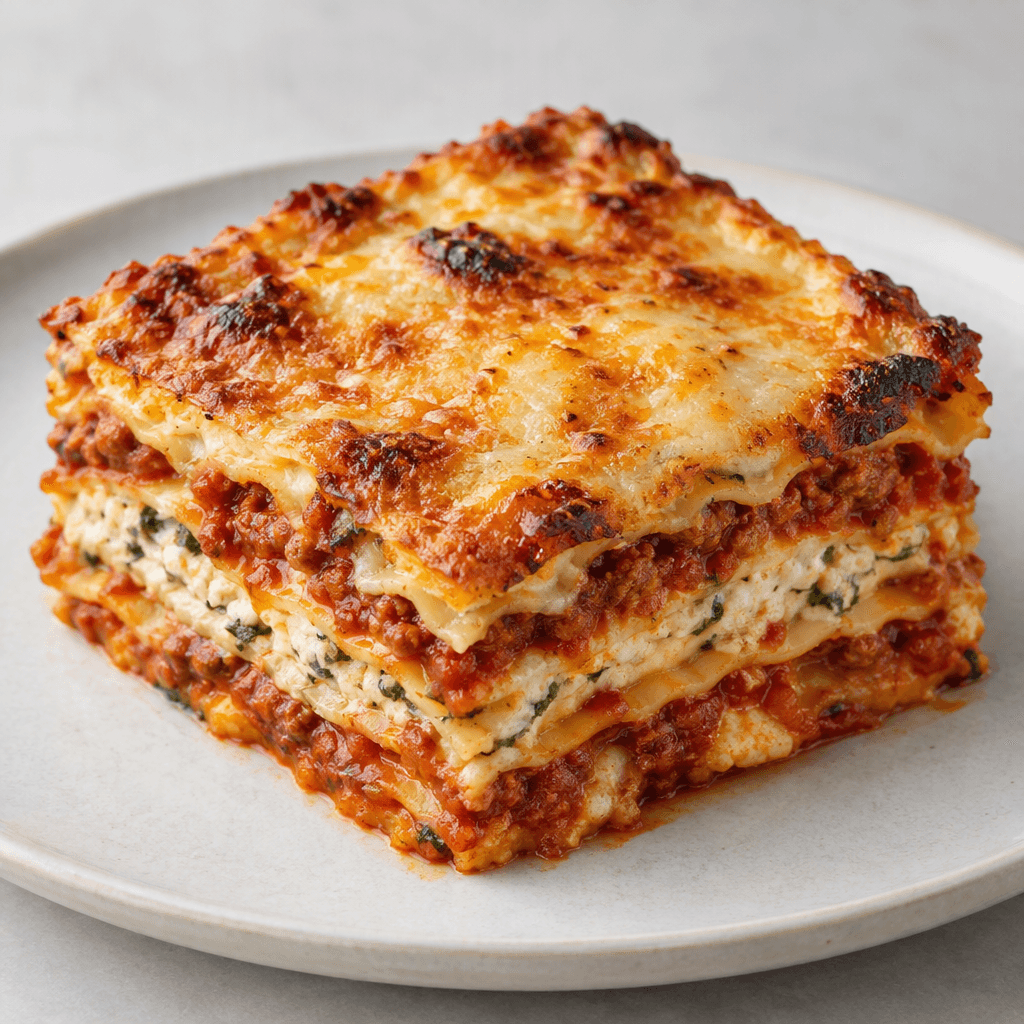
Baked lasagna Calories
Layered pasta baked with meat or vegetable sauce, cheese, and béchamel.
In season: Spring · Summer · Autumn · Winter
CALORIES
GI
POTASSIUM
FIBER
Quick answer
1 piece (medium) of Baked lasagna (180 g) has 261 calories. That works out to 145 calories per 100 g. It contains 29.7 g of carbs, 13 g of protein, 10.3 g of fat and 3.1 g of fiber. Its 198 mg of Phosphorus covers 28% of the Daily Value. Its glycemic index is 46 (medium), so it raises blood sugar at a moderate pace.
What is Baked lasagna?
Baked lasagna is an Italian oven dish made by layering flat pasta sheets with a tomato-based meat or vegetable sauce, béchamel and cheese. The top turns golden and sometimes crisp at the edges, while the middle stays tender and creamy. Its savoury, gently tangy sauce is balanced by the richness of the cheese and béchamel.
In Italy it is served hot in slices as a substantial main course, often with a simple salad; it is also familiar on tables around the world. For a lighter version, use a vegetable filling or go easy on the béchamel and cheese. It provides both carbohydrates and protein, with 7.2 g of protein per 100 g.
Baked lasagna Nutrition Facts
Selected: 100 g
145
KCAL / 100G
Carbs
16.5g
· 6% DV
Protein
7.2g
· 14% DV
Fat
5.7g
· 7% DV
Fiber
1.7g
· 6% DV
DV is the share of the daily value covered, on a 2,000 kcal reference diet.
Calories come from: Carbs 45% · Protein 20% · Fat 35%
Baked lasagna Vitamins & Minerals
Vitamins
B12
0.35µg · 15% DV
Vitamin A
110µg · 12% DV
Biotin
3.2µg · 11% DV
B2
0.13mg · 10% DV
Minerals
Phosphorus
110mg · 16% DV
Sodium
320mg · 14% DV
Selenium
7.5µg · 14% DV
Calcium
110mg · 11% DV
How Nutritious Is Baked lasagna?
Nutrient density
Medium
How many vitamins, minerals and how much fiber this food carries per calorie. A high score means a lot of nutrition for few calories.
Satiety score
Medium
An EatBetter score computed from fiber, protein and calorie density. A high score means staying full longer on the same calories.
Both scores are calculated per 100 g and do not change with the selected portion. The satiety score is EatBetter's own calculation, not a clinical measure.
Baked lasagna Glycemic Index
GLYCEMIC INDEX
GLYCEMIC LOAD
Accounts for portion size — a more realistic measure than GI alone.
How to Burn Off Baked lasagna
To burn the 145 calories in 100 g:
🚶
Walking (5 km/h)
🏃
Running (8 km/h)
🚴
Cycling
🏊
Swimming
Times are calculated with the MET equation for a 70 kg adult. Actual burn varies with your weight, age and pace.
Is Baked lasagna Processed?
NOVA 3
Processed
1. Unprocessed
2. Minimally Processed
3. Processed
4. Ultra-Processed
NOVA classifies foods into 4 groups by industrial processing. NOVA 1 (unprocessed) is the healthiest.
Does Baked lasagna Contain Allergens?
Contains these allergens:
Which Diets Is Baked lasagna Good For?
Vegan
— Not suitable
Vegetarian
— Not suitable
Gluten-Free
— Not suitable
Dairy-Free
— Not suitable
Mediterranean
✓ Suitable
Paleo
— Not suitable
Whole30
— Not suitable
DASH
— Not suitable
Keto
— Not suitable
Low FODMAP
— Not suitable
Baked lasagna Fat Profile
SATURATED
2.2g
MONOUNSATURATED
1.7g
POLYUNSATURATED
0.5g
Omega 6:3 ratio 4.5:1
Above the ideal 4:1 (4.5:1).
Compare Baked lasagna
Foods Similar to Baked lasagna
Frequently Asked Questions About Baked lasagna
How do you make baked lasagna?
Baked lasagna is made by layering pasta sheets with tomato-based sauce, béchamel, and cheese, then baking until tender and browned. Spread sauce across each layer so the pasta cooks evenly, and let the dish rest before slicing so the layers hold together.
How long does baked lasagna take to cook?
Baked lasagna commonly takes around 40–50 minutes in a preheated 375°F (190°C) oven, though the exact time depends on the recipe and whether the noodles are precooked. It is ready when bubbling at the edges and browned on top; rest it before serving.
Do you have to boil noodles for baked lasagna?
No, you do not have to boil every type of lasagna noodle before baking. Follow the package directions: oven-ready sheets need enough sauce around them to soften, while regular dried noodles should be boiled or they may stay firm.
What order do you layer baked lasagna?
For baked lasagna, start with a thin layer of sauce, then add pasta sheets, meat or vegetable sauce, béchamel or ricotta, and cheese. Repeat the layers and finish with sauce and cheese on top so the exposed pasta does not dry out.
Why is my baked lasagna watery?
Baked lasagna usually turns watery when its sauce or vegetables release too much liquid. Simmer the tomato sauce until thick, cook watery vegetables such as mushrooms or zucchini first, and let the finished dish rest before cutting so its layers can set.
Why does baked lasagna fall apart when sliced?
Baked lasagna falls apart most often because it is cut while still piping hot. Rest it after baking so the sauce and creamy layers firm up, then use a sharp knife or spatula to lift each portion cleanly.
Can you make baked lasagna ahead of time?
Yes, baked lasagna can be assembled ahead and refrigerated before baking. Cover it well, then bake until hot throughout; a chilled dish may need extra oven time, so check that the center is fully heated before serving.
Can you freeze baked lasagna?
Yes, baked lasagna freezes well in individual portions or as a whole dish. Cool it first, wrap it tightly, and thaw it in the refrigerator before reheating; covering it while it warms helps keep the pasta and cheese from drying out.
What should you serve with baked lasagna?
A crisp green salad is a classic side for baked lasagna because its fresh, acidic dressing balances the rich cheese and sauce. Garlic bread is another common pairing, though a simple salad makes the meal feel lighter.
Can baked lasagna be made without meat?
Yes, baked lasagna can be made without meat by layering pasta with vegetables such as spinach, mushrooms, or roasted eggplant and a tomato sauce. Cook watery vegetables before assembling so they do not make the finished layers soggy.
Have another question about Baked lasagna?
Ask the AI nutrition coach — calories, portions, alternatives and more, answered in seconds in the app.

Scan calories with your camera
Instant AI nutrition analysis

Nutrition data compiled from USDA FoodData Central and scientific sources.