

Ready & Packaged Foods
All →Vegetables & Legumes
All →Desserts & Confectionery
All →Meat & Protein
All →Grains & Bakery
All →Beverages
All →Milk & Dairy
All →

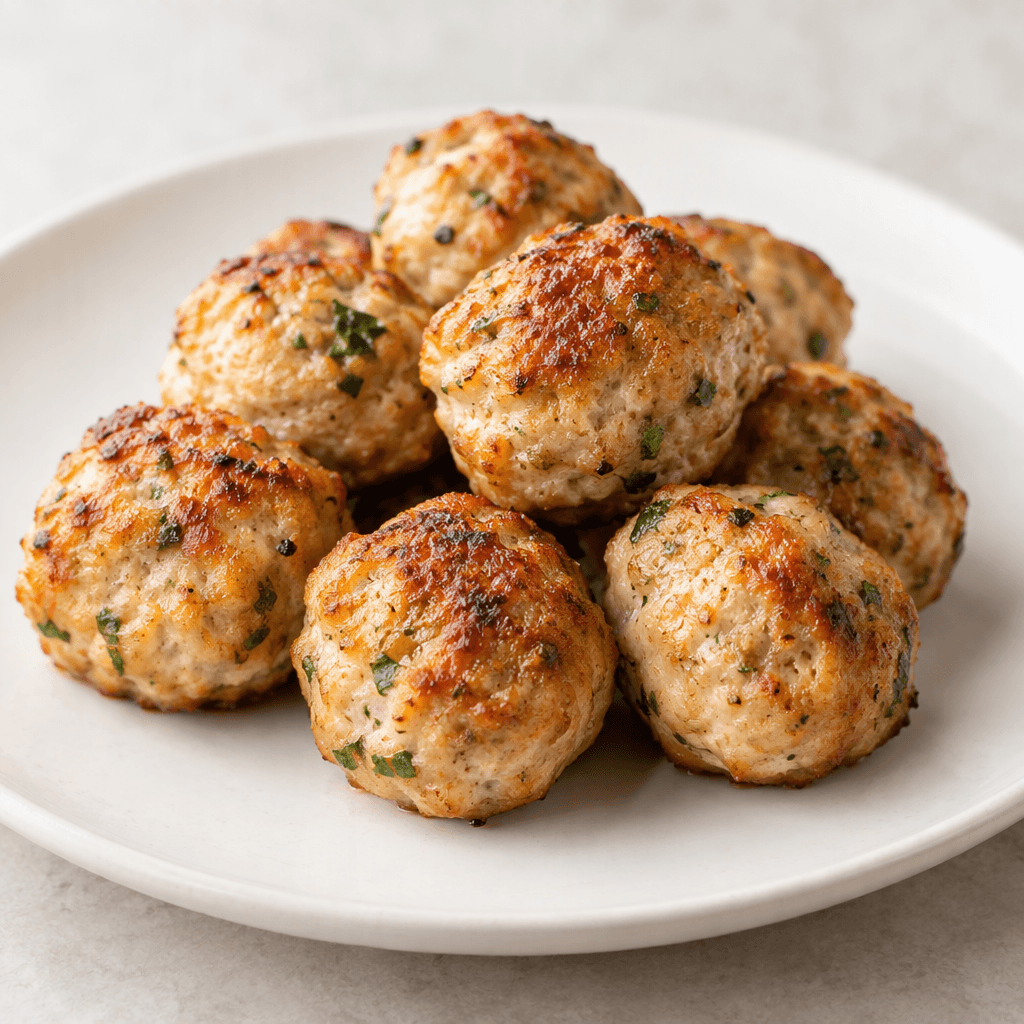
Baked chicken meatball Calories
Baked chicken meatball
CALORIES
GI
POTASSIUM
FIBER
Quick answer
3 piece (medium) of Baked chicken meatball (90 g) has 149 calories. That works out to 165 calories per 100 g. It contains 4.7 g of carbs, 18.5 g of protein, 5.6 g of fat and 0.5 g of fiber. Its 6 mg of B3 covers 38% of the Daily Value. Its glycemic index is 35 (low), so it raises blood sugar slowly.
What is Baked chicken meatball?
Baked chicken meatball is made by shaping ground chicken, often mixed with onion, herbs and seasonings, then cooking it in the oven. It is a familiar home-style preparation in Turkey, with ingredients and seasoning varying from one household to another.
The meatballs develop lightly browned edges while staying tender inside. In Turkey they are commonly served as a main dish with salad, rice or yogurt; elsewhere, they also fit easily into a weeknight meal, tucked into flatbread or served with roasted vegetables. They are protein-rich compared with many sides, providing 20.5 g of protein per 100 g. Pair them with fresh vegetables for a balanced plate, or make them smaller to serve as part of a spread.
Baked chicken meatball Nutrition Facts
Selected: 100 g
165
KCAL / 100G
Carbs
5.2g
· 2% DV
Protein
20.5g
· 41% DV
Fat
6.2g
· 8% DV
Fiber
0.6g
· 2% DV
DV is the share of the daily value covered, on a 2,000 kcal reference diet.
Calories come from: Carbs 13% · Protein 52% · Fat 35%
Baked chicken meatball Vitamins & Minerals
Vitamins
B3
6.7mg · 42% DV
B6
0.5mg · 29% DV
B5
0.9mg · 18% DV
B12
0.3µg · 13% DV
Minerals
Selenium
16µg · 29% DV
Phosphorus
180mg · 26% DV
Sodium
420mg · 18% DV
Zinc
1mg · 9% DV
How Nutritious Is Baked chicken meatball?
Nutrient density
Medium
How many vitamins, minerals and how much fiber this food carries per calorie. A high score means a lot of nutrition for few calories.
Satiety score
Medium
An EatBetter score computed from fiber, protein and calorie density. A high score means staying full longer on the same calories.
Both scores are calculated per 100 g and do not change with the selected portion. The satiety score is EatBetter's own calculation, not a clinical measure.
Baked chicken meatball Glycemic Index
GLYCEMIC INDEX
GLYCEMIC LOAD
Accounts for portion size — a more realistic measure than GI alone.
How to Burn Off Baked chicken meatball
To burn the 165 calories in 100 g:
🚶
Walking (5 km/h)
🏃
Running (8 km/h)
🚴
Cycling
🏊
Swimming
Times are calculated with the MET equation for a 70 kg adult. Actual burn varies with your weight, age and pace.
Is Baked chicken meatball Processed?
NOVA 2
Minimally Processed
1. Unprocessed
2. Minimally Processed
3. Processed
4. Ultra-Processed
NOVA classifies foods into 4 groups by industrial processing. NOVA 1 (unprocessed) is the healthiest.
Does Baked chicken meatball Contain Allergens?
No known major allergens
Which Diets Is Baked chicken meatball Good For?
Vegan
— Not suitable
Vegetarian
— Not suitable
Gluten-Free
✓ Suitable
Dairy-Free
— Not suitable
Mediterranean
✓ Suitable
Paleo
✓ Suitable
Whole30
— Not suitable
DASH
— Not suitable
Keto
✓ Suitable
Low FODMAP
— Not suitable
Baked chicken meatball Fat Profile
SATURATED
1.7g
MONOUNSATURATED
2.1g
POLYUNSATURATED
0.7g
Omega 6:3 ratio 7.5:1
Above the ideal 4:1 (7.5:1).
Compare Baked chicken meatball
Foods Similar to Baked chicken meatball
Frequently Asked Questions About Baked chicken meatball
What goes into baked chicken meatballs?
Baked chicken meatballs are usually made with ground chicken, egg, finely chopped or grated onion, seasoning, and a binder such as breadcrumbs. Garlic, parsley, and herbs are common additions; the exact mixture varies by recipe.
How do you make baked chicken meatballs?
To make baked chicken meatballs, combine ground chicken with onion, egg, seasoning, and breadcrumbs, then shape the mixture into evenly sized balls. Arrange them on a lined baking sheet and bake in a preheated oven until browned and cooked through.
How do you keep baked chicken meatballs moist?
Keep baked chicken meatballs moist by avoiding overbaking and not making the mixture too lean or too dry. Grated onion adds moisture, while shaping the meatballs evenly helps them finish cooking at the same time.
What temperature should baked chicken meatballs reach?
Baked chicken meatballs should reach an internal temperature of 165°F (74°C) to be safely cooked. Check the center of the largest meatball with a food thermometer; browning on the outside does not confirm that the middle is done.
Why do baked chicken meatballs fall apart?
Baked chicken meatballs fall apart when their mixture is too wet or does not have enough binder. Drain excess liquid from grated onion, add breadcrumbs a little at a time, and chill the shaped meatballs briefly before baking so they hold together better.
Can you make baked chicken meatballs without breadcrumbs?
Yes, you can make baked chicken meatballs without breadcrumbs by using rolled oats, crushed crackers, or another suitable binder. Add it gradually, since too much can make the meatballs dense; allow the mixture to rest so the binder can absorb moisture.
Can baked chicken meatballs be frozen?
Yes, baked chicken meatballs freeze well after cooking, and you can also freeze the shaped mixture before baking. Freeze them in a single layer first, then transfer them to an airtight container; thaw cooked meatballs in the refrigerator before reheating.
How long do baked chicken meatballs last in the fridge?
Cooked baked chicken meatballs keep for 3–4 days in the refrigerator when stored in a covered container. Refrigerate them promptly rather than leaving them out, and reheat until the centers are hot before serving.
What sauce goes well with baked chicken meatballs?
Baked chicken meatballs pair well with tomato sauce, garlic-yogurt sauce, or a simple herb dressing. Tomato sauce works well for a pasta-style meal, while yogurt-based sauces complement a plate of vegetables, rice, or flatbread.
Are baked chicken meatballs healthier than fried chicken meatballs?
Usually, baked chicken meatballs use less added oil than fried chicken meatballs, so baking can be a lighter cooking method. The overall meal still depends on the ingredients and sides; a vegetable side is a useful alternative to a rich, fried accompaniment.
Have another question about Baked chicken meatball?
Ask the AI nutrition coach — calories, portions, alternatives and more, answered in seconds in the app.

Scan calories with your camera
Instant AI nutrition analysis

Nutrition data compiled from USDA FoodData Central and scientific sources.